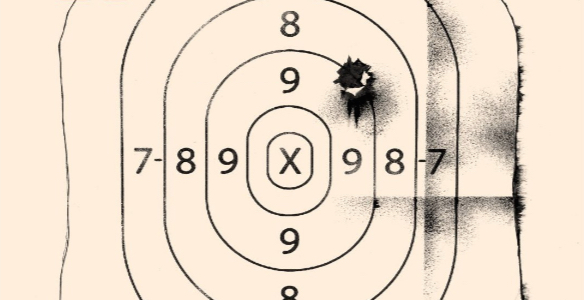
“Why?” in Days of Hate 5

by Patrick Ehlers

This article contains SPOILERS. If you haven’t read the issue yet, proceed at your own risk!

Why am I watching this scene?

Screenwriter Advice, Traditional

While the “who,” “what,” and “where” of a scene is crucial to the audience’s understanding of what they’re experiencing in the moment, it’s the “why” of a scene that ends up being the most meaningful. If there’s no reason for the scene, then it doesn’t belong in the piece. This is one of those pieces of writerly advice that’s actually kind of intuitive, and readers and audiences feel it without having to be told. If we start reading about a man climbing a tree, then we assume something happens to him in that tree. Writer Aleš Kot and artist Danijel Žeželj take the conflict inherent the mere existence of a scene — three scenes, actually — to tease out a slowly burning tension-inferno in Days of Hate 5. Continue reading
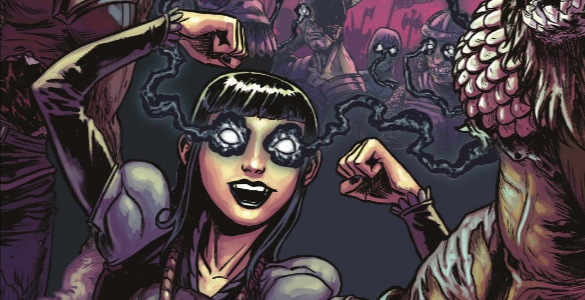
Aesthetic Takes Center Stage in Curse Words 14

by Patrick Ehlers

This article contains SPOILERS. If you haven’t read the issue yet, proceed at your own risk!

There’s an intangible quality to most of your favorite art that belongs solely to that work. Maybe it’s a voice, or a take, or a perspective, or a rhythm. It’s that magical X factor that makes you say “that’s a Farside joke” or “that’s a Stevie Wonder horn line.” Curse Words’ DNA is so hard to nail down — a mix of crass irreverence and hopelessness, with a jolly veneer that just barely hides some genuine darkness. Issue 14 drifts away from Wizord and lets this lurching aesthetic take center stage. Continue reading

Doctor Aphra 20: Discussion

by Patrick Ehlers and Mark Mitchell

This article contains SPOILERS. If you haven’t read the issue yet, proceed at your own risk!

Darth Vader: You are overly fond of talking.
Doctor Aphra: I’m nervous.

-Darth Vader 3

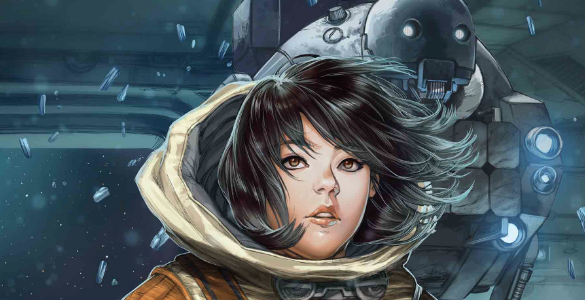
Patrick: Chelli Lona Aphra is a motormouth. She’ll unleash a torrent of words when she’s confident, when she’s nervous, when she’s got something to hide, and when she’s got something to say. It makes it tough to get a read on her, but after 20 issues of her own series and a bunch of appearances in Darth Vader, the reader has the benefit of familiarity. By this point in our journey with her, we sorta know Doctor Aphra. The Imperial chumps trying to probe her for information, on the other hand, don’t stand a chance of untangling the truth. Writer Si Spurrier leverages dramatic irony, both in the form of the reader’s past experiences with Aphra and by contrasting his words with Kev Walker’s art, to dig deeper into the character of Doctor Aphra. Continue reading

Ambiguity and Closure in Doctor Strange 390

by Patrick Ehlers

This article contains SPOILERS. If you haven’t read the issue yet, proceed at your own risk!

slim-banner

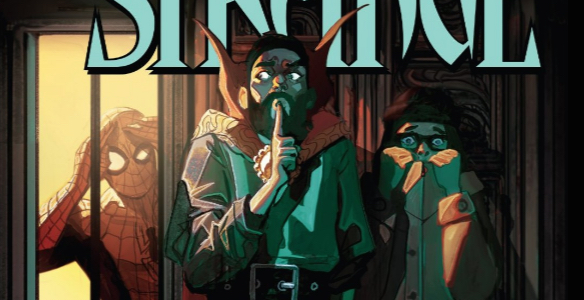
I had a writing teacher in college that used to say there were four kinds of stories. The first is the most common: the hero wants something, gets it, and is happy he got it. We see this one in superhero media all the time, right? Batman wants to catch the Riddler, he does, feels great about it. The second type of story is the hero wants something, gets it, is unhappy he got it. This is the old Twilight Zone twist — “I can live forever, BUT AT WHAT COST?” The last two kinds of stories are similar: hero wants something, doesn’t get it, is happy to have not gotten it, and; hero wants something, doesn’t get it, is unhappy to have not gotten it. Doctor Strange 390 manages to be a weird mix of all these types of stories, where even the question of who our hero is leads to some fascinating ambiguity. Donny Cates’ send-off to Doctor Strange is as mysterious, and true to the tone of the character, as a reader could possibly hope for. Continue reading

Moonshine 10: Discussion

by Drew Baumgartner and Patrick Ehlers

Moonshine 10

This article contains SPOILERS. If you haven’t read the issue yet, proceed at your own risk!

Remove everything that has no relevance to the story. If you say in the first chapter that there is a rifle hanging on the wall, in the second or third chapter it absolutely must go off. If it’s not going to be fired, it shouldn’t be hanging there.

Anton Chekhov

Drew: Chekhov’s gun has parallels in virtually every artform (at least in aesthetics that value clarity); whether it’s a brushstroke in illustration, a word in prose, or a note in music, if it doesn’t have an explicit purpose, it shouldn’t be there. But, of course, our knowledge of this principle lends a sense of foreshadowing to every object, character, or concept that is introduced in a narrative (again, if we can assume the narrative is playing by Chekhov’s rules). But because narratives are driven by drama (that is, difficulties for the protagonist), Chekhov’s gun mostly applies to things that can somehow harm or disrupt the characters’ lives — there’s a reason it’s not called “Chekhov’s birthday present.” Which creates very different expectations for things going right and wrong — things going wrong are far more likely to be introduced ahead of time (per Chekhov’s rules), while the drama of things going right is left best to the last possible moment. In that way, narratives reflect our own experience of reality, where we’ve given the name “Murphy’s law” to the notion that things will go wrong if they can, but no similar expectation for things going right. That is, we expect things to go wrong, so things going right is always a pleasant surprise. Or, as Lou Pirlo puts it in Moonshine 10, “God works in mysterious ways,” but “Old Lucifer…he was direct.” Continue reading

The Difference Between Mayoral Action and Superhero Action in Daredevil 602

By Patrick Ehlers

This article contains SPOILERS. If you haven’t read the issue yet, proceed at your own risk!

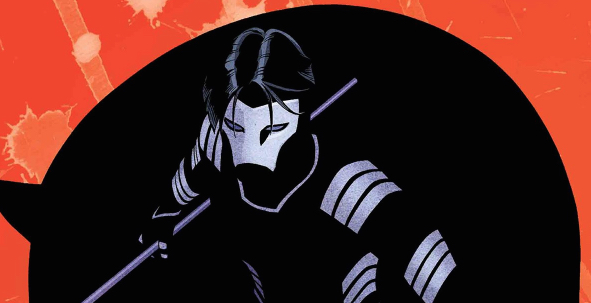
“New York City’s uniformed protectors are under attack by the Hand.” It’s a straightforward premise, one with both obvious drama and an obvious solution: superheroes fight the ninjas. But as of Daredevil 601, Matt Murdock is more than just a superhero; he’s also the mayor of New York. Suddenly those simple solutions don’t seem quite as simple. Charles Soule, Mike Henderson, Matt Villa and Clayton Cowles’ Daredevil 602 illustrate the difference between the streamlined drama of the superhero and the complicated drama of the mayor. Continue reading

Defeat and Retaliation in Analog 2

by Patrick Ehlers

This article contains SPOILERS. If you haven’t read the issue yet, proceed at your own risk!

slim-banner

Normal Person + Anonymity + Audience = Total Fuckwad

Penny Arcade, 2004

Back in 2004, the Penny Arcade guys were disgusted by the behavior of some people playing Unreal Tournament online, leading to them publishing the strip referenced above. Fourteen years later, and we know better than to ever be shocked by a faceless teenager hiding behind the gamertag “6ftcock” using hate speech in PU:BG. Vile behavior begets other vile behavior, and as long as the bullies never have to meet their victims, that fuckwadery is as make-believe as the game they’re playing. At least, that’s what John Gabriel’s Greater Internet Fuckwad Theory postulates. But what if those hateful impulses, those destructive anti-social tendencies are just part of who we are, with or without the internet? Gerry Duggan and David O’Sullivan’s Analog 2 dutifully moves the series’ plot mechanics forward, while continuing to mine this thematically rich vein. Continue reading

The Impact of One Charismatic Figure in Darth Vader 16

by Patrick Ehlers

This article contains SPOILERS. If you haven’t read the issue yet, proceed at your own risk!

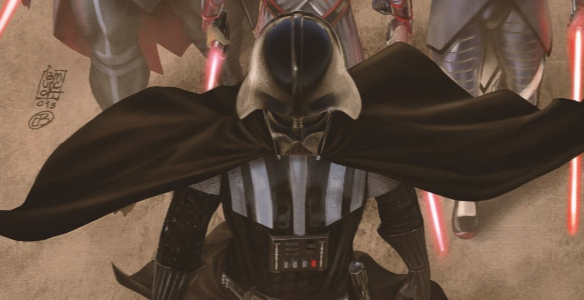
It’s sort of astonishing the impact a single person can have on the course of history. The whole of Star Wars is based on this — the galaxy is shaped by one dude’s unquenchable rage. But that’s clearly the negative side of the equation, right? In the movies, anger-monsters like Darth Vader and Kylo Ren are bested by charismatic onscreen personalities. Han Solo is charming because Harison Ford is. Leia is a compelling figure because Carrie Fisher is. In Darth Vader 16, writer Charles Soule and artist Giuseppe Camuncoli show where that power of personality can come from. Continue reading

Despicable Deadpool 300: Discussion

by Drew Baumgartner & Patrick Ehlers

Despicable Deadpool 300

This article contains SPOILERS. If you haven’t read the issue yet, proceed at your own risk!

slim-banner

Drew: Five years into this run, pointing out that Deadpool is a Sad Clown would be lazy analysis — not only has that point been well established, but the series itself has managed to explore it so thoroughly, reducing the character’s emotional journey to a two-word summary couldn’t possibly do it justice. And yet, I couldn’t think of a more appropriate way to begin this piece than embedding Smokey Robinson’s “Tears of a Clown,” not because of a shallow similarity between the content of these two works, but because of some profound similarities in how they treat that content. The lyrics describe a narrator who puts on a good face in spite of his profound sadness, but the music doesn’t betray that sadness for a second — it sounds like any other Motown hit (though that bouncy bassoon that maybe hints that this song is about a clown). By this point in the story, Wade Wilson has completely dropped that fascade of silliness, but just like the instruments in “Tears of a Clown,” the series itself maintains that clownish exterior. Continue reading

Oh, Thank God, C-3PO Still Sucks in Star Wars 47

by Patrick Ehlers

This article contains SPOILERS. If you haven’t read the issue yet, proceed at your own risk!

slim-banner

When I was a kid, I hated C-3PO. Hated him. I thought his bumbling antics severely hurt the movies I loved. But something strange happened on my first viewing of The Phantom Menace: I was relieved to see him. Hell, I was excited to see proto-Threepio in Anakin’s bedroom. He was an island of familiarity in a sea of characters that were significantly more annoying. That’s largely how the newest Star Wars movies have been treating Threepio — as a sort of elder statesman of the franchise, commanding respect. Sure, he’s still annoying, but that all stems from his hoity toity affectations. Kieron Gillen and Salvador Larroca’s Star Wars 47 reminds us that C-3PO sucks, not just superficially, but deep down to his core. Continue reading