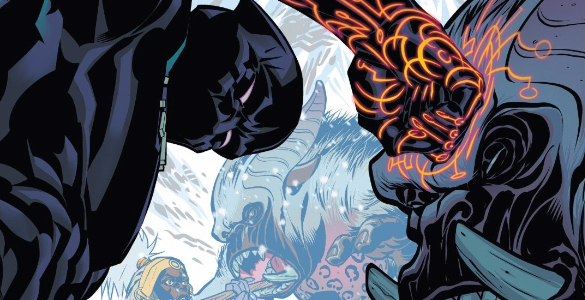
Nagging Consistency in Black Panther 15

By Ryan Desaulniers

This article contains SPOILERS. If you haven’t read the issue yet, proceed at your own risk!

All comic series are, in their own way, their own brand, and with a brand comes the idea of offering consistency in the same way that you expect a Big Mac to taste like a Big Mac, no matter where the McDonald’s is. So Spider-Man makes quips and deals with great responsibility, Batman broods, Deadpool makes pop culture references. We expect it. And while creative team changes in long-running series may offer variety, some hallmarks generally remain.  Fifteen issues into the Ta-Nehisi Coates run of Black Panther, the consistencies are starting to wear on me as a reader. Continue reading
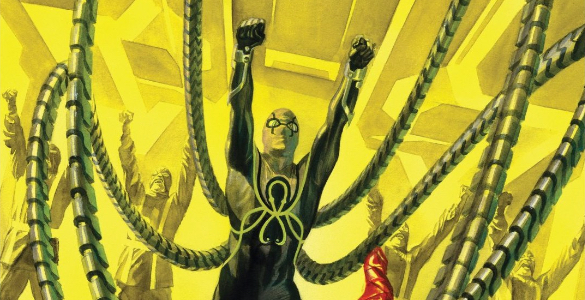
The Art of the Tie-in: Amazing Spider-Man 29

by Drew Baumgartner

Amazing Spider-Man 29

This article contains SPOILERS. If you haven’t read the issue yet, proceed at your own risk!

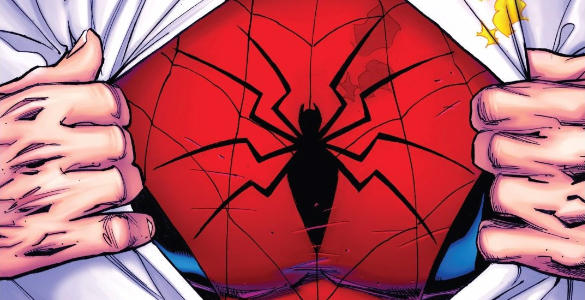
It’s easy to vilify crossover events for disrupting your favorite series, but that’s kind of the point, right? An event that boasts “everything changes here” should be disruptive to the universe around it — that’s just making good on that claim. The feeling that the story we were reading has been put on the back burner is definitely frustrating, but it’s exactly what would happen in the event of a Earth-shaking change in the status quo. But there are ways to soften the whiplash effect of event tie-in issues, and Amazing Spider-Man 29 features just about all of them. Actually, it might be to precise to pin it on this one issue — while this is the first to explicitly acknowledge the events of Secret Empire, so much of what happens here spins out of threads writer Dan Slott has been spinning for years. In many ways, it feels less like the event forced a change to the series and more like the changes that were coming all along were given a fresh twist by tying them to Secret Empire. Continue reading

Action is Let Down by Low Stakes in Star Wars: Poe Dameron 16

by Michael DeLaney

This article contains SPOILERS. If you haven’t read the issue yet, proceed at your own risk!

The Phantom Menace probably had more lightsaber action than any of the original Star Wars entries, but it was all predicated on the titillating minutia of trade disputes. Unfortunately,Star Wars: Poe Dameron 16 has more in common with The Phantom Menace than it does with other successful Charles Soule Star Wars outings. Instead of trade disputes, the impetus behind the latest arc of Poe Dameron is…a fuel shipment. Continue reading

Jean Grey 3: Discussion

By Ryan Desaulniers and Ryan Mogge

This article containers SPOILERS. If you haven’t read the issue yet, proceed at your own risk!

Ryan D: When one writes about comic books, due to the popular types of stories being told, the critical eye encounters Joseph Campbell’s template for “the hero’s journey.” This monomyth pervades the pages of superhero titles, and seems even more prevalent in solo runs of characters due to the ease of accessibility inherent to that narrative. In Jean Grey, however, Dennis Hopeless and his creative team use a different kind of literary precedent — that of the Bildungsroman –– to tell the story of the young Jean as she gears up to meet the looming threat of the Phoenix. The Bildungsroman is a novel of formation or education with the psychological and moral development of the protagonist as the crux of the narrative, along the lines of Ponyboy in The Outsiders or Marji in PersopolisJean Grey 3 continues that trend of Jean moving painfully towards development and maturity as she learns a lesson in the company of “Marvel’s First Mutant,” Namor. Continue reading

The Worthiness of Being Called Canon in Star Wars: Doctor Aphra 8

by Taylor Anderson

This article contains SPOILERS. If you haven’t read the issue yet, proceed at your own risk!

When Disney acquired the rights to Star Wars, a decree was sent forth from the Magic Kingdom proclaiming that the extended universe portrayed in various books, comics, and TV shows is no longer canon. The reasoning behind this is clear. Disney will be making Star Wars stories until the end of time and they want the creative (see: commercial) freedom to write their own version of the Star Wars universe without conflicting accounts of what happened a long time ago in a galaxy far, far away. Whether this is a good idea or not, it places the impetus on Disney to faithfully convey stories from Star Wars, which can be problematic when issues like Doctor Aphra 8 feel out of joint with their source material.

Continue reading

Failure to World-Build in I Am Groot 2

by Mark Mitchell

This article contains SPOILERS. If you haven’t read the issue yet, read on at your own risk!

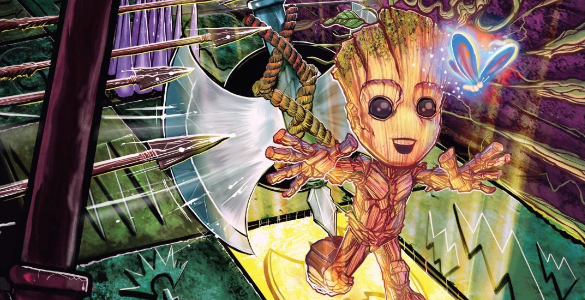
World building is delicate business. Finding the right balance between teasing the audiences’ imagination and leaving them impatient for answers can trip up even the most skilled artist. My go-to example for successful world building is 2015’s Mad Max: Fury Road. Director George Miller immediately throws the audience into the thick of an alien, hostile world, but it’s never confusing. Miller avoids confusion in two ways: first, he uses classic archetypes when constructing characters — Max Rockatansky is the silent hero, Immortan Joe is a mad king, the War Boys are his soldiers, etc. These archetypes are well-worn in fiction and require no further justification. Second, if something or someone is introduced that directly affects the plot and its utility in the world can’t be intuited by the audience, he explains it. Providing this concrete framework for the necessary elements of the film means many other details, like the infamous Crow Fishers, can go unexplained, teasing the audience and allowing their imaginations to run wild, without causing confusion. Continue reading

The Failings of Friendship in Desperate Times in Secret Empire 5

by Spencer Irwin

This article contains SPOILERS. If you haven’t read the issue yet, proceed at your own risk!

“The power of friendship” is a popular trope in most media. The idea that most situations can be overcome through the bonds we share with our friends is powerful in a lot of ways, but it’s one that never really seems applicable to war or espionage stories like Secret Empire. Make no mistake, Hydra is not going to be defeated by friendship or optimism alone, but in Secret Empire 5, Nick Spencer, Rod Reis, Andrea Sorrentino, Joshua Cassara, and Rachelle Rosenberg do explore the effect pre-existing relationships have on their conflict. It’s not always a good one. Continue reading

Secrets, Surprises and Criminality in All-New Guardians of the Galaxy 4

by Patrick Ehlers

All-New Guardians of the Galaxy 4

This article contains SPOILERS. If you haven’t read the issue yet, proceed at your own risk!

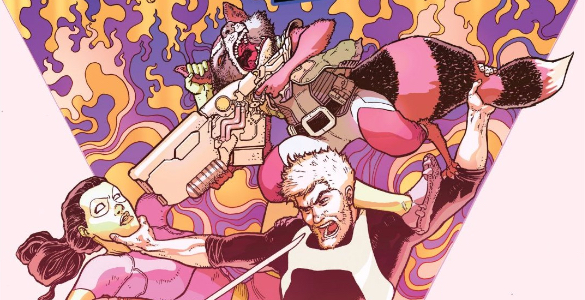
Liars. Thieves. Con men. They’ve all got secrets. It’s no wonder that the Galaxy’s rascally Guardians, who are more criminals than they are heroes, have a whole host of surprises and secrets up their collective sleeve. Writer Gerry Duggan and artist Aaron Kuder keep the reader in the role of the mark, setting us up to be as surprised as everyone else in their story. It’s a little frustrating to be kept at such a distance, but it is perfectly in-line with what it must be like to know these guys. Continue reading

Understanding Golden Age Tropes is an Asset in Doctor Strange 22

by Taylor Anderson

Doctor Strange 22

This article contains SPOILERS. If you haven’t read the issue yet, proceed at your own risk!

No matter how much success comic book movies have in crossing over into the mainstream or how dark and gritty Christopher Nolan, Alan Moore, or anyone else can make their comic book universe, monthlies will never be able to escape the shadow of the goofiness of the Golden Age. In some ways, the silliness of Golden Age comics have been celebrated by serious comic book fans and writers. They knowingly acknowledge that comics of the past weren’t great, but also pay homage to the stories that gave birth to some of today’s most beloved heroes. Doctor Strange is a product of the Golden Age, and in issue 22 Dennis Hopeless both celebrates and takes a dig at these roots. Continue reading

Peter Parker: The Spectacular Spider-Man 1: Discussion

by Ryan Mogge and Ryan Desaulniers

This article containers SPOILERS. If you haven’t read the issue yet, proceed at your own risk!

Ryan M.: How much background do you need to enjoy a single issue of an on-going serial? There is an argument that the answer is none. Most of us start out by just diving in, checking things out and then heading to Wikipedia or a very knowledgeable friend to help fill in the cracks. The serialized narrative is a moving train, you catch it when you can, and see what it has to offer. This can be one of the format’s strengths, giving the reader a feeling of discovery by entering a rich established world. You may have questions that aren’t answered or relationship dynamics you can’t understand, but you are seeing into a fictional world that is fully realized. It’s one of the reasons that origin stories can feel plodding. They are explaining why things are rather than showing what they become. In Peter Parker: The Spectacular Spider Man 1, Chip Zdarsky balances out that sense of history by giving the story a day-in-the-life feel with a few big turns that make it clear that a bigger story is evolving. Continue reading