Relishing the Details in Outcast 33

by Drew Baumgartner

Outcast 30

This article contains SPOILERS. If you haven’t read the issue yet, proceed at your own risk!

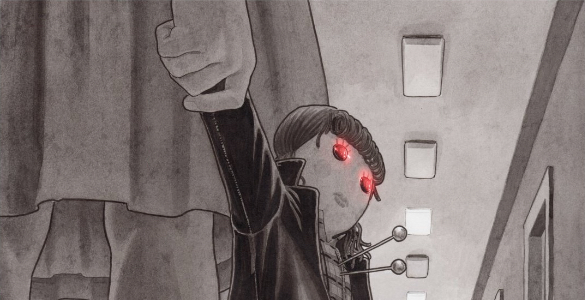
One of the most distinctive stylistic choices of Outcast has always been its use of small insert shots, inset into larger panels. Early in the series, those inserts were largely used to capture small scene details and gestures, but as the cast has grown, they’ve increasingly focused on faces, offering us the emotional state of several characters at a glance — especially those who might not be actively participating in the action/conversation of the scene. We might understand that as reflective of Kyle’s own shift in priorities, focusing less on the textural trappings of his life and more on the people he loves, but the effect is a series that now has an audience surrogate on virtually every page, reflecting our own shock and horror back at us. Continue reading
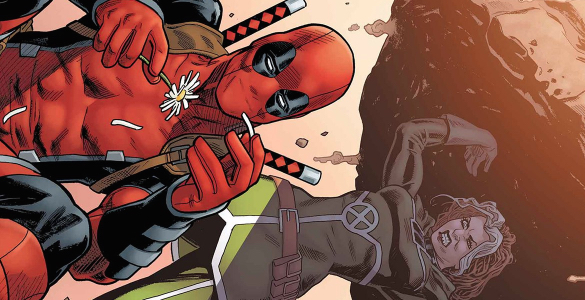
It’s Important to Use Your Words and Not Your Fists in Despicable Deadpool 293

by Taylor Anderson

This article contains SPOILERS. If you haven’t read the issue yet, proceed at your own risk!

slim-banner

At work, my coworkers and I had a professional development meeting where we learned how to handle conflict with each other. It was basically a class on how to be a decent human being and how to express your feelings without terribly offending someone else. While the class seemed a bit puerile, I have to admit that it is important for people to be able to handle their conflict well, otherwise minor problems can become big ones. Given that superheroes deal with conflict almost by definition, you would think they would be able to handle it well and without the need of professional development classes. As Despicable Deadpool 293 illustrates, however, there is nothing further from the case. Continue reading

Motherlands 1: Discussion

by Mark Mitchell and Spencer Irwin

This article contains SPOILERS. If you haven’t read the issue yet, proceed at your own risk!

slim-banner

Mark: I grew up in a fairly regimented househould. That’s not a complaint, it instilled a lot of (to my mind) positive values in me, but it did definitely affect my worldview. My parents are deeply religious, and accordingly, their religion guides them to seek out things that have redeeming value. Growing up, this translated into strong feelings on what is and is not appropriate. To give you an example of where the line lay: The Simpsons? Not appropriate. When I reached a more rebellious age I began to watch, when I could, things I knew my parents didn’t approve of, but usually with one hand on the channel changer in case they happened to walk into the room. Of course, as I’ve grown older, I’ve determined for myself where the boundaries of good taste are tread, but from birth, a sense of good old fashioned Puritanical Shame has been instilled in me, and occasionally my palms still get a little sweaty when reading a smutty comic, like my parents are going to walk in on me at any moment.

Simon Spurrier and Rachael Stott’s Motherlands 1 is smut — it’s shrill and pornographic and grotesquely violent — but it’s principled smut. Continue reading

Days of Hate 1: Discussion

by Ryan Desaulniers and Patrick Ehlers

This article contains SPOILERS. If you haven’t read the issue yet, proceed at your own risk!

Fom ancient grudge break to new mutiny,
Where civil blood makes civil hands unclean.

William Shakespeare, Romeo and Juliet

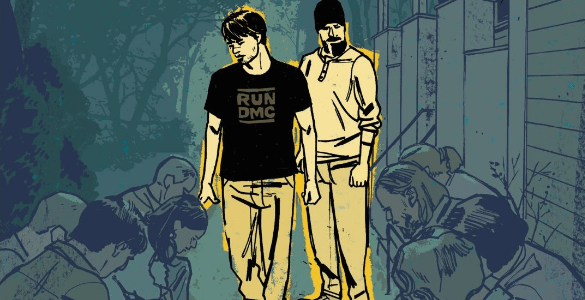
Ryan D:  The Capulets and Montagues. The Hatfields and the McCoys. The Shiite and the Sunni. These famous rivalries span generations, with their common point being that the reason which the fighting began has long since ceased to matter. The conflict now revolves around the most recent slight or atrocity perpetrated by the other side. In the aptly named Days of Hate, writer Ales Kot and artist Danijel Zezelj bring us a speculative world where our current political divide is seen played out to one natural conclusion in which the catalyst has been lost in four long years of partisan turmoil and war. Continue reading

Bucky Takes Center Stage in Tales of Suspense 101

by Drew Baumgartner

Tales of Suspense 101

This article contains SPOILERS. If you haven’t read the issue yet, proceed at your own risk!

I like spy stories enough, but I’d never claim to be a connoisseur of the genre. I’m sure there are countless subtle subgenres, but to my lay eyes, the most obvious division is between the sensationalized high adventure of, say, James Bond films, and the more grounded stories of intrigue and espionage of John le Carré’s novels. And I recognize that that’s a gross oversimplification, but the actual point I want to talk about is tone — while the later category takes itself super seriously, the former is much lighter and more fun (more recent Bond films notwithstanding), savoring terrible one-liners and groan-inducingly punny names. The Bond franchise has recently eschewed that lightness of tone in pursuit of something more serious, but Tales of Suspense 101 represents another approach; one where everyone agrees the situation is very serious, but the characters can’t help but be funny, anyway. Continue reading

All-New Wolverine 30: Discussion

by Michael DeLaney and Patrick Ehlers 

This article contains SPOILERS. If you haven’t read the issue yet, proceed at your own risk!

Michael: Tom Taylor continues to write one of the best Wolverine books that is actually pretty un-Wolverine-ish. Wolveriney? Wolverinian? What I mean to say is that for a character who is best known for being a bloodthirsty stab machine, this Wolverine is almost the opposite. To be clear, Logan was/is much more than a barbaric beast. But in Laura Kinney, Tom Taylor has crafted a Wolverine who is wise, humble and (mostly) peaceful. Like Logan, Laura is full of guilt over the violent life that she was born into. But in All-New Wolverine 30, Laura takes that guilt and transforms it into repentance. Continue reading

Silence is Golden in Black Panther 169

By Ryan Desaulniers

Black Panther 169

This article contains SPOILERS. If you haven’t read the issue yet, proceed at your own risk!

All comics are silent comics. This is an immutable fact due to their very nature as a static, visual medium. This makes it all the more impressive that artists can imbue a page with a bevvy of techniques which trick our beautiful brains into not only interpreting some onamonpaeatic words as sound, but even suggest the sound’s quality in a way that we, as readers, hardly notice as we go. Black Panther 169 takes away the sense of perceived sound and employs a level of visual storytelling which this title had not yet utilized, making for a gripping read, one focused on two characters, in opposition, in a high-stakes sprint to their objectives. Continue reading

The Reader Knows Too Much in Action Comics 996

by Michael DeLaney 

This article contains SPOILERS. If you haven’t read the issue yet, proceed at your own risk!

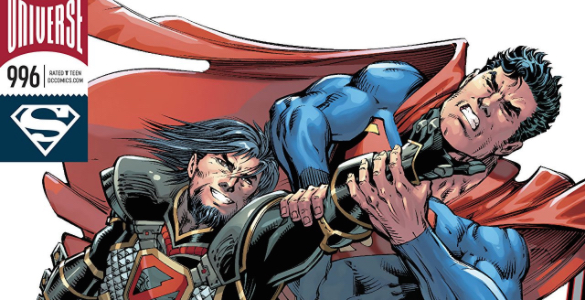
Action Comics 996 has me thinking about our expectations and interactions with an individual comic book issue. As readers, we are operating in a dimension above the characters on the comic book page. We are omniscient in that we know what Lois and Superman are up to in their separate times and spaces. Unlike Superman, we know that Zod’s son lies in wait for our hero because of Dan Jurgens’s cover for the issue. Since Lor-Zod’s appearance is a foregone conclusion, does that “spoil” the story at all? Does it diminish the final page reveal? Continue reading

Black Magick 10 Defines its Allegory

by Drew Baumgartner

Black Magick 10

This article contains SPOILERS. If you haven’t read the issue yet, proceed at your own risk!

[W]e conceive the Devil as a necessary part of a respectable view of cosmology. Ours is a divided empire in which certain ideas and emotions and actions are of God, and their opposites are of Lucifer. It is as impossible for most men to conceive of a morality without sin as of an earth without ‘sky’. Since 1692 a great but superficial change has wiped out God’s beard and the Devil’s horns, but the world is still gripped between two diametrically opposed absolutes. The concept of unity, in which positive and negative are attributes of the same force, in which good and evil are relative, ever-changing, and always joined to the same phenomenon — such a concept is still reserved to the physical sciences and to the few who have grasped the history of ideas.

Arthur Miller, The Crucible

I don’t think I fully appreciated The Crucible until this last year. Or, more precisely, without any direct reference for McCarthyism, I couldn’t fully appreciate the allegory that underpins The Crucible. That we once again live in a world where problems can be made up and pinned on innocent individuals gives The Crucible an unfortunately renewed relevance, suggesting once again that we haven’t come as far from 1690s Salem as we might like to think. Black Magick 10 carries a similar allegorical weight, also centering around the persecution of witches, with the obvious difference that the witches in Black Magick actually exist. In this way, the parallels to our modern political climate (and, heck, that of McCarthyism) might be stronger — the persecuted class does actually exist, they just aren’t the scapegoats society has made them out to be. It reflects the attitudes that politicizes someone’s very identity, suggesting that peace and happiness should only be reserved for those who conform to society’s norms. Continue reading

Narrative Distance in The Wild Storm 11

by Drew Baumgartner

Wild Storm 10

This article contains SPOILERS. If you haven’t read the issue yet, proceed at your own risk!

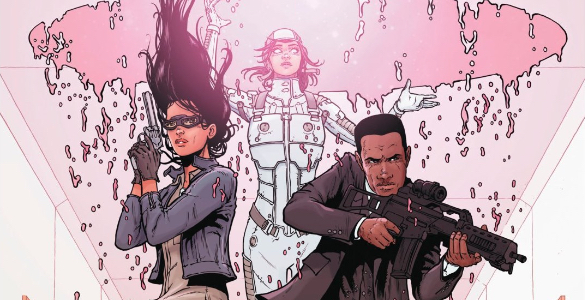
As readers, we’re all duly familiar with the narrative modes — third person omniscient, first person, objective observer, etc — we’re taught them from an early age, and are aware of them in basically all narrative writing. We’re far less aware of the narrative modes in visual storytelling, and lack the kind of common nomenclature to identify them that we have for literary narrative modes. But there’s no doubt that they profoundly influence our perceptions of visual media — there’s a profound difference between a camera shooting from over a character’s shoulder to one that is meant to literally represent their point of view, and we can feel that difference, even if we don’t have precise language to describe it. It allows visual storytelling to be much more visceral and subtle than prose, as we’re not necessarily consciously aware of its effects. With The Wild Storm 11, Warren Ellis and Jon Davis-Hunt exploit this feature of visual narrative for all its worth, keeping us at a distance from any of the events of the issue. Continue reading