
By Drew Baumgartner

This article contains SPOILERS. If you haven’t read the issue yet, proceed at your own risk!

Batgirl’s eidetic memory has long been one of her most valuable assets as a crime fighter. Remembering crime scenes in intricate detail or the face of every suspect she encounters makes detective work almost a natural extension of her being. Indeed, her eidetic memory has proven so essential to her detective work, it’s easy to forget that it has dramatic possibilities beyond that. Or, at least, other creative teams have made it easy to forget — not so with Hope Larson’s run, which has found countless inventive ways to use Batgirl’s eidetic memory. With issue 20, Larson finds yet another great use for it, as Batgirl takes a drive down some literal memory lanes. Continue reading



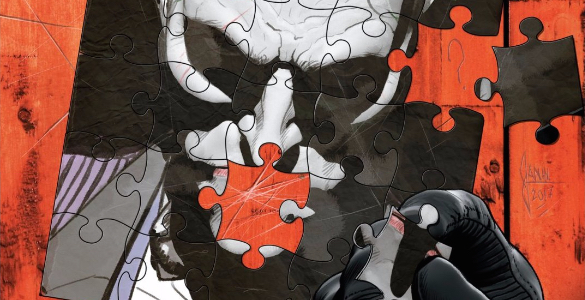









 Drew: Batman, as an idea, is essentially a very elaborate scared-straight program. The whole reason Bruce Wayne dresses up like a bat is because he believes criminals — a superstitious and cowardly lot — will be too afraid to commit crime in Gotham. Sure, some criminals are too cocksure to fear him, or simply don’t believe that he exists, but pretty much everybody runs once he actually shows up. Joker is different. For whatever reason — that he doesn’t feel fear, doesn’t mind fear, or just that he just sees Batman as a guy in a costume who keeps insisting that everybody take him seriously — the idea of Batman doesn’t deter Joker from crime. In fact, modern interpretations of the character suggest that he commits crimes in order to gain Batman’s attention. That notion is what’s made their struggle such a fundamental one, and also explains why the Joker has so many fictional fans — if he can not blink in the face of terror, so can others. The idea that the Joker could be an empowering figure is a fascinating one, but unfortunately, Detective Comics 16 doesn’t take the time to do it justice.
  Retcon Punch