The Value of Teammates in Hawkeye 9

By Drew Baumgartner

This article contains SPOILERS. If you haven’t read the issue yet, proceed at your own risk!

The Hawkeyes are team players. Whether it’s the Avengers for Clint or the Young Avengers for Kate, they’re more or less synonymous with their respective teams. That’s part of what makes their solo series so subversive and interesting — in part because it finds them away from their usual teammates, and in part because it finds them forging new teams out of the people around them. Only, for Hawkeyes, it’s never quite that simple. Case in point: the first half of Kelly Thompson and Leonardo Romero’s Hawkeye 9 provides an object lesson in why Kate needs her team, but the second complicates their relationship, forcing Kate to keep that team at an arm’s length. Continue reading

Elsewhere 1: Discussion

by Mark Mitchell and Ryan Desaulniers 

This article contains SPOILERS. If you haven’t read the issue yet, proceed at your own risk!

Mark: I’m unsure how exactly to begin unpacking Jay Faerber and Sumeyye Kesgin’s Elsewhere 1. It’s an issue that’s pregnant with ideas, yet surprisingly without depth. It moves incredibly fast, but when it ends there’s the feeling that nothing has happened. Like buying cotton candy at a carnival, it looks like there’s a lot of substance, but once you’ve consumed it all, you’re still left feeling unsatisfied. But if Elsewhere 1’s ideas are interesting, how come the issue never really takes off? Continue reading

Drax’s Confession Sets the Tone in All-New Guardians of the Galaxy 7

by Michael DeLaney

This article contains SPOILERS. If you haven’t read the issue yet, proceed at your own risk!

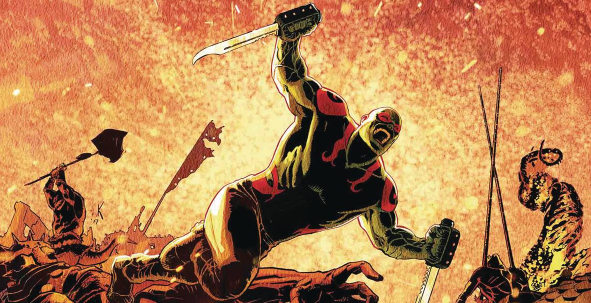
In Gerry Duggan’s All-New Guardians of the Galaxy the one formerly known as “Drax the Destroyer” has enacted a strict no destroying policy. This has likely frustrated Drax’s teammates and readers alike, but in All-New Guardians of the Galaxy 7 we find out why he’s done this — and I can’t say I blame him. Continue reading

You Need Wings in East of West 34

by Taylor Anderson

This article contains SPOILERS. If you haven’t read the issue yet, read on at your own risk!

The bullshit piled up so fast in Vietnam you needed wings to stay above it.

Captain Benjamin Willard, Apocalypse Now

War is a messy business. Aside from the needless death it causes, war destroys communities and families, wrecks economies, and has a way of dragging people and countries down into its bloody maw. Those who try to keep their hands clean often find, despite their best efforts, that war has a particular talent for drawing the unwilling into its embrace as well. Xiaolian Mao has tried, for 34 issues, to keep her hands out of not just war, but the apocalypse, but with attempts on her life and a final attack against her people, she finds that even she can’t avoid her part in ending the world.
Continue reading

Making a Connection in Black Bolt 4

by Drew Baumgartner

Black Bolt 4

This article contains SPOILERS. If you haven’t read the issue yet, proceed at your own risk!

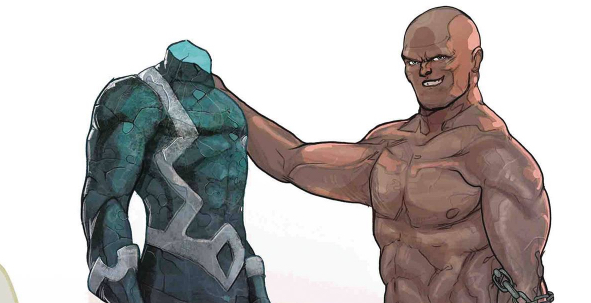
Black Bolt and Crusher Creel are about as different as characters get in the Marvel universe. Sure, Black Bolt is generally a good guy and Creel is generally a bad guy, but they’re also on opposite ends of the relatability spectrum. Creel has that sympathetic backstory that makes his decisions understandable, while Black Bolt’s regality and silence make him almost impenetrably aloof. Black Bolt’s abilities stem from his genetics, while Creel’s came to him later in life. All of these things make Black Bolt and Creel unlikely bedfellows, but Black Bolt 4 finds them forging a connection, even as Saladin Ahmed and Christian Ward do everything the can to illustrate how different these characters are. Continue reading

“People” are the Detail that Matters Most in Green Arrow 28

by Spencer Irwin

This article contains SPOILERS. If you haven’t read the issue yet, proceed at your own risk!

At one point in Green Arrow 28 Lex Luthor compares himself to Sherlock Holmes, priding himself in his ability to be 12 steps ahead of everyone else, and proving it by (rather accurately) analyzing Arrow’s current situation based off of a few small clues in a most Cumberbatchian fashion. Yet for all his genius and detective prowess, there’s one small detail Luthor is rather blind to: people, especially the people who have helped make his company great. Continue reading

Silence at the Crossroads in Sex Criminals 20

by Ryan Desaulniers

Sex Criminals 20

This article contains SPOILERS. If you haven’t read the issue yet, proceed at your own risk!

At the risk of sounding dramatic, cliche, or platitudinous: sometimes love is not enough to save a relationship. So many things go into successfully balancing the scale of a happy, healthy long-term romantic relationship, and while love is certainly important, it is certainly not the only factor. This is were we see Jon and Suzie in Sex Criminals 20 — at a crossroads, loving each other dearly, but unable to continue as a couple. Continue reading

Emphasizing Theme in Injection 14

by Drew Baumgartner

Injection 14

This article contains SPOILERS. If you haven’t read the issue yet, proceed at your own risk!

Sandwiches are important.

Brigid Roth

When do you know something in a given narrative is important? Is it someone in the story saying as much? Is it that that element keeps coming back? Or is it some subtler means of emphasis that can make even the first appearance of an idea feel meaningful? Ultimately, these methods aren’t mutually exclusive, but I do see them as existing on a kind of continuum of obviousness, with someone stating the importance of something as “impossible to miss,” and those subtler methods covering a wide range from “clear” to “ambiguous” (the scale theoretically continues into “unclear” and “impossible to detect,” though those will obviously be difficult to notice from a reader’s perspective). Then again, those elements can be used in ways beyond their perceived meaning. That is, a character could say something was important in order to mislead the audience, or, in the case of Injection 14, to draw our attention to what really matters. Continue reading

Teenage Mutant Ninja Turtles Dimension X 1: Discussion

By Patrick Ehlers and Taylor Anderson

This article contains SPOILERS. If you haven’t read the issue yet, proceed at your own risk!

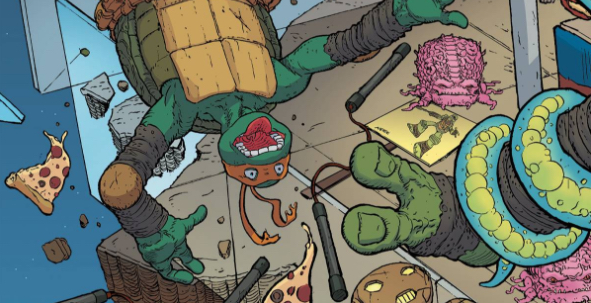
Patrick: I recently spent the week with my three year old niece. Like all three year olds, she’s totally incapable of not expressing her emotions — everything that upsets her triggers a screaming fit and everything that delights her… triggers a screaming fit, but just a different kind. Spending the day with her is, of course, equal parts charming and exhausting, but the thing that struck me the most was how honest that time is. She’s got no way of hiding, muting or dulling her emotional reactions. As a crusty ol’ adult, I’ve got decades of training tamping those things down, to the point where I have to actively attempt to express what I’m feeling. There’s a strength to being able to feel without filter, and the young simply haven’t developed that filter yet. Paul Allor and Pablo Tunica’s Teenage Mutant Ninja Turtles Dimension X 1 explores how that strength manifests itself in our heroes as they visit a planet that makes emotions manifest physically. Continue reading

Batman’s Biggest Weakness is Gotham City in Batman 28

by Michael DeLaney

This article contains SPOILERS. If you haven’t read the issue yet, proceed at your own risk!

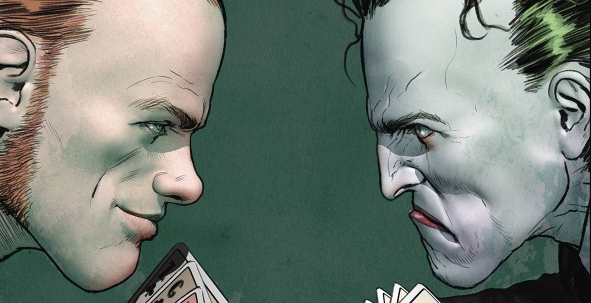
What is Batman’s weakness? Some might say his mortality, some might say his relationships, while others might argue that Batman has no weaknesses. Batman 28 argues that Batman’s largest, most vulnerable spot might be Gotham City itself. Continue reading