Scrutiny Reveals the Flaws in Batman and the Signal 2

By Patrick Ehlers

This article contains SPOILERS. If you haven’t read the issue yet, proceed at your own risk!

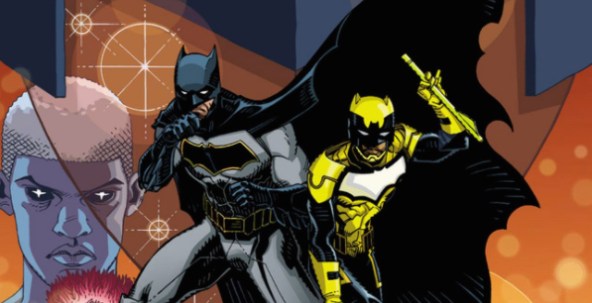
One of the driving philosophies of Batman and the Signal is the idea that light reveals the flaws in something. A story from the beginning of issue 2 targets Gotham City skyscrapers, partially constructed at night by crews of illegal laborers. Duke’s father was one of these nighttime construction men. He would bring his son to check out the fruits of his nocturnal labor in the cold light of day so Duke could clearly witness the cost of cutting corners. Fittingly, this metaphor falls apart the more closely you examine it. Can you see tiny imperfections in the craftsmanship that goes into building a skyscraper? Probably. Is that overlooking the fact that its a modern marvel of engineering that pierces the sky with steel, iron and glass? Absolutely. My experience writing about comics for Retcon Punch has shown me that we are more often rewarded for our intense scrutiny than we are disappointed by the trivial cracks in the handiwork.

Leave it to Batman and the Signal to demonstrate the opposite. Continue reading
Opportunity Knocks in The Further Adventures of Nick Wilson 2

By Drew Baumgartner

The Futher Adventures of Nick Wilson 2

This article contains SPOILERS. If you haven’t read the issue yet, proceed at your own risk!

We believe that we are always better off gathering as much information as possible and spending as much time as possible in deliberation. We really only trust conscious decision making. But there are moments, particularly in times of stress, when haste does not make waste, when our snap judgements and first impressions can offer a much better means of making sense of the world.

Malcolm Gladwell, Blink

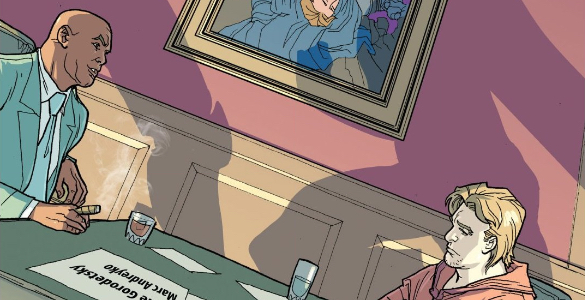
We’re all bad at making decisions. Or, rather, we’re bad at listening to the parts of ourselves that make good decisions. That’s the main takeaway of Malcolm Gladwell’s Blink, but its a ubiquitous phenomenon once you know how to spot it. We’re more concerned with the logical story of our choices than we are with the more perceptive part of us that can make the right choice subconsciously. “It felt right” isn’t a satisfying explanation, so we avoid it to our own detriment. To hear Gladwell’s explanation, we then draw out the decision-making process long beyond that initial (and often correct) feeling, sometimes long enough to talk ourselves out of the right choice or miss the opportunity entirely. That’s the path Nick starts down in The Further Adventures of Nick Wilson, but a few swift kicks in the but remind him that missed opportunities might be worse than bad decisions. Continue reading

Star Wars: Doctor Aphra 17 and a Lived-in Universe of Love

By Michael DeLaney


This article contains SPOILERS. If you haven’t read the issue yet, proceed at your own risk!

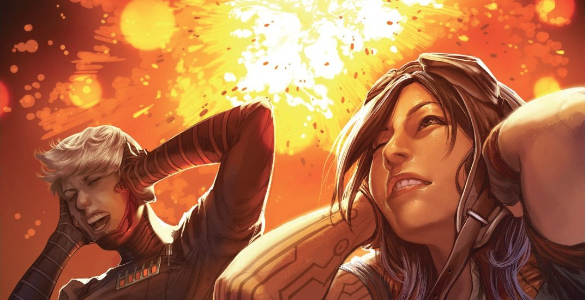
We talk a lot today about representation in pop culture. People who are not straight white men yearn to see a reflection of themselves, on the big screen or otherwise. As this representation increases, so does the opportunity for a more nuanced reflection. Star Wars: Doctor Aphra 17 presents such an opportunity in the relationship between Aphra and Magna Tolvan. Continue reading

A Minor Retcon Changes the Tone of Green Lanterns 41

by Mark Mitchell


This article contains SPOILERS. If you haven’t read the issue yet, proceed at your own risk!

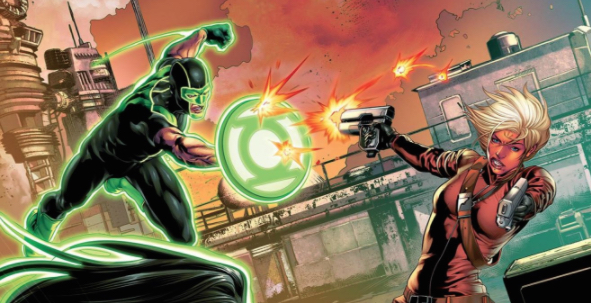
Mark: Comic book fans and, of course, readers of this site will be familiar with the idea of a “retcon” in comics — basically, a piece of new information that updates (often by contradicting) previous information. Usually retcons happen with shifts in creative teams, character relaunches, or when reaching back deep into a line’s history to incorporate some historical element that doesn’t quite fit in the modern landscape. Much more rare is the retcon-ing of information from a mere six issues in the past — an issue written by the same author, no less — but that’s the case in Tim Seeley, Barnaby Bagenda, and Tom Derenick’s Green Lanterns 41. The issue opens with a depiction of Simon Baz and Night Pilot’s date, the aftermath of which seeded the “Superhuman Trafficking” arc back in Green Lanterns 35.

Continue reading

Melting n’ Melding Bodies in Astonishing X-Men 8

by Taylor Anderson

This article contains SPOILERS. If you haven’t read the issue yet, proceed at your own risk!

There’s a scene in John Carpenter’s The Thing when Kurt Russell and the rest of crew at an Antarctic research station realize that their sled dogs have been melted by an alien and blobbed together into one hideous creature that is the stuff of nightmares. Like a lot of the movie, it’s disturbing to say the least. There’s something about the the design of the blob-dog-alien creature that just rings as…wrong. Eyes are where they shouldn’t be, jaws open up from weird crevices, and melted organic all make for something that looks like it came straight out of Hell. It sounds awful (which it is), but that’s also what makes the movie great and, coincidentally, is what makes Astonishing X-Men 8 enjoyable as well.

Continue reading

Moonshine 7: Discussion

by Patrick Ehlers and Drew Baumgartner

This article contains SPOILERS. If you haven’t read the issue yet, proceed at your own risk!

Patrick: On February 14th, a 19 year old former student opened fire on Marjory Stoneman Douglas High School. He killed 14 students and three teachers. The gunman had been expelled before completing school, and he bounced in and out of foster care. He suffered from depression, cut himself, frequented white supremacy websites, and actively posted about his desire to shoot up the school. When he was still a student, he wasn’t allowed to wear a backpack, because administrators feared he might bring something dangerous on the campus. On the day of the shooting, he was armed with an AR-15, which he had purchased legally. This shooting is a critical system failure. And that failure is necessarily the failure of the generation that came before both the shooter and his victims — the children punished for their parents’ crime of inaction. How does that happen? How does a generation obsessed with protecting their young end up harming them? Brian Azzarello and Eduardo Risso’s Moonshine 7  explores the devastating relationship between generations, staging acts of innocence and malice simultaneously. Continue reading

The View from the Edges of The Black Monday Murders 8

by Ryan Desaulniers 

Black Monday Murders 8

This article contains SPOILERS. If you haven’t read the issue yet, proceed at your own risk!

The Edge… there is no honest way to explain it because the only people who really know where it is are the ones who have gone over.

Hunter S. Thompson

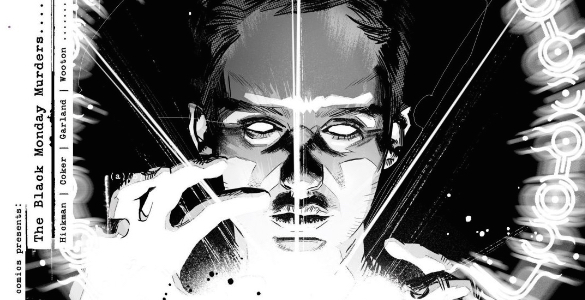
Ryan D: If there’s one incredible thing about being a comic reader nowadays, it’s that we are privy to so many new worlds being built, month to month, in front of us. In a time when so much of Hollywood’s machinations revolve around rehashing existing properties, comic books (alongside maybe the slew of Netflix-style originals) lead the charge for the new and exciting. When encountering one of these new universes, it’s always interesting to see how we are introduced to the mechanics inherent in them. How much does the creative team tip their hand as issues progress? Black Monday Murders 8 shows us how confident writer Jonathan Hickman is at keeping both the audience and its characters on the edge of this world. Continue reading

Lettering Reveals Status and Power in Marvel Two-In-One 3

By Patrick Ehlers

This article contains SPOILERS. If you haven’t read the issue yet, proceed at your own risk!

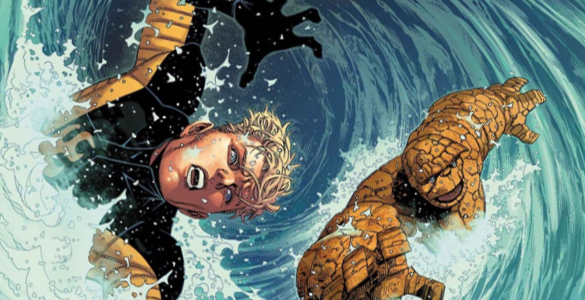
Marvel Two-in-One 3 is all about characters either rediscovering or redefining their relationship to their super powers. Our titular pair of marvels even goes to doctor Rachina Koul in the middle of nowhere Wyoming to jump-start Johnny’s powers. Ben describes Johnny as “broken” and whether that’s just referring to his ability to flame on, or more holistically applies to the man is left up to the reader’s discretion. But the implication is clear: without their defined roles as superheroes and supervillains, these guys just don’t know how to function. The damn Mad Thinker is going so crazy he’s styled his facial hair to look like Reed Richards and claiming to launch a “New Fantastic Four.” Basically: everyone goes nuts without boundaries. Today, I want to explore how lettering emphasizes the connection between a character, their powers, and how they view themselves in this universe. Continue reading

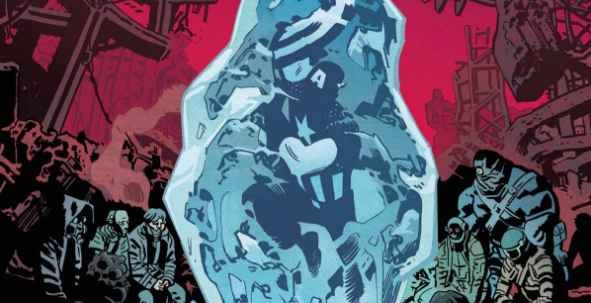
Dystopia in the Not-So-Distant Future in Captain America 698

by Spencer Irwin

This article will contain SPOILERS. If you haven’t read the issue yet, proceed at your own risk!

I was raised on classic television, and as a kid I remember always getting a big kick out of the fact that the original Lost in Space series took place in the “distant future” of 1997. As a general rule, ascribing a specific date to your fictional future is a great way to rob it of its power and wonder, but Captain America 698 turns that rule completely on its head, finding its most effective twist in the “when” of its dystopian future. Continue reading

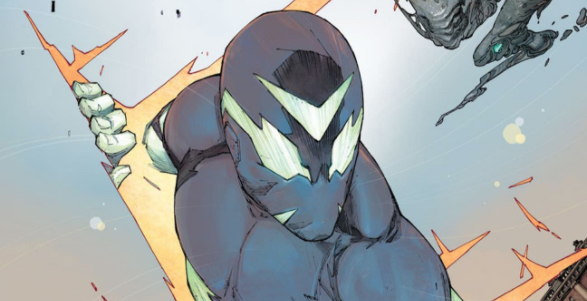
Biological Truths in the Details of Sideways 1

By Patrick Ehlers

This article contains SPOILERS. If you haven’t read the issue yet, proceed at your own risk!

Kenneth Rocafort’s art is so packed with detail that shapes, lines and colors often find themselves marooned in the gutter and in the space between his panels. His visually noisy style gives the impression that Rocafort has so much creative energy that it simply cannot be contained by the incidents of the story he’s tasked with telling. As the rift-opening hero Sideways, Derek literally exists between spaces, and Rocafort is long practiced in filling those voids with exciting, vital details. Sideways 1 is marvelous introduction to a character I can’t wait to see more of. Continue reading