Family in Descender 29

by Ryan Desaulniers

This article contains SPOILERS. If you haven’t read the issue yet, proceed at your own risk!

You can choose your friends but you sho’ can’t choose your family…

Harper Lee, To Kill a Mockingbird

How do you define “family?” The answer to this may differ drastically depending on a number of factors, but as subjective as the idea is, many social and medical science disciplines use “family” as a basic unit of study. A UNESCO report claims family to be “a kinship unit and that even when its members do not share a common household, the unit may exist as a social reality.” That strikes me an appropriately broad definition, but could we include robots in it? Descender 29 returns to the “present” after three issues chronicling the first interactions with the eponymous machines which may have created organic life in this universe to a galaxy on fire, but despite the huge plot pieces moving here, the development and dissolution of family units takes center stage. Continue reading

Recurrent Lyrics and Actions Empower Scott in Mister Miracle 8

By Patrick Ehlers

This article contains SPOILERS. If you haven’t read the issue yet, proceed at your own risk!

A lot of Mister Miracle stands on the foundation of process and repetition. The nine-panel grid is established early and repeated on every page. All nine panels will be committed to a single action. Then the next nine panels are committed to a different action. This repetition leads to the feeling of being trapped, both for Scott Free and for the reader. But issue 8 finds writer Tom King introducing a sort of rosetta stone for how to find joy and contentment in the inescapable repetition. “Hush, Little Baby.” Continue reading

The Personal Mythology of Batman: Creature of Night 3

by Michael DeLaney

This article contains SPOILERS. If you haven’t read the issue yet, proceed at your own risk!

Whether we realize it or not, Americans like to mythologize our lives. Exposure to different forms of fiction and historical accounts feed into our egos, ascribing significance and meaning where otherwise there is none. Kurt Busiek and John Paul Leon’s Batman: Creature of Night 3 mythologizes it’s protagonist’s life literally and figuratively. Continue reading

Ms. Marvel 29: Discussion

by Taylor Anderson and Ryan Mogge

This article contains SPOILERS. If you haven’t read the issue yet, proceed at your own risk!

Taylor: There’s a reason why Archie comics are still around almost 80 years after the first issue was published. The lives of teenagers, to a certain extent, will always be the same, and Archie comics have traditionally done a pretty good job of chronicling what it’s like to be a high-schooler. In particular, the series’ focus on the romantic and emotional lives of its characters is what has made it an enduring title. After all, it’s not necessarily your AP Biology class you remember so much as the crush who happened to sit next to you in it. But it would be a mistake to think that Archie comics have cornered the market when it comes to teen dramas, or, as Ms. Marvel 29 shows, that teen dramas can’t include super heroes. Continue reading

The Illusion of Control in James Bond: The Body 4

By Spencer Irwin

This article contains SPOILERS. If you haven’t read the issue yet, proceed at your own risk!

We all know what happens when James Bond meets a beautiful woman. It’s one of the most (in?)famous aspects of the franchise, and it’s an assumption creators Ales Kot and Eoin Marron clearly lean into when their injured Bond runs into a woman named Moira early in James Bond: The Body 4. Even Bond himself, if only momentarily, thinks he knows exactly how things are going to play out.

It never happens. Moira isn’t a conquest; she’s a complicated woman with her own desires and internal life that Bond can barely begin to fathom. That’s really the idea behind this entire issue: James Bond is a professional who thinks he understands how the world works, but control is far more elusive than he ever truly realized. Continue reading

Failure Defeated by Pure Action in Daredevil 601

By Patrick Ehlers

This article contains SPOILERS. If you haven’t read the issue yet, proceed at your own risk!

Daredevil is a punching bag. I know all superheroes suffer — conflict is the engine of story, and masked dudes with superpowers have to really be put through the ringer for a desensitized audience to feel anything. But Matt Murdock is a special case: his default state seems to be “just got beat up.” I mean, look at the cover to this issue. No one’s going to ask “oh no, is Matt gonna be okay?” Yeah, sure — he’ll be fine. He always bleeds from the face when he’s working on a plan. So part of what makes Daredevil 601 feel so unsettling is how smoothly everything goes for the Mayor Without Fear. Continue reading

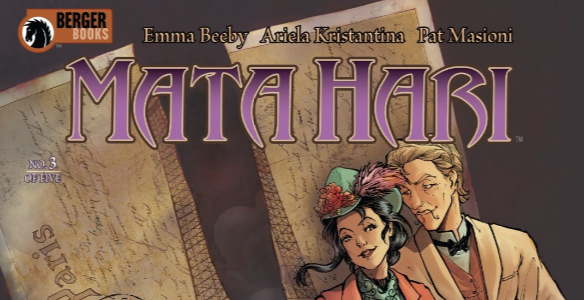
Elusive and Scattered Narratives in Mata Hari 3

by Mark Mitchell

This article contains SPOILERS. If you haven’t read the issue yet, proceed at your own risk!

Mata Hari continues to be an interesting but ultimately elusive book in its third of five installments. Margaretha Zelle’s life is clearly worthy of examination, but the book itself is hamstrung by the extremely limiting nature of this mini-series’ run. Continue reading

Action Comics 1000: Discussion

by Drew Baumgartner, Michael DeLaney, Patrick Ehlers, and Spencer Irwin

Action Comics 1000

This article contains SPOILERS. If you haven’t read the issue yet, proceed at your own risk!

“From the City that Has Everything”

Drew: Superman changed the world. That’s obvious enough in-universe, but it’s just as true of our world. Action Comics 1 created (or at least codified) the superhero genre, a genre that came to define both the 20th and 21st centuries, and is still growing as Action Comics rings in its 1000th issue. It’s a singular achievement, but celebrating it as such might not be in the spirit of Superman, for whom humbleness is as much a part of his character as heroism. He’s not one to take compliments easily, let alone brag, so any efforts to do so on his behalf run the risk of feeling crass. Most of the stories in this issue opted to ignore lionizing Superman outright, aiming instead to illustrate what it is that makes him so laudable, but in the issue’s opening chapter, Dan Jurgens came up with a way to address the issue with Superman himself, providing a commentary on the whole exercise of a huge anniversary issue, and offering a justification that even Superman can get behind. Continue reading

Quantum and Woody 5 is Chaotic-Good

by Drew Baumgartner

Quantum and Woody 5

This article contains SPOILERS. If you haven’t read the issue yet, proceed at your own risk!

Superhero comics are full of Chaotic Good characters — conscientious free spirits that believe in doing good, but by their own standards. From Batman to Wolverine to the Teenage Mutant Ninja Turtles, Chaotic Good characters fight for their morals, though not necessarily for the law. Neither Quantum nor Woody would fit this category — Quantum is good, but too lawful, while Woody is chaotic, but too morally passive. Together, though, their actions end up taking on a Chaotic Good, picking up Woody’s chaotic nature and Quantum’s desire to do good. Writer Daniel Kibblesmith and artist Kano attempt something similar with Quantum and Woody 5, delivering an issue that is both chaotic and good. Continue reading

Axes of Horror in Infidel 2

by Patrick Ehlers

This article contains SPOILERS. If you haven’t read the issue yet, proceed at your own risk!

slim-banner

Infidel is tough for me to write about because it is so damn real and so damn scary. To look at how Pornsak Pichetshote and Aaron Campbell are successful is to look deep into what scares me about the world. We’re talking about highly entrenched societal ills like racism, xenophobia, terrorism, murder. Infidel delivers on what’s scary about all of those enormous concepts, but perhaps more importantly gives similar horrific weight to the mundane inconveniences and atrocities of modern life and connects them to the aforementioned huge horrors. Do you feel safe, a few steps removed from accidentally throwing a loved one down the stairs? Well, joke’s on you: the spectre of Infidel is as close to you as a package of strawberries rotting on your kitchen counter. Continue reading