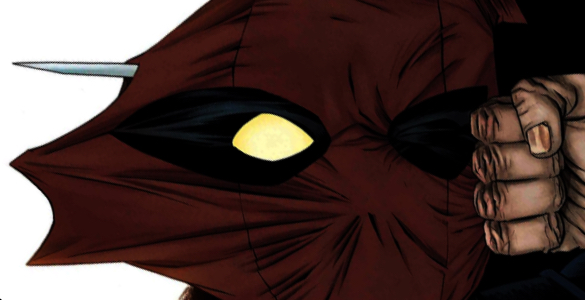
The Specificity of Allusions in Deadpool vs. Old Man Logan 3

by Drew Baumgartner

Deadpool vs Old Man Logan 3

This article contains SPOILERS! If you haven’t read the issue, proceed at your own risk.

Back in high school english class, I was daunted by the idea that every work of literature alludes to earlier, more foundational works. How could I ever understand the meaning of a novel if I haven’t also read the novels it references, and the novels those reference and so on and so on. I’m still fascinated by the notion that every work of art has an ever-branching family tree of influences, but I’m less concerned about missing them — a work lives or dies on its own merits, so if I don’t “get it,” I’m happy to pin that on the work itself. I have a largely similar attitude to comics, where general familiarity with the character and the world might be a safe assumption, but a given issue can’t take for granted that we’ve read any other comic, let alone one from years ago. And yet, comics also has this rich, ever-growing continuity that can (and some might argue should) inform every character’s identity. Such is the case with Deadpool Vs. Old Man Logan 3, which draws upon writer Declan Shalvey’s own personal history with Wade Wilson in one of the most rewarding ways I’ve seen in years. Continue reading
Batman 37 Knocks it Out of the Park

by Drew Baumgartner

Batman 37

This article contains SPOILERS. If you haven’t read the issue yet, proceed at your own risk!

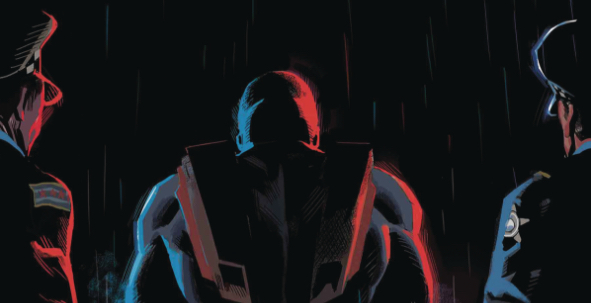
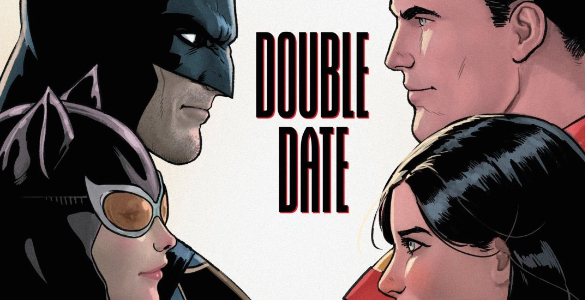
There are lots of reasons to love superhero comics. Maybe you’re in it for the high-wire action or the sci-fi worlds. Maybe you’re in it for the superhuman feats or the super human morals. There are as many reasons to love superheroes as there are superhero fans, but I think at some level, every fan must share some real affection for these characters, and perhaps even a childlike desire to be them. Those aspirations usually exist off the page, taking shape in our minds as we read, but Tom King and Clay Mann have found an elegant way to address the phenomenon in-universe: making Batman and Superman fans of one another. Continue reading

Hellboy – Krampusnacht: Discussion

by Drew Baumgartner and Taylor Anderson

Hellboy Krampusnacht

This article contains SPOILERS. If you haven’t read the issue yet, proceed at your own risk!

The Christmas tree, where did that tradition come from? It sounds like the behavior of a drunk man. I can picture it now: ‘honey, why is there a…pine tree in our living room?’ “I like it! Tomorrow, we’re gonna…we’re gonna decorate it…for Jesus.”

Jim Gaffigan

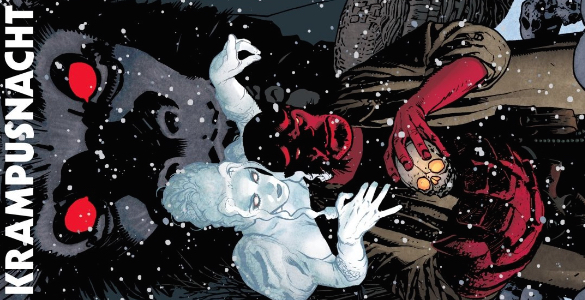
Drew: Traditions are weird. Even if you understand the origins of holiday gift-giving or decorations or whatever, the reason you do it actually boils down to the fact that you always have, or your family always had. That is, the reason traditions are traditions is because they’re traditions. It’s not a super satisfying answer, especially when you’re questioning why we do these silly things in the first place, but the simple fact is that we tend to do things the way we’re used to doing them, even if we also think they’re silly. It takes some doing to break out of those habits, as the Krampus learns in Hellboy: Krampusnacht. Continue reading

Potent Symbols Abound in Falcon 3

by Drew Baumgartner

Falcon 3

This article contains SPOILERS. If you haven’t read the issue yet, proceed at your own risk!

Falcon 3 opens with Sam and Rayshaun in prison. Denied any due process by the white mayor, it’s hard not to see the parallels to mass incarceration, a problem that disproportionately affects black men. Moreover, Sam and Rayshaun are powerless to do anything about it. They eventually escape, sure, but it’s only by the force of literal magic — there’s no other means available to them. It’s a potent symbol, the kind that makes Rodney Barnes and Joshua Cassara’s Falcon so refreshing. Continue reading

The Seeds of Doubt in Judas 1

By Drew Baumgartner

Judas 1

This article contains SPOILERS. If you haven’t read the issue yet, proceed at your own risk!

In a religion built on redemption and forgiveness, one man had to sacrifice himself for everyone…and it wasn’t Jesus.

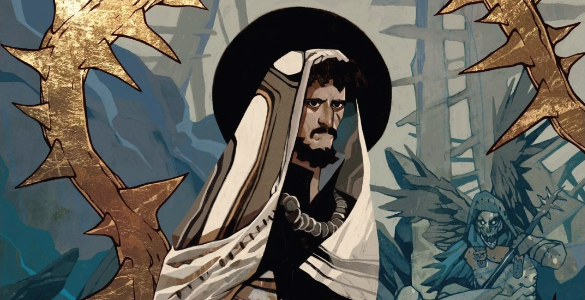
This text appears in the back of this issue, serving as a kind of tagline for the series. This might put it a bit too bluntly (I can almost hear the record scratch on that ellipsis), but the notion that Judas is the true victim of the story of his betrayal is an intriguing one. After all, if Jesus needed to suffer and die in order to redeem humanity, then he must have needed a betrayer — Judas is essential to our salvation. Moreover, while Jesus’s suffering was great, it was temporary, and was ultimately followed by eternal life in the kingdom of heaven. That seems a heck of a lot better than eternal damnation. That bitterness creeps in at the edges of Jeff Loveness and Jakub Rebelka’s Judas 1, but it’s really a manifestation of something much more profound: doubt. Continue reading

It’s Kirby vs. Lee in Mister Miracle 5

by Drew Baumgartner

Mister Miracle 5

This article contains SPOILERS! If you haven’t read the issue, proceed at your own risk.

Charlie: I’ve written myself into my screenplay.

Donald: That’s kind of weird, huh?

Adaptation

To call Adaptation “kind of weird” would be putting it mildly — ostensibly about Charlie Kaufman’s attempt to adapt Susan Orlean’s The Orchid Thief, the movie is ultimately about itself, but becomes this weird fictionalized version of itself, as Kaufman invents a twin brother to introduce hackneyed thriller elements to the film’s closing acts. It’s much, much weirder than someone simply writing themself into their own screenplay. Heck, the actual script is credited to both Charlie and Donald Kaufman, and both were nominated for an Academy Award for best adapted screenplay even though Donald is a fictional character (or, arguably, a manifestation of Charlie’s most commercial writing instincts). But I think Mister Miracle 5 might just top it for meta weirdness, serving as a kind of final word on comics’ own Charlie and Donald Kaufman — Jack Kirby and Funky Flashman. Continue reading

Black Lightning: Cold Dead Hands 2 Settles Into Itself

by Drew Baumgartner

Black Lightning Cold Dead Hands 2

This article contains SPOILERS. If you haven’t read the issue yet, proceed at your own risk!

For as many superhero comics there are out there, it’s remarkable how little diversity there is — both in terms of representation and narrative variety. Those are both points that have been made to death, but are rarely mentioned in the same breath. But with Black Lighting: Cold Dead Hands 2, Tony Isabella and Clayton Henry make a strong case that they might be related — or more precisely, that the solution to both can be the same thing: Jefferson Pierce’s blackness lends the character to stories totally unlike the reheated adventures of other superhero faire. It demonstrates the storytelling potential of diverse characters, emphasizing perspectives, obstacles, and motivations that otherwise might never come up at the Big 2. Continue reading

Beyond Homage in Hawkeye 13

By Drew Baumgartner

Hawkeye 13

This article contains SPOILERS. If you haven’t read the issue yet, proceed at your own risk!

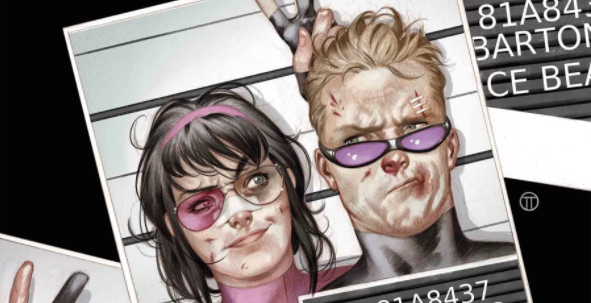
When it comes to franchised characters in comics, virtually every creative team owes a huge debt to those who came before. I think this might be particularly true for Kate Bishop, who was characterized so iconically (and recently) in two beloved series — Matt Fraction and David Aja’s Hawkeye and Kieron Gillen and Jamie McKelvie’s Young Avengers — that her past interpretations are all but inescapable. I don’t mean to sell short the contributions of Kelly Thompson and her collaborators on this series, but they clearly understand the importance of reconciling Kate with her past, which is arguably why “Kate’s past” has made for such a satisfying narrative motif. But issue 13 finds Thompson and Leonardo Romero fully addressing Kate’s metatextual past, crashing a bumbling Clint Barton back into Kate’s life. Continue reading

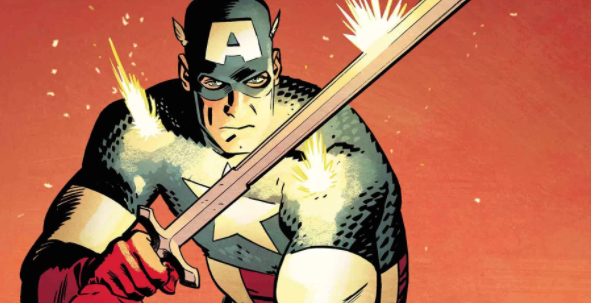
Steve Goes Freelance in Captain America 696

by Drew Baumgartner

Captain America 696

This article will contain SPOILERS. If you haven’t read the issue yet, proceed at your own risk!

Do the citizens of the Marvel Universe adequately compensate their superheroes? There’s little doubt that the entire planet benefits from the efforts of Captain America and his ilk, but whatever gratefulness the citizens feel doesn’t put food on the table. Which is why so many superheroes either take day jobs (with S.H.I.E.L.D. or the Heroes for Hire, for example), institutionalizing their heroic output, are already independently wealthy (like Tony Stark), or have some wealthy patron (like Tony Stark). That notion of patronage hints at what I’m getting at: superheroism is a bit like making art — society may value the idea of it generally, but that doesn’t exactly translate to money in the bank. It’s a lesson Steve Rogers is learning as his journey as a freelance superhero begins in earnest in Captain America 696. Continue reading

The Fix 10: Discussion

by Drew Baumgartner and Patrick Ehlers

The Fix 10

This article contains SPOILERS. If you haven’t read the issue yet, proceed at your own risk!

slim-banner

You either die a hero, or you live long enough to see yourself become the villain.

Harvey Dent, The Dark Knight

Drew: If that quote doesn’t feel like it fits this issue, it’s because it doesn’t. Where The Dark Knight explores the ideas of good, evil, and the moral relativism that exists in between, The Fix is gleefully amoral, concerned less with good and bad as it is with whatever its protagonists can get away with. Which is to say, a quote about heroes and villains doesn’t make a whole lot of sense in the world of The Fix. But I wonder if we strip away the morality from that quote, if we might get something a bit more universal (if still deeply pessimistic): you either die happy, or you live long enough to see yourself become miserable. The ordering of those outcomes betrays a cynical worldview that The Dark Knight (or at least Harvey Dent) shares with The Fix, one that presumes things are inclined to get worse. Of course, while The Dark Knight spun that cynicism into tragedy, The Fix funnels it into dark humor, making any successes Roy or Mac may enjoy are but haughty spirits before the inevitable fall. Continue reading