Memories Leave their Mark in Batgirl 20

By Drew Baumgartner

Batgirl 20

This article contains SPOILERS. If you haven’t read the issue yet, proceed at your own risk!

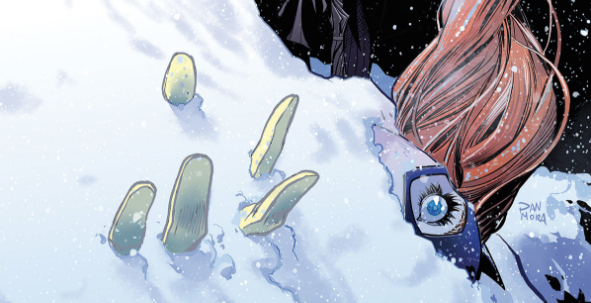
Batgirl’s eidetic memory has long been one of her most valuable assets as a crime fighter. Remembering crime scenes in intricate detail or the face of every suspect she encounters makes detective work almost a natural extension of her being. Indeed, her eidetic memory has proven so essential to her detective work, it’s easy to forget that it has dramatic possibilities beyond that. Or, at least, other creative teams have made it easy to forget — not so with Hope Larson’s run, which has found countless inventive ways to use Batgirl’s eidetic memory. With issue 20, Larson finds yet another great use for it, as Batgirl takes a drive down some literal memory lanes. Continue reading

The Wilds 1: Discussion

by Drew Baumgartner and Mark Mitchell

Wilds 1

This article contains SPOILERS. If you haven’t read the issue yet, proceed at your own risk!

They might not have done so with elaborate ritual, since there has never been solid evidence that they included symbolic objects in graves, but it is clear that they did not just dump their dead with the rest of the trash to be picked over by hyenas and other scavengers.

Francesco d’Errico

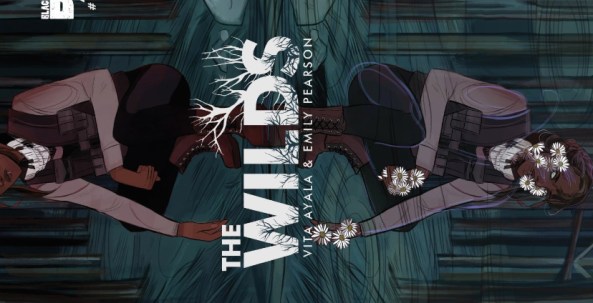
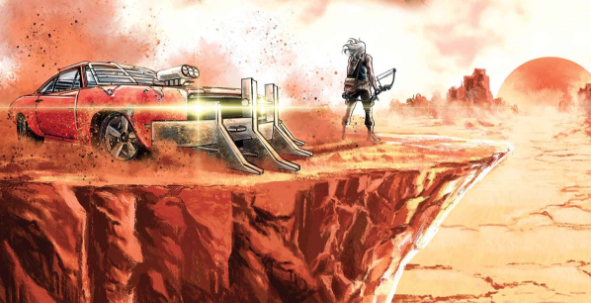
Drew: What makes us human? As with any attempt to draw hard lines around a vague concept, there seem to be exceptions to every feature we might describe as human, forcing us to consider that other species might just qualify for whatever working definition we land on. Such is the case with Neanderthals — the “they” in the quote at the top of this piece — which display enough of what we understand as culture and morality for me to be satisfied with their humanity. But were their contemporary Homo sapiens? The trouble with that nebulous definition of humanity is that our gut tends to default to speciesism, especially in the moment. It’s easy for me to rule Neanderthals in now, but what about chimpanzees or dolphins? They have irrefutably human-like use of tools and language, but they just don’t feel human — they inspire a kind of visceral “this is an animal” feeling that requires a great deal of rational thought to overcome. That confusing, blurry line between human and non-human has long been a point of fascination for sci-fi writers, whether the non-human is a robot, alien, or some kind of mutated human, literalizing the struggle Homo sapiens seem to have in even recognizing the humanity of one another. This is far from the only intriguing theme in Vita Ayala and Emily Pearson’s The Wilds 1, but it might be the most unexpected. Continue reading

Old Habits Die Hard in Amazing Spider-Man 796

by Drew Baumgartner

Amazing Spider-Man 796

This article contains SPOILERS. If you haven’t read the issue yet, proceed at your own risk!

There’s a concept in psychology of the “repetition compulsion,” which essentially lays out a kind of self-fulfilling prophecy for our neuroses. A straightforward (and non-pathological) example would be an introvert avoiding big crowds, which in turn prevents them from developing comfort around (or at least strategies to cope with) big crowds, which in turn encourages them to avoid big crowds, but this phenomenon can be seen operating at everything from our smallest habits to our biggest problems. Lest this sound too fatalistic, those cycles of repetition can be broken, but my actual point in bringing them up is just to emphasize how cyclical our lives can be — even when embarking on a new adventure, our old habits may force them to resemble our old adventures. Such has long been the case of superheroes, whose new adventures are in part only marketable because people liked the old adventures, so leaning into those repetition compulsions (even the destructive ones) is a logical choice.

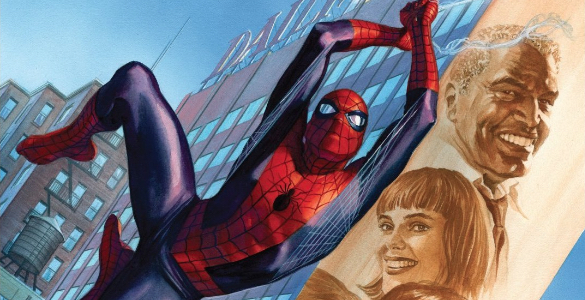
Writer Dan Slott has always managed to keep a remarkable balance between the old and the new, repeating enough to keep his characters recognizable, but changing enough to keep the stories exciting, largely by changing the big patterns (Pete’s job, relationship status, identity, etc) but holding onto the small ones (Pete’s talkativeness, bad luck, sense of responsibility, etc). But with issue 796, Slott and co-writer Christos Gage begin folding some of those larger repetitions back into the mix, suggesting that Slott might just be putting the toys back in place as he hands over the reigns of the series he’s been writing for over a decade. Continue reading

Black Panther Annual 1: Discussion

by Drew Baumgartner and Ryan Desaulniers

Black Panther Annual 1

This article contains SPOILERS. If you haven’t read the issue yet, proceed at your own risk!

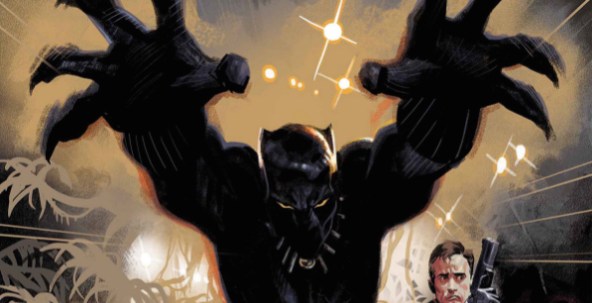
Drew: Over the past two weeks, countless articles have been written about the world-building in the Black Panther film. It’s obviously something the movie does remarkably well, combining a kind of anthropological survey of African culture with a sci-fi utopia for an Afrofuturist aesthetic that is unique in the world of blockbuster movies. Moreover, that world-building was essential in ingratiating a new audience to the character and his home country, implying a rich culture that stretched far beyond what we saw on the screen. Of course, superhero comics — especially long-running ones — are often more interested in what has already been built than they are in what is new, trading on our nostalgia for familiar events and characters in a way that a single film obviously can’t. There’s certainly a case to be made for honoring the storied history of any character in that way, though the approach may be at odds with appealing to newcomers (who may have been brought in by, say, a widely popular movie), all of which puts Black Panther Annual 1 in a difficult position. Is it aimed at newcomers looking for an approachable entry into comics after seeing the movie, or is it aimed at long-time readers who are already duly familiar with the character’s history? Continue reading

Giving Meaning to the Inevitable in Mighty Thor 704

by Drew Baumgartner

The Mighty Thor 704

This article contains SPOILERS. If you haven’t read the issue yet, proceed at your own risk!

Heroes are predictable, at least in terms of the noble qualities that define heroism. That is, while a hero’s cunning plan or stroke of genius may surprise us, that they would try to save the day — even and especially at great risk to themselves — is kind of a foregone conclusion. And no hero represents that quality of self-sacrifice better than Jane Foster, whose daily choice to wield Mjolnir to protect others has slowly allowed her cancer to advance. So that she would take up the hammer once again, even with the knowledge that doing so would surely kill her, isn’t exactly a surprise Jason Aaron and Russell Dauterman could have hoped to withhold. So instead, they spend this issue detailing exactly what that decision means to her beyond self-sacrifice, getting at just what it is that makes Jane so selfless in the first place. Continue reading

Opportunity Knocks in The Further Adventures of Nick Wilson 2

By Drew Baumgartner

The Futher Adventures of Nick Wilson 2

This article contains SPOILERS. If you haven’t read the issue yet, proceed at your own risk!

We believe that we are always better off gathering as much information as possible and spending as much time as possible in deliberation. We really only trust conscious decision making. But there are moments, particularly in times of stress, when haste does not make waste, when our snap judgements and first impressions can offer a much better means of making sense of the world.

Malcolm Gladwell, Blink

We’re all bad at making decisions. Or, rather, we’re bad at listening to the parts of ourselves that make good decisions. That’s the main takeaway of Malcolm Gladwell’s Blink, but its a ubiquitous phenomenon once you know how to spot it. We’re more concerned with the logical story of our choices than we are with the more perceptive part of us that can make the right choice subconsciously. “It felt right” isn’t a satisfying explanation, so we avoid it to our own detriment. To hear Gladwell’s explanation, we then draw out the decision-making process long beyond that initial (and often correct) feeling, sometimes long enough to talk ourselves out of the right choice or miss the opportunity entirely. That’s the path Nick starts down in The Further Adventures of Nick Wilson, but a few swift kicks in the but remind him that missed opportunities might be worse than bad decisions. Continue reading

Moonshine 7: Discussion

by Patrick Ehlers and Drew Baumgartner

This article contains SPOILERS. If you haven’t read the issue yet, proceed at your own risk!

Patrick: On February 14th, a 19 year old former student opened fire on Marjory Stoneman Douglas High School. He killed 14 students and three teachers. The gunman had been expelled before completing school, and he bounced in and out of foster care. He suffered from depression, cut himself, frequented white supremacy websites, and actively posted about his desire to shoot up the school. When he was still a student, he wasn’t allowed to wear a backpack, because administrators feared he might bring something dangerous on the campus. On the day of the shooting, he was armed with an AR-15, which he had purchased legally. This shooting is a critical system failure. And that failure is necessarily the failure of the generation that came before both the shooter and his victims — the children punished for their parents’ crime of inaction. How does that happen? How does a generation obsessed with protecting their young end up harming them? Brian Azzarello and Eduardo Risso’s Moonshine 7  explores the devastating relationship between generations, staging acts of innocence and malice simultaneously. Continue reading

The Makings of a Monster in Lazarus X+66 6

by Drew Baumgartner

Lazarus X+66 6

This article contains SPOILERS. If you haven’t read the issue yet, proceed at your own risk!

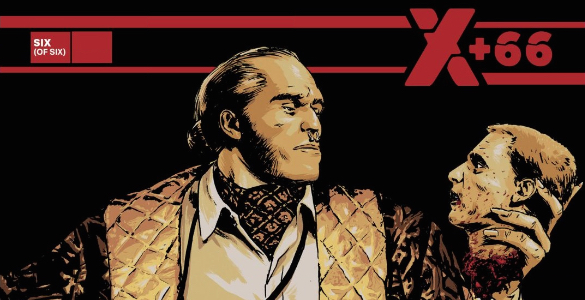
Comics tend to make a big deal about the prosocial mission of superheroes. That is, their origin isn’t just about why they can leap tall buildings or outrun a bullet, but why they choose to use those powers to protect innocent people. It’s interesting that creators emphasize this point — the choice to don a cape and charge into a burning building is a certainly a remarkable one, but it’s also understandable. That is, even if we don’t all have the courage and strength to do those things, we immediately grasp the desire to help people. Villains, on the other hand, demand a much more thorough explanation — if stopping a massacre is remarkable but understandable, causing a massacre is both remarkable and baffling. Creators are rarely up to the task, vaguely suggesting an overgrown thirst for power or money, but never quite convincing us how those things add up to a homicidal maniac. Those creators would do well to check out Lazarus X+66 6, which offers an origin for the Zmey that covers both his superhuman abilities and his monstrous psychology. Continue reading

Three Interrogation Scenes in Old Man Hawkeye 2

by Drew Baumgartner

Old Man Hawkeye 2

This article contains SPOILERS. If you haven’t read the issue yet, proceed at your own risk!

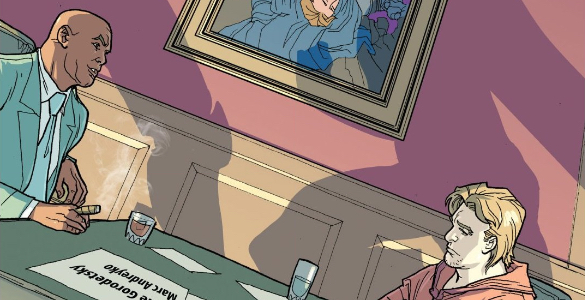
The conventional wisdom in improv is that transaction scenes — like those between a customer and a storekeeper — are inherently uninteresting. The relationship between the two characters is impersonal and perfunctory, and the transaction is void of any tension. Any of those elements can be changed to rescue a transaction scene, but beginners are encouraged to avoid those setups altogether in favor of those that have relationships and tension built in to the premise. (At least, this is my understanding, though I’m prepared to have our improv contingent correct me in the comments.) Interrogation scenes definitely have that tension built in, as one person wants information the other is reluctant to share, but the relationships are often still impersonal. Moreover, they’re scenes we’ve seen a million times, whether they’re taking place in a police station or as Batman dangles a crook from some rooftop. Which is to say, the tension isn’t quite enough to carry those scenes. Like a transaction scene, an interrogation can be rescued if complications are added in the right places. Unfortunately, those complications are largely absent from Old Man Hawkeye 2, leaving two of its its three interrogations feeling pretty limp. Continue reading

Clashing Tones in The Amazing Spider-Man Annual 42

by Drew Baumgartner

Amazing Spider-Man Annual 42

This article contains SPOILERS. If you haven’t read the issue yet, proceed at your own risk!

It’s hard to separate a character from the types of stories they inhabit. Indeed, it’s an idea that doesn’t even really make sense in most media, where characters tend to inhabit just the one story, but it kind of runs amok in comics, where there are countless forces pushing characters into other types of stories. There’s crossovers and cameos, which will pull the guest-starring character into the (potentially very different) tonal world of the home series. There’s cross-media franchises, which will accentuate the parts of the character that best suit the medium, whether it’s an action movie, a video-game, or a kids cartoon. And, perhaps more than anything, there’s the monthly grind of telling yet another story with this character, inspiring creators to think outside the box to find something new and exciting to show us. Those forces compound over the decades, such that a given character is less defined by the type of stories they inhabit than the range of stories they could inhabit. Such is the case with Spider-Man, who is so famously versatile to have teamed up with basically everyone in the Marvel Universe, has appeared in countless film and television iterations, and often stars in multiple comics series at once. Even so, there seem to be a few types of stories that Spider-Man isn’t quite suited for, as The Amazing Spider-Man Annual 42 illustrates. Continue reading