Memories Come Rushing Back in All-New Wolverine 25

by Drew Baumgartner

All-New Wolverine 25

This article contains SPOILERS. If you haven’t read the issue yet, proceed at your own risk!

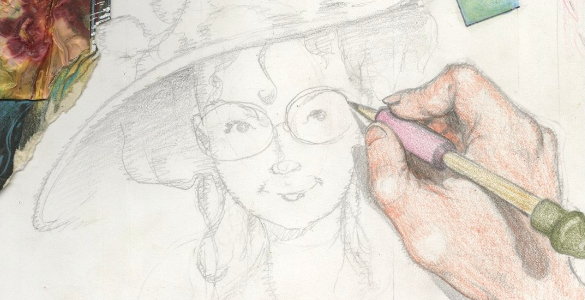
I think it’s fair to say that All New-Wolverine is more concerned with the idea of legacy than most comics. Laura is donning the mantle of her mentor, and the first arc of this series found her reconciling with her literal clones. Indeed, I might argue that it’s one of the greatest strengths of this series, as writer Tom Taylor has mined Laura’s history for ever more emotionally devastating gut-punches. So when issue 25 features a “Legacy” banner across the cover, it’s almost a promise of legacy-squared, somehow centralizing the idea of legacy even more than the series normally does. Those are daunting expectations, but Taylor and artist Juann Cabal more then live up to them, forcing Laura to relive some of her most traumatic memories. Continue reading

Agency and Sacrifice in Black Bolt 6

by Drew Baumgartner

Black Bolt 6

This article contains SPOILERS. If you haven’t read the issue yet, proceed at your own risk!

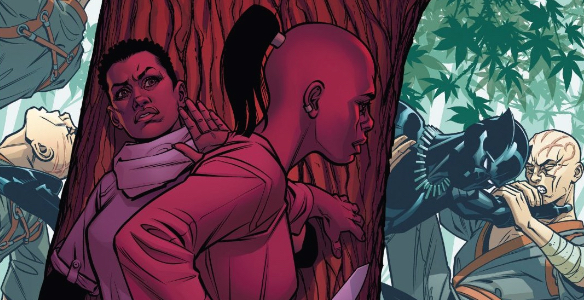
“Freedom isn’t free” has become the insulting platitude gun advocates offer to justify the United States’ unrivaled gun violence numbers. Never mind that countless countries enjoy similar freedoms without the same body counts — the freedom to own a gun, the logic goes, is worth the lives of any number of concertgoers, congressmen, nightclubbers, pedestrians, or schoolchildren. It’s strange that the notion of the cost of freedom has gone from personal costs one might make in order to secure freedom for themselves and their country to some kind of blood sacrifice we demand of others, since the two couldn’t really be more different. One is about noble sacrifice, the other is about throwing someone else under the bus to save your own skin. It’s a point that Saladin Ahmed and Christian Ward make elegantly in Black Bolt 6, as the mad scramble for freedom yields some unexpected costs. Continue reading

Surprises in the Details of Eleanor and the Egret 4

by Drew Baumgartner

Eleanor and the Egret 4

This article contains SPOILERS. If you haven’t read the issue yet, proceed at your own risk!

We call this story “Man in Hole,” but it needn’t be about a man and it needn’t be about somebody getting into a hole — it’s just a good way to remember it: Somebody gets into trouble and gets out of it again. People love that story. They never get sick of it.

Kurt Vonnegut

I’ve always been attracted to the kind of abstract narrative shapes Vonnegut famously catalogued in his Master’s Thesis — there’s something fascinating at the thought that virtually all stories draw from a narrow range of narrative trajectories. But, of course, looking at narratives in such an abstract way overlooks a lot of the texture and details that actually makes stories so thrilling in the first place. That is, while we might take it for a given that the man gets out of the whole, we can still be surprised at exactly how that happens. Those details are what distinguishes one narrative from another, yet even then, they can often feel rote and predictable. Not so with Eleanor and the Egret 4, which uses the cartoon logic of its high-concept premise to deliver some truly unexpected twists. Continue reading

Batman 32: Discussion

by Drew Baumgartner and Michael DeLaney

Batman 32

This article contains SPOILERS. If you haven’t read the issue yet, proceed at your own risk!

I don’t know.

Teenager, Traditional

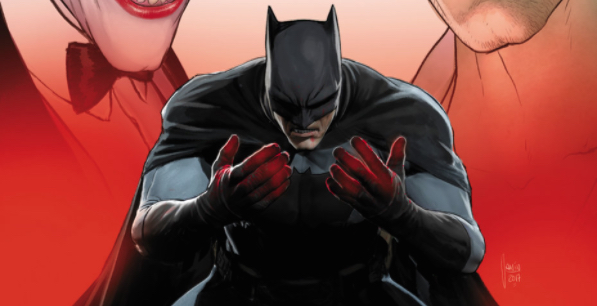
Drew: I used to work as an Assistant Dean for an academic enrichment program — basically, high-school students would come to a college campus for a few weeks over the summer to take some classes and get a feel for dorm living. The Dean’s office was there to keep kids out of trouble, or, more accurately, to address the trouble that the kids inevitably got into. Most of the time, the motives for their infractions were clear enough — they skipped class because it was boring or they tried to sneak into the girl’s dorm to see their girlfriend — but every so often, a kid would do something so inexplicable, the first question had to be “why?” And the answer, invariably, was “I don’t know.” Sometimes, our better judgement eludes us, allowing weird impulses or emotions to lead us to actions we can neither explain nor defend. It’s a phenomenon that teens are particularly prone to, with their hormonally-charged emotions and only-partially-developed impulse control, but it happens to adults, too (even sober ones). It is one of these moments that turns out to be Bruce Wayne’s “greatest sin,” as the climax of “The War of Jokes and Riddles” leads him to a rare flash of moral weakness. Continue reading

Jessica and Simon Regroup in Green Lanterns 32

by Drew Baumgartner

Green Lanterns 32

This article contains SPOILERS. If you haven’t read the issue yet, proceed at your own risk!

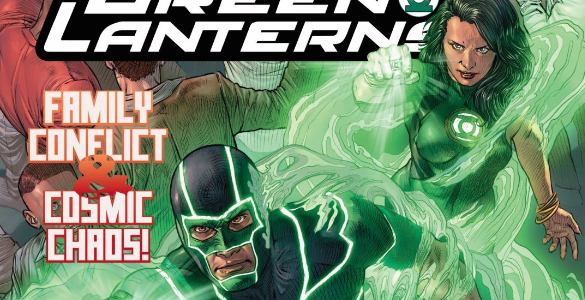
When talking about serialized narratives, we’ll often talk about how certain installments “put the pieces in place” — that is, it was saddled with setting up the next installment (often to its own detriment). But superhero comics represent a peculiar type of serialized narrative, one where “putting the pieces in place” often means putting things back where they belong. However far afield you may take Bruce Wayne, he’s always going to return to Gotham, return to his allies, return to fighting crime as Batman. These kinds of periodic resets are partially a vestige of a time when superhero stories were much more episodic than today but they also offer a straightforward way to keep the characters going into perpetuity. Often, that kind of reset is reserved for the very end of an arc, giving us just enough of the hero’s old status quo to restore some sense of normalcy. Occasionally, though, we’ll get a story like Green Lanterns 32, which takes time to remind us who our heroes are when they’re not busy dealing with a crisis. Continue reading

Introducing the Implied “Rock” in The Hard Place 2

By Drew Baumgartner

The Hard Place 2

This article contains SPOILERS. If you haven’t read the issue yet, proceed at your own risk!

The Hard Place is like a nested doll of hooks. “Former gangbanger tries to stay clean after prison” is a fine premise, but Doug Wagner and Nic Rummel pushed that a step further in their first issue, asking what happens when that gangbanger is forced back into the game at gunpoint. Issue 2 cleverly twists the knife further, making AJ’s co-hostage the daughter of his psychopathically violent boss, such that the presumption that AJ is complicit in the robbery doesn’t just pit him against the cops, but the entire criminal underworld. Continue reading

Superherodom Encroaches in Black Panther 18

By Drew Baumgartner

Black Panther 18

This article contains SPOILERS. If you haven’t read the issue yet, proceed at your own risk!

Ta-Nehisi Coates’ run on Black Panther has always vacillated between concerns for greater Wakanda (civil unrest, history, religion) and more straightforward superheroics. It perfectly captures the multiple directions T’Challa is always pulled in, blowing up the typical Marvel interpersonal dramas into matters of state. In recent arcs, those two worlds seem even further apart, as issues almost seemed to alternate between these two concerns. The results have been fantastic — the previous two issues represent opposite ends of that spectrum, and are among the strongest Coates has written — but threatened to split this book into two series running in parallel. That is, until issue 18 reveals that everything might be connected, after all. Continue reading

A Romp Through Absurdity in Fu Jitsu 1

by Drew Baumgartner

Fu Jitsu 1

This article will contain SPOILERS. If you haven’t read the issue yet, proceed at your own risk!

I just killed James Dean and disarmed a bomb from the future.

Fu Jitsu, Fu Jitsu 1

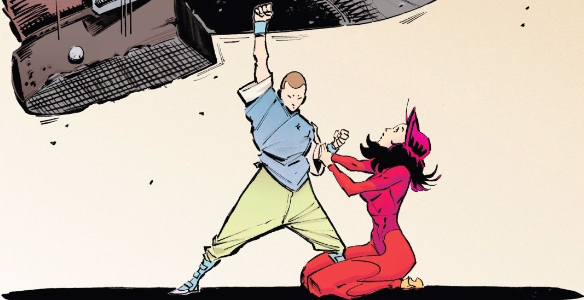
My own interpretation of the solicit for Fu Jitsu 1 was “if Forrest Gump was a genius and immortal” — it’s an absurd premise, but one that could be fun. Turns out this issue is actually several times more absurd than I expected, but it embraces that absurdity so enthusiastically, I can’t help but love it. Continue reading

Godshaper 6: Discussion

by Spencer Irwin and Drew Baumgartner

This article contains SPOILERS. If you haven’t read the issue yet, proceed at your own risk!

slim-banner

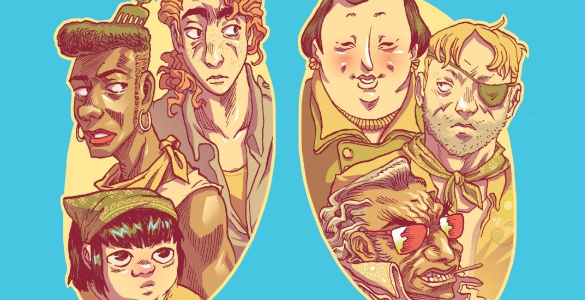
Spencer: It’s a marvelous thing to watch a series come into focus — to reach that eureka moment where you finally get what a creator is trying to say, where a series’ message finally clicks. Simon Spurrier and Jonas Goonface’s Godshaper 6 has been one of those moments for me, a finale that brings all the themes the series has been exploring together in a satisfying, yet completely unexpected fashion. Continue reading

Spicing Up the Procedural in The Wild Storm 7

by Drew Baumgartner

Wild Storm 7

This article contains SPOILERS. If you haven’t read the issue yet, proceed at your own risk!

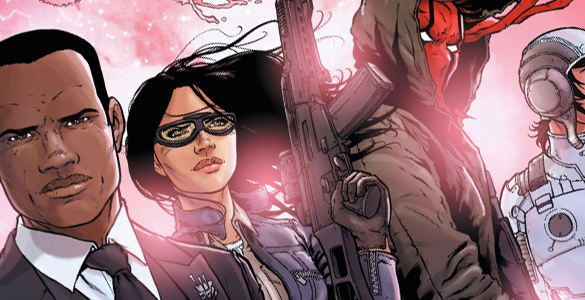
I have a friend who loved Law & Order until someone pointed out to him just how predictable every episode is. Law & Order was notorious for having a particularly rigid structure, but I’d argue that predictability is built into all procedurals. That is, so long as we understand the procedure. Everything follows logically from what comes before — once the victim is identified, the police will want to talk to their home, work, family and friends, for example — so we have a rather strong expectation of what will come next. That may make it sound like it’s difficult to surprise people in a procedural, but those strong expectations actually make it much, much easier to do something unexpected, as the “expected” is such a known quantity. This is something Warren Ellis and Jon Davis-Hunt clearly understand, leaning hard into the expected of The Wild Storm 7 while simultaneously taking us in some unexpected new directions. Continue reading