Batman 26: Discussion

By Drew Baumgartner and Michael DeLaney
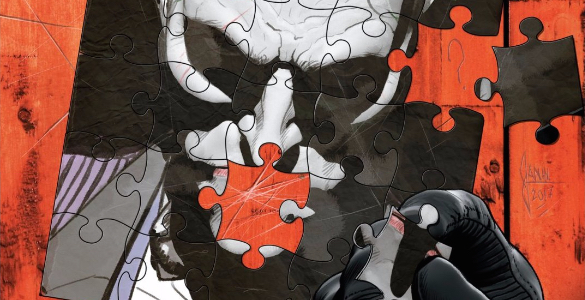
Batman 26

This article contains SPOILERS. If you haven’t read the issue yet, proceed at your own risk!

A single death is a tragedy; a million deaths is a statistic.

Joseph Stalin

Drew: Joseph Stalin likely never uttered this phrase, but while its provenance may be dubious, it’s hard to argue with its sentiment. We’ve all experienced this personally; individual deaths carry with them the nuance and beauty of the decedent’s death in a way that dozens of deaths simply can’t. Each of those deaths are felt singularly by the loved ones they affect, to be sure, but the rest of us can’t really fit the sum of those tragedies into our brain. They become, for lack of a better term, a statistic. This is why war stories are so rare in superhero comics — the higher death count doesn’t necessarily equal higher emotional stakes, so killing swaths of civilians runs the risk of making any one of those deaths lose whatever oomph it might have on its own. Writer Tom King seems keenly aware of how easy it would be for the victims of “The War of Jokes and Riddles” to become statistics, taking pains to emphasize just how deeply Batman feels each of those deaths. Continue reading
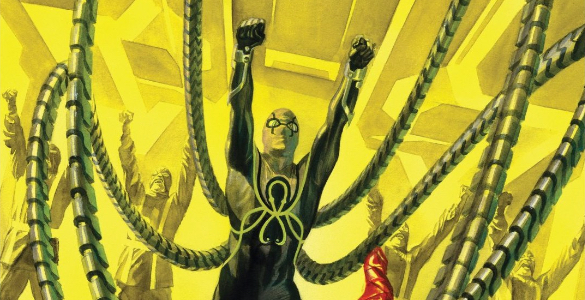
The Art of the Tie-in: Amazing Spider-Man 29

by Drew Baumgartner

Amazing Spider-Man 29

This article contains SPOILERS. If you haven’t read the issue yet, proceed at your own risk!

It’s easy to vilify crossover events for disrupting your favorite series, but that’s kind of the point, right? An event that boasts “everything changes here” should be disruptive to the universe around it — that’s just making good on that claim. The feeling that the story we were reading has been put on the back burner is definitely frustrating, but it’s exactly what would happen in the event of a Earth-shaking change in the status quo. But there are ways to soften the whiplash effect of event tie-in issues, and Amazing Spider-Man 29 features just about all of them. Actually, it might be to precise to pin it on this one issue — while this is the first to explicitly acknowledge the events of Secret Empire, so much of what happens here spins out of threads writer Dan Slott has been spinning for years. In many ways, it feels less like the event forced a change to the series and more like the changes that were coming all along were given a fresh twist by tying them to Secret Empire. Continue reading

Laying the Evidence in Batgirl 12

by Drew Baumgartner

Batgirl 12

This article contains SPOILERS. If you haven’t read the issue yet, proceed at your own risk!

There are no incidental details in prose. Or rather, there are no specific incidental details in prose. You might get a sketchy description of someone’s home or office, with the understanding that you can more or less fill in the blanks on what kind of furniture might be there, but if a specific item of furniture matters, it has to be mentioned explicitly. This makes it very difficult to introduce elements casually; if a specific item of furniture is mentioned, we can’t help but assume it will have some significance to the story. For most stories, that’s not a problem — indeed, faith that the details matter to the narrative might be fundamental to our enjoyment of them — but that gets complicated when there’s a mystery to be solved. That is, prose has a hard time giving us clues that don’t immediately broadcast themselves as clues; the very fact that it’s being mentioned betrays its significance. Continue reading

Explaining the Absurd in Eleanor and the Egret 3

by Drew Baumgartner

Eleanor and the Egret 3

This article contains SPOILERS. If you haven’t read the issue yet, proceed at your own risk!

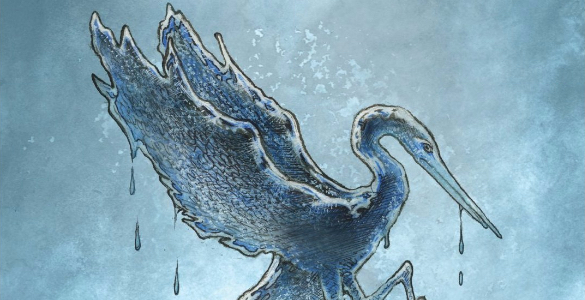
One of my favorite Loony Tunes premises was that of “Ralph Wolf and Sam Sheepdog,” the rival canines attempting to eat/protect a herd of sheep, respectively. Those cartoons are full of all of the great slapstick and expressions that make classic Chuck Jones cartoons such a pleasure, but by favorite gag is that, at the start and end of the day, Ralph and Sam punch their timecards — they’re just doing their jobs. Any other adversarial relationship in Loony Tunes, whether it’s Elmer Fudd and Bugs, Sylvester and Tweetie, or the (similarly designed) Wile E. Coyote and Roadrunner, needs no further explanation; the motivations of the characters are enough to carry the gags. Ralph and Sam, though, have a reason beyond their apparent animal natures, something that tilts at the nonsensical task of explaining the cartoon logic of these characters. It somehow grounds them in reality while simultaneously heightening the absurdity of the situations they’re in. Eleanor and the Egret has always reveled in its own kind of absurdity, but issue 3 starts to reveal Eleanor’s backstory, hinting at some human emotions at the core of this cartoony world. Continue reading

Secret Weapons 1: Discussion

by Patrick Ehlers and Drew Baumgartner

This article contains SPOILERS. If you haven’t read the issue yet, proceed at your own risk!

slim-banner

Patrick: Thwip! Bamf! Snikt! You know those sound effects: respectively, they mean a) Spider-Man shooting some web fluid, b) Nightcrawler teleporting away, and c) Wolverine deploying his claws. It is perhaps illustrative of the predictability of their superpowers that there are immutable sound effects that accompany them. You know exactly what it sounds like when Wolvie pops his claws, but you also know exactly what he can do with them. These powers are used in unsurprising ways to save the day, but what happens when the superheroes have powers that aren’t so easy to understand? Well, then you’ve got the residents of The Willow and the cast of Secret Weapons. Continue reading

Silver Sufer 12: Discussion

by Drew Baumgartner and Patrick Ehlers

Silver Surfer 12

This article containers SPOILERS. If you haven’t read the issue yet, proceed at your own risk!

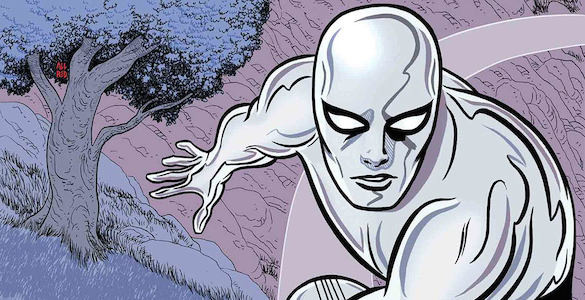
Drew: To say that Dan Slott, Michael Allred, and Laura Allred delight in the formal aspects of comics would be a profound understatement. The most indicative example must be issue 11 of the previous volume, which featured a kind of Möbius strip that readers had to consciously break out of. It’s the kind of innovation that might feel gimmicky to the passerby, but on closer inspection is so closely tied to the content of the story, it’s almost impossible to imagine it being handled any other way. In that case, Norrin and Dawn were stuck in a time loop, so the closed loop of the layout was essential to making that point literal. This issue finds Dawn stuck in time in a very different way, and the creative team manages to find a different technique to capture her stasis. Continue reading

The Non-Quixotic Quest in The Old Guard 5

by Drew Baumgartner

The Old Guard 5

This article contains SPOILERS. If you haven’t read the issue yet, read on at your own risk!

To dream the impossible dream
To fight the unbeatable foe
To bear with unbearable sorrow
To run where the brave dare not go

Joe Darion, “The Impossible Dream”

Is Andy the anti-Don Quixote? Her world-weary cynicism is certainly the opposite of his delusions of chivalry; her bitter pragmatism the opposite of his flights of fancy. But the thing that strikes me most is that Andy is the unbeatable foe, the kind of mythical being Quixote could only dream of. Of course, this gives them different priorities — while he’s focused on those imaginary beings, she’s utterly undaunted by the mortal tilting at her. Sure, the mortal can get in a few good licks, but is more of an annoyance than a nemesis. Indeed, it turns out the only thing worthy of an unbeatable foe’s attention is another unbeatable foe. Continue reading

There’s No Virtue in Compliance in Bitch Planet Triple Feature 1

by Drew Baumgartner

Bitch Planet Triple Feature 1

This article will contain SPOILERS. If you haven’t read the issue yet, proceed at your own risk!

It is more important that innocence should be protected, than it is, that guilt be punished; for guilt and crimes are so frequent in this world, that all of them cannot be punished…. when innocence itself, is brought to the bar and condemned, especially to die, the subject will exclaim, ‘it is immaterial to me whether I behave well or ill, for virtue itself is no security.’ And if such a sentiment as this were to take hold in the mind of the subject that would be the end of all security whatsoever.

John Adams

There are always folks who will defend punishment for the guilty — whether it’s prison, public shaming, or being shot by a cop — but that often necessitates retroactively framing those who receive punishment as guilty. In the wakes of countless police (and neighborhood watchmen) shootings, the offenses that have been deemed worthy of death have ranged from stealing a pack of cigarettes to wearing a goddamned hoodie. It’s an absolutely despicable line of reasoning (even when it’s “I agree they didn’t deserve to die, but…”), but it falls completely on its face in the case of Philando Castile, who was inarguably guilty of no crime whatsoever. This is exactly the situation Adams was warning against. There is no virtue in innocence or — in the parlance of Bitch Planet — compliance, so why follow the rules at all? Continue reading

Subjective Martyrdom in All-New Wolverine 21

by Drew Baumgartner

All-New Wolverine 21

This article contains SPOILERS. If you haven’t read the issue yet, read on at your own risk!

And Jesus put forth his hand, and touched him, saying, I will; be thou clean. And immediately his leprosy was cleansed.

Matthew 8:3

While I’ve often marveled at the depth of Tom Taylor’s allusions on All-New Wolverine, it doesn’t exactly take a biblical scholar to catch the parallels to Jesus in this issue. Laura practices peace, heals the sick, and ultimately dies (maybe), but it’s that middle point that Taylor really sinks his teeth into, detailing not only the pitiful masses in need of help, but the suffering Laura endures in order to cure them. She’s Jesus, just without the religious conviction (I opted not to open this essay with Luke’s account, which finds Jesus getting downright snippy when recently-cured lepers fail to praise God to his satisfaction). Continue reading

Remixing Jack Kirby in Bug! The Adventures of Forager 2

by Drew Baumgartner

Bug! The Adventures of Forager 2

This article contains SPOILERS. If you haven’t read the issue yet, read on at your own risk!

How do we characterize a remix? As a self-aware riff on whatever work is being remixed, it feels somewhat postmodern, but in my mind, remixes don’t necessarily share the skepticism and ironic distance we associate with postmodernism. Indeed, many remixes might be better understood as reverent tributes to their source material, taking what I’d argue is a decidedly romantic approach: offering an unabridged window into how the remixer sees a given work of art (or entire oeuvre). I was first struck by this idea when listening to The Beatles’ Love, which feels very much like bouncing around inside a Beatles fan’s head, but it came back in a big way as I read Bug! The Adventures of Forager 2, an issue that takes the same approach to comics mythology (both DC’s and others). Continue reading