Form Trumps Myth in Hal Jordan and the Green Lantern Corps 37

By Patrick Ehlers

This article contains SPOILERS. If you haven’t read the issue yet, proceed at your own risk!

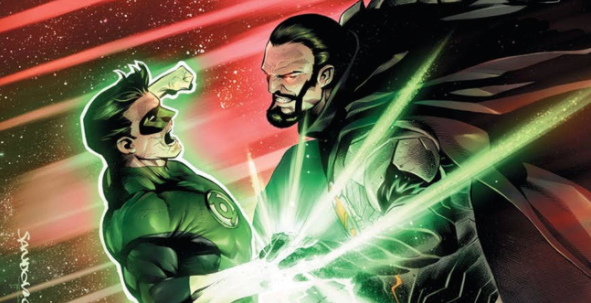
My Green Lantern fandom often feels like a relic from a time before I truly understood what I loved about comics. I love the limits of the medium — the way an artist has to imply light and sound and movement and time all on a still page which literally possesses none of these qualities. So much of a comic story, for me, is in how it is told, rather than what it’s telling. But Green Lantern is a myth-making franchise, and the moment-to-moment storytelling can often be measured by the twists and connections it makes to its own winding history. Hal Jordan and the Green Lantern Corps 37 eschews that entirely, pulling one of Superman’s Big Bads into the ring for some refreshingly innovative visual storytelling. Continue reading
Those Brutal Claws in Deadpool vs. Old Man Logan 4

By Patrick Ehlers

This article contains SPOILERS. If you haven’t read the issue yet, proceed at your own risk!

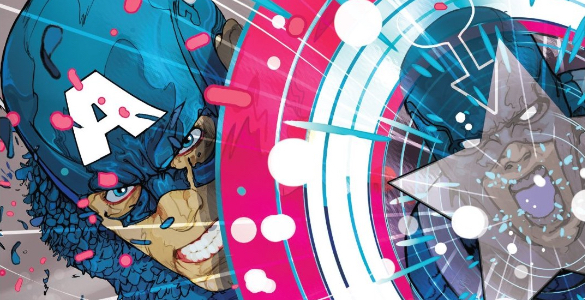
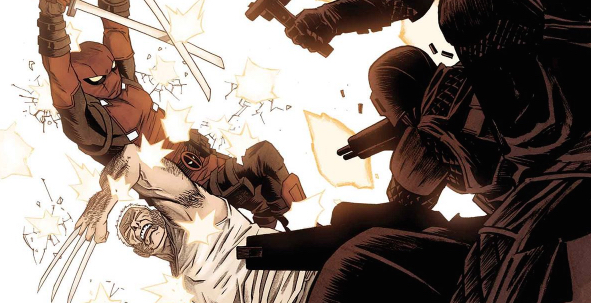
Omega level mutants — always a problem, right? They have such power, but so little control over it. What’s a government to do? Let the ticking time bomb walk around free? Hook them up with a mutant training academy? Or maybe it’s in the public interest to take ’em out. Education seems like the most humane option, but Deadpool vs. Old Man Logan 4 reminds the reader just how fucking deadly two non-Omega level mutants can be when they understand how to use their powers. Continue reading

Too Many Premises in Ice Cream Man 1

By Patrick Ehlers

This article contains SPOILERS. If you haven’t read the issue yet, proceed at your own risk!

There is an often-repeated, often misunderstood, rule of improv called “yes and.” What it boils down to is that when you’re in an scene with another person, it is your job as a performer to not deny any of the reality your partner has set up, and everything you say should add to that reality. Mechanically, it looks like this: you hear what your partner said, acknowledge and affirm it, and then add something that respects what has already been established. This is great for starting scenes, but beyond the first couple lines, the “and” half of the equation gets dangerous. That’s how you start to get President Michael Vick drilling for pirates’ gold on Jupiter. See how fast that sentence got away from me? That’s too many premises to deal with in any way that makes sense, and is totally divorced from reality. Continue reading

Inspiring Vulnerable Populations in Ms. Marvel 26

By Patrick Ehlers

This article contains SPOILERS. If you haven’t read the issue yet, proceed at your own risk!

Kamala Khan is such a good kid. She get’s these stretchy-growy-shrinky superpowers and the very first thing she does is try to protect the vulnerable people in her community. Of course, that doesn’t mean helping impoverished families navigate the SNAP program or helping people with job placement or anything like that — it means punchin’ bad dudes with her temporarily over-sized fists. It’s an inspiring thing, both to read and for the characters within Kamala’s orbit. Issue 26 continues the ‘Teenage Wasteland” story arc by showing us just how thoroughly Kamala has inspired her friends to act as nobly and selflessly as she did when faced with roughly the same threat. Continue reading

Mister Miracle 6: Discussion

by Patrick Ehlers and Drew Baumgartner

This article contains SPOILERS. If you haven’t read the issue yet, proceed at your own risk!

Patrick: I had a little bit of a rebellious streak in high school. No, no — not actually in school, but during my confirmation classes. See, I was a good kid, studied hard and had a lot of extracurricular activities, but I couldn’t help but be a smart-ass where it came to my religious education. It’s easy to recognize this as some pretty impotent angst in retrospect: I was only resisting a belief structure which relinquished control over me as soon as I decided there was no God. One of my shit-eatingest points of rebellion was my constant assertion that Jesus didn’t really pay the price of death the way we understand it. Even granting the reality wherein he was crucified and suffered horribly for a couple days, he got to come back afterward. It’s not the act of dying, but the cold state of “not living” that should be the sacrifice. I don’t want to speak for Tom King and Mitch Gerads’ respective rebellious streaks, but it seems like Mister Miracle 6 agrees with at least part of 16-year old Patrick. Risking or sacrificing one’s life is only valuable is the the life itself is something you have to do without.  Continue reading

Archie 27: Discussion

by Ryan Mogge and Patrick Ehlers

This article contains SPOILERS. If you haven’t read the issue yet, proceed at your own risk!

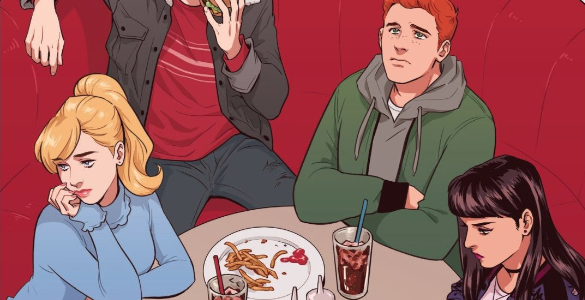
Ryan M: You can’t always get what you want. It’s a tough lesson, and one my parents tried to impart by singing Rolling Stones off-key to my brother and I throughout childhood. In relationships, defining and declaring wants is only the first step — you need agreement. Archie 27 picks up right where the last issue left off, with Betty and Archie being asked to make a romantic choice by Dilton and Veronica, respectively. Dilton and Veronica have defined their wants, but the power lies with Betty and Archie. Continue reading

Unfortunate Allies in Teenage Mutant Ninja Turtles 78

By Patrick Ehlers

This article contains SPOILERS. If you haven’t read the issue yet, proceed at your own risk!

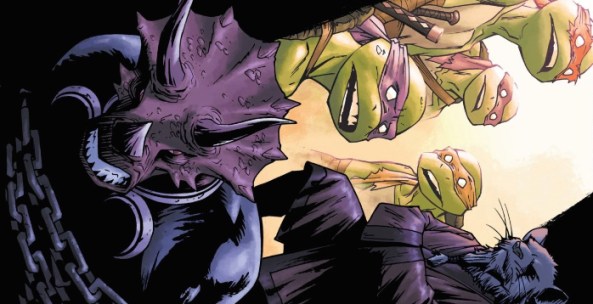
There are obvious advantages to teamwork. You could argue that that’s one of the defining qualities of the Teenage Mutant Ninja Turtles — they support each other, cover for each other’s weaknesses, and the quartet is stronger for it. But Mike, Leo, Don and Raph are brothers, and have earned the right to trust their eternal alliance through multiple lifetimes of shared experiences. Teenage Mutant Ninja Turtles 78 goes outside our main heroes to explore the possible dangers of teamwork. Continue reading

The Inelegance of Grief in Black Bolt 9

By Patrick Ehlers

This article contains SPOILERS. If you haven’t read the issue yet, proceed at your own risk!

I just finished reading Who Killed My Daughter?, fiction writer Lois Duncan’s real life account of her daughter’s murder in 1989. It’s less a narrative, and more a collection of interviews with police, transcriptions from psychic readings, re-printed newspaper articles, and half-remembered conversations with loved ones. But the book opens and closes with the saddest, richest, most beautiful and heartbreaking mediations on love, loss and acceptance I’ve ever read. The explicitly stated point of the book was to bring tipsters out of hiding, to provoke someone who knew something to come forward, but for these moments, Duncan nakedly expresses her feelings. The truth is, the mess of primarily source documents that pad WKMD‘s page count add immeasurably to the expression of Duncan’s grief, because that’s what loss is — confusion, contradiction, a mess. Saladin Ahmed and Christian Ward’s Black Bolt 9 embraces that same messiness to say farewell to Crusher Creel.  Continue reading

The Weight of Influence in Batman 38

By Patrick Ehlers

This article contains SPOILERS. If you haven’t read the issue yet, proceed at your own risk!

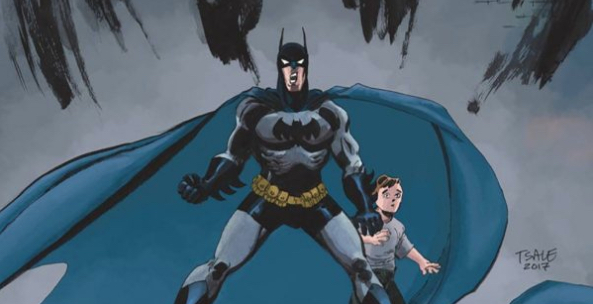
About halfway through Batman 38, Batman discovers a clue that leads him to Dennis O’Neil Avenue. Longtime Batman fans are going to recognize that name, but even relative neophytes are gong to pause at the specificity of that name. Outside of some of the biggest names of the last century — Martin Luther King Jr or John F Kennedy — you’re going to be hard pressed to find a figure who’s full name is up on a street sign. Hell, Chicagoans love Casimir Pulaski, but the north-south thoroughfare that bares his name is simply called “Pulaski Road.” (Though, hilariously, there’s also a brown placard below the street sign designating it “Honorary Casimir Pulaski Road.” It’s a weird town.) But writer Tom King’s use of O’Neil’s full name makes the creators influence on this issue explicit, just as the story itself leans in to one of O’Neil’s pet themes: the psychology of Batman. Continue reading

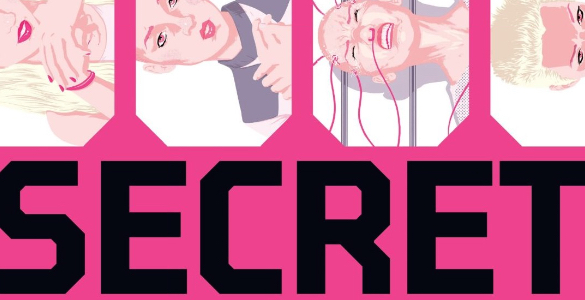
Secret Weapons 0: Discussion

by Patrick Ehlers and Spencer Irwin

This article contains SPOILERS. If you haven’t read the issue yet, proceed at your own risk!

slim-banner

Patrick: Discovering oneself is an inherently lonely pursuit. In high school, I was discovering my own sexuality, and had left my then-girlfriend to pursue a relationship with this dude from my theatre class. I didn’t know what I was doing, and I ending up nuking that relationship as well, effectively alienating everyone from all social groups I could have ever claimed to be a part of. Looking back on the events, I was surrounded by people who cared deeply about me, but I couldn’t really see them at the time. I saw me, and only me. This was a time that should have been social and should have been about finding my place in a much more interesting world. But that was so hard to see from the perspective of a 17 year old kid who couldn’t stop wrestling with the question “am I gay?” Secret Weapons 0 presents the intense loneliness of self-discovery as an origin story unlike any I’ve ever read. Nikki finds the answers to so many personal questions, but ends up losing just about everything outside of herself. Continue reading