WTF is Happening in Deadman 1?

by Patrick Ehlers

This article contains SPOILERS. If you haven’t read the issue yet, proceed at your own risk!

While the concept of a ghost investigating its own murder is pretty straightforward, there’s something of an incongruous cognitive leap we need to make to buy into it. Specifically, if there’s a consciousness around to investigate its own murder, is that person really dead? It’s a circular logic question, and one that ultimately isn’t super fruitful — either we buy in to the premise of the story or we don’t. But that tension still hangs over the proceedings in Deadman 1, and creator Neal Adams leans into that emotional confusion hard, breaking down every page and every story beat into a whirling WTF mess of plot twists and body swaps. Continue reading
Paper Girls 17: Discussion

by Drew Baumgartner & Patrick Ehlers

Paper Girls 17

This article contains SPOILERS. If you haven’t read the issue yet, proceed at your own risk!

slim-banner

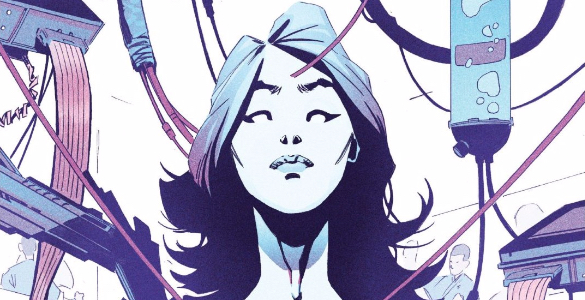
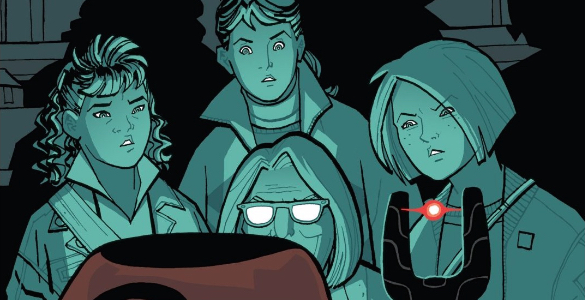
Drew: Brian K. Vaughan series are hard to pin down, generically. I mean, they obviously fall into big capital-G genres like “sci-fi” or “space opera,” but the list of specific influences — which Vaughan often name-checks — can shift from issue to issue. Case in point, Paper Girls has sprinted through dozens of generic touchstones in its 17 issues. And yet, I’ve been holding onto its starting point in the Spielberg/Columbus-style suburbia of the late ’80s as some kind of essential component of its DNA, even as the series hasn’t been in that setting since its very first arc. While some of the girls may still be in that head-space (Mac sure seems to be), they’re traversing worlds that have entirely different points of reference (both for the people who live in those worlds, and the stories we tell about them), which seems to be leaving an impression on them. Continue reading

Glitterbomb – The Fame Game 2: Discussion

by Patrick Ehlers & Drew Baumgartner

This article contains SPOILERS. If you haven’t read the issue yet, proceed at your own risk!

slim-banner

Patrick: What are we doing here? I mean, here, reading (or in my case, writing) a piece critical of a work of art? The art itself, issue two of Glitterbomb The Fame Game, is an exploration of emotional voyeurism, and is openly critical of the people profiting off the vulnerability of others. The risk associated with saying anything about this issue is always going to pale in comparison to the risk the creators take in actually expressing the story therein. Writer Jim Zub and artists Djibril Morissette-Phan and K. Michael Russell lay their own fears of fame out on the page in naked, sometimes groaningly obvious, ways. I can point this out and say “look how obvious this is”, but this is always going to be a weaker product than the story that actually says something. Continue reading

Absurdist Alternate History Finds Its Way to the Present in Fu Jitsu 2

by Patrick Ehlers

This article contains SPOILERS. If you haven’t read the issue yet, proceed at your own risk!

Drew made a case for the first issue of Fu Jitsu being the height of absurdity. He wasn’t wrong: Fu, and his attendant mythology are an unwieldy mess of ancient Chinese mysticism, Biblical appropriation, and nuclear-fueled alternate history. Fu’s connection to the “present day” was largely superficial — he enjoys football and Whataburger. But issue 2 rams the historical absurdism into modern — even future — absurdism, trading in some of the least-likely real-life threats from 2017 and beyond.  Continue reading

Clarity in the Mystery of All-New Wolverine 26

by Patrick Ehlers

This article containers SPOILERS. If you haven’t read the issue yet, proceed at your own risk.

There are a couple mysteries at the heart of All-New Wolverine 26. What happened to Laura’s mother? What is currently happening to Daken? Those are kind of soft mysteries, where the reader can make some easy assumptions and figure out at least some version of the events. Daken is being experimented on the the mysterious Orphans of X? Yeah, okay, there’s probably a specific reason for that, but the mystery isn’t going to keep me up at night. Where writer Tom Taylor and artist Juan Cabal pull the rug out from under us is in questioning the realty of Daken’s experience all together. Continue reading

Purity of Tone in Batman 33

by Patrick Ehlers

Batman 33

This article contains SPOILERS. If you haven’t read the issue yet, proceed at your own risk!

Catwoman: He’s right, you know. There are rules.

Batman: I know. I wrote them.

Batman 33

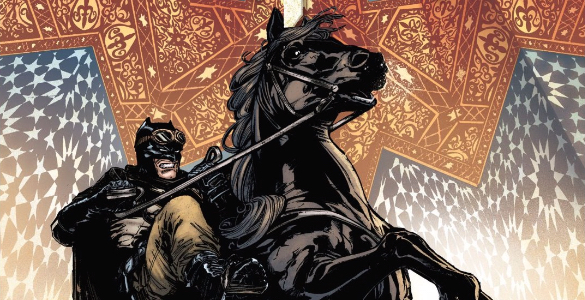
Of course Batman wrote the rules; he’s Batman. But the infallible detective isn’t nearly so authoratative as the creators that have used Batman to repeatedly define both genres and mediums. Is there a better demonstration of superhero camp than Batman ‘66? Is there a purer gritty reboot than Batman: Year One? Within the stories, Batman may be writing the rules of non-interference in Khadym, but from the reader’s perspective, he’s demonstrating writer Tom King’s realignment of Batman’s tone. Continue reading

Discussion: Mighty Thor 700

by Taylor Anderson and Patrick Ehlers

This article contains SPOILERS. If you haven’t read the issue yet, proceed at your own risk!

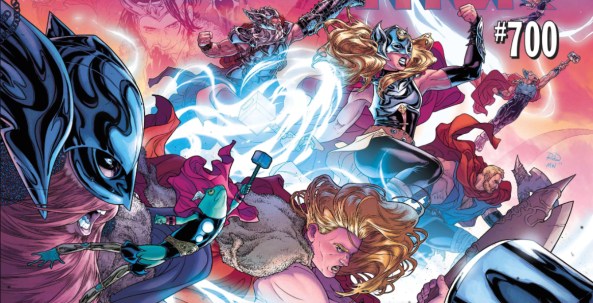
Taylor: Midway through the extra large, special 700th issue of Mighty Thor, Karnilla, Queen of the Norns, asks which ingredient is the most essential in the makeup of a Thor. It’s a good question, and one that writer Jason Aaron has been exploring ever since he took over the reigns of Thor some 60 issues ago. While Aaron has posed various answers to this question multiple times, he’s never come outright and revealed to readers what exactly makes a Thor Thor. That is, he’s never done that until now. Using the 700th issue as his podium, Aaron waxes poetic on the nature of Thor, presenting us with not so much a new Thor narrative, but a grand tapestry that relishes in pondering what Thor has been, currently is, and what it will always be. Continue reading

Teenage Mutant Ninja Turtles Universe 15: Discussion

By Drew Baumgartner and Patrick Ehlers

Teenage Mutant Ninja Turtles Universe 15

This article contains SPOILERS. If you haven’t read the issue yet, proceed at your own risk!

Drew: The Teenage Mutant Ninja Turtles have always been the perfect outcasts in a medium made for outcasts. Well, saying that comics were “made” for outcasts isn’t entirely accurate, but it certainly had become a medium for outcasts — at least in the US — by the time the turtles were invented in the 1980s. We don’t really need to get into the causality of why comics fandom was perceived as a weird thing — the point is that it was. And in the age before the internet, someone with a “weird” hobby or enthusiasm for some obscure piece of pop culture might not know anyone else like themselves. While the rest of the world could connect over their religion, political party, or even local sports team, the average comics reader in 1984 might not have had anyone they knew who shared their interest. I don’t bring this up to pity the lot of the poor comics fan — heaven knows plenty of people were more isolated and actively persecuted — just to say that themes of not fitting in have always been an essential part of the TMNT makeup. This is a point that Erik Burnham and Sophie Campbell clearly understand, as their Teenage Mutant Ninja Turtles Universe finds several characters seeking their place in the world. Continue reading

Rhetoric Paints the Picture in Rocket 6

by Patrick Ehlers

This article contains SPOILERS. If you haven’t read the issue yet, proceed at your own risk!

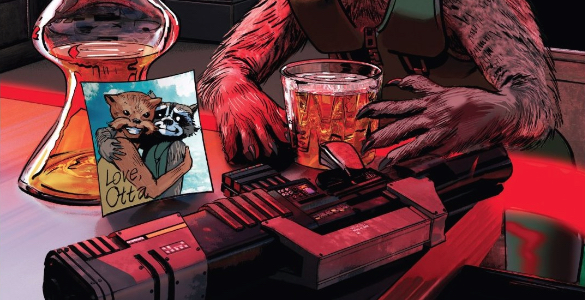
Rocket is an amazing series. Adam Gorham’s artwork is evocative, gritty and ambitious in a way that is simultaneously grounded and totally off the wall. There’s also the novelty of the persistent gutter narration, lending the whole thing a literary noire vibe that seldom makes its way into such a strongly visual medium. One aspect of this series I’ve seldom found an opportunity to praise is the rhetorical strength of Al Ewing’s writing. The story itself is compelling, but I’m referring to the moment-to-moment use of language and how Ewing uses tonal shifts, word play, and rhetorical flourishes to illustrate Rocket’s emotional journey. And this issue takes us on one hell of a journey. Continue reading

Gwenpool Trades Genre for Medium in Gwenpool 21

by Patrick Ehlers

This article contains SPOILERS. If you haven’t read the issue yet, proceed at your own risk!

This may be the first time in my life where I’m reading a superhero who is as obsessed with the gutter as I am. Since discovering that she can manipulate the physical space of the comic book page, Gwen no longer needs to rely on her knowledge of story tropes to defeat her enemies. Gwen is on something of a fan’s journey here, discovering that her real power (read: her real fandom) lies not in the genre but in the medium. Gwen’s no longer a fan of superhero stories, but a fan of of comics. Continue reading