Batman 32: Discussion

by Drew Baumgartner and Michael DeLaney
Batman 32

This article contains SPOILERS. If you haven’t read the issue yet, proceed at your own risk!

I don’t know.

Teenager, Traditional

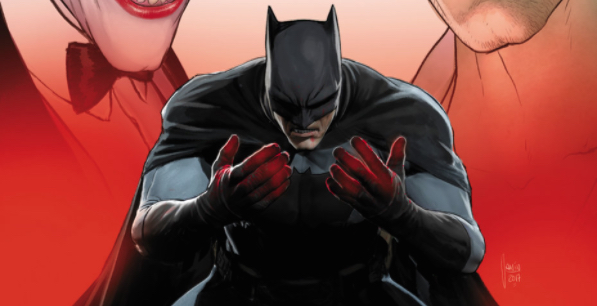
Drew: I used to work as an Assistant Dean for an academic enrichment program — basically, high-school students would come to a college campus for a few weeks over the summer to take some classes and get a feel for dorm living. The Dean’s office was there to keep kids out of trouble, or, more accurately, to address the trouble that the kids inevitably got into. Most of the time, the motives for their infractions were clear enough — they skipped class because it was boring or they tried to sneak into the girl’s dorm to see their girlfriend — but every so often, a kid would do something so inexplicable, the first question had to be “why?” And the answer, invariably, was “I don’t know.” Sometimes, our better judgement eludes us, allowing weird impulses or emotions to lead us to actions we can neither explain nor defend. It’s a phenomenon that teens are particularly prone to, with their hormonally-charged emotions and only-partially-developed impulse control, but it happens to adults, too (even sober ones). It is one of these moments that turns out to be Bruce Wayne’s “greatest sin,” as the climax of “The War of Jokes and Riddles” leads him to a rare flash of moral weakness. Continue reading

Worlds Collide and Teams Clash in Avengers 672

by Spencer Irwin

This article will contain SPOILERS. If you haven’t read the issue yet, proceed at your own risk!

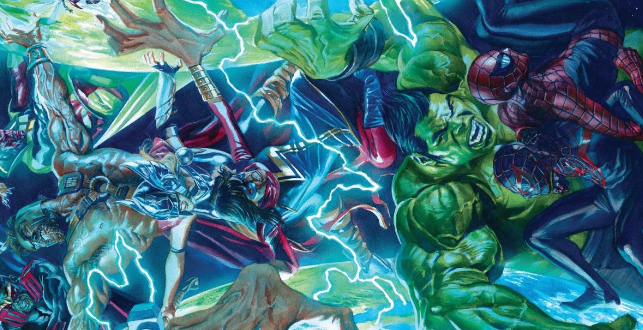
Avengers 672 opens with both the Avengers and the Champions having the same fight in two different places. A new satellite is about to reveal images either confirming or denying proof of the High Evolutionary’s Counter Earth, a planet sharing our orbit on the far side of the sun. Nova and Peter Parker have both been to the planet, but Amadeus and Wasp insist that it cannot exist because it would defy all laws of physics and throw off the balance of the entire solar system. Mark Waid and Jesus Saiz use this scenario — of two planets that cannot share the same orbit without causing destruction — to illustrate the problem facing both of these teams: they can’t be in the same place without tearing each other down. Continue reading

Jessica and Simon Regroup in Green Lanterns 32

by Drew Baumgartner

Green Lanterns 32

This article contains SPOILERS. If you haven’t read the issue yet, proceed at your own risk!

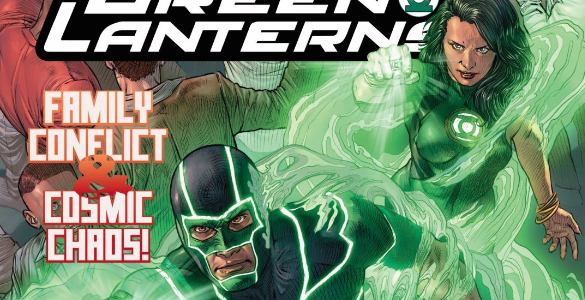
When talking about serialized narratives, we’ll often talk about how certain installments “put the pieces in place” — that is, it was saddled with setting up the next installment (often to its own detriment). But superhero comics represent a peculiar type of serialized narrative, one where “putting the pieces in place” often means putting things back where they belong. However far afield you may take Bruce Wayne, he’s always going to return to Gotham, return to his allies, return to fighting crime as Batman. These kinds of periodic resets are partially a vestige of a time when superhero stories were much more episodic than today but they also offer a straightforward way to keep the characters going into perpetuity. Often, that kind of reset is reserved for the very end of an arc, giving us just enough of the hero’s old status quo to restore some sense of normalcy. Occasionally, though, we’ll get a story like Green Lanterns 32, which takes time to remind us who our heroes are when they’re not busy dealing with a crisis. Continue reading

A Missed Opportunity in Hal Jordan and the Green Lantern Corps 29

by Mark Mitchell

This article contains SPOILERS. If you haven’t read the issue yet, proceed at your own risk!

Robert Venditti and Rafa Sandoval have been weaving a story about fathers and sons during the “Fall of the Gods” arc, and while they still deliver an issue with the interesting character moments, deft balancing of Lantern personalities, and exciting action they have become known for, the narrative threads fail to fully come together in Hal Jordan and the Green Lantern Corps 29. Continue reading

The Power of Humanity in The Mighty Thor 23

by Spencer Irwin

This article contains SPOILERS! If you haven’t read the issue, proceed at your own risk.

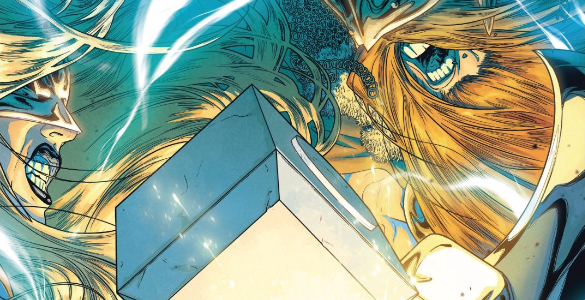
Late in The Mighty Thor 23, as Thor and the War Thor clash over the fate of Svartalfheim, Thor yells that they “have to behave like gods!” I have to wonder what gods she’s been hanging around to make that statement, because almost all of the gods Jason Aaron has presented us throughout his Thor epic have been reckless and arrogant at best, and downright sociopathic at worst. Throughout this issue, Aaron and artist Valerio Schiti seem to be arguing that godhood is more of a weakness than a strength.  Continue reading

The Weight of Memories in Saga 47

by Ryan Mogge

This article contains SPOILERS. If you haven’t read the issue yet, proceed at your own risk!

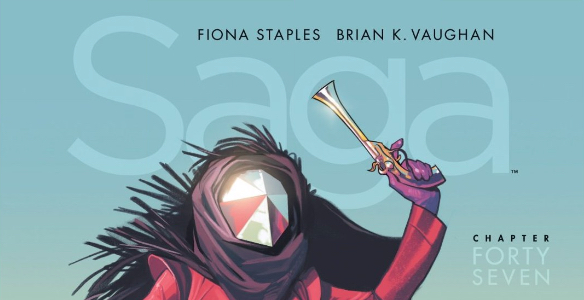
We all experience millions of moments. Some are life-changing, some represent a larger theme in our lives, and some don’t seem to mean much of anything. If you could choose three of these moments to tell your story, it would be hard not to stick to the benchmarks: births, deaths, weddings, etc. In Saga 47, Brian K. Vaughan and Fiona Staples give us a few glimpses into The Will’s past and, by the nature of storytelling, we know that these are not random, but their selection tells a story of its own.
Continue reading

Murder by Proxy in Batgirl 15

By Michael DeLaney

This article contains SPOILERS. If you haven’t read the issue yet, proceed at your own risk!

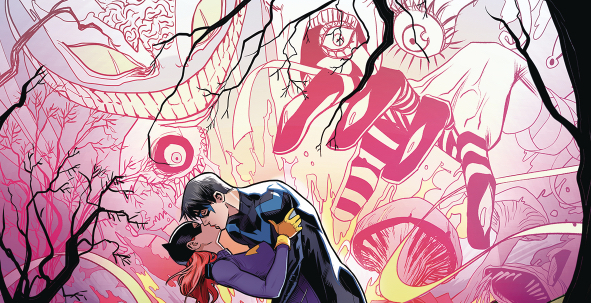
Villains tend to die by some one in ten chance coincidence of their own making – like Green Goblin getting impaled on his own glider. Similarly, storytellers jump through some creative hoops in order for our heroes to feel some respect of responsibility for their enemy’s end. Which is what Hope Larson does in Batgirl 15, as Nightwing vaporizes a woman’s body to dust via proxy. Continue reading

Introducing the Implied “Rock” in The Hard Place 2

By Drew Baumgartner

The Hard Place 2

This article contains SPOILERS. If you haven’t read the issue yet, proceed at your own risk!

The Hard Place is like a nested doll of hooks. “Former gangbanger tries to stay clean after prison” is a fine premise, but Doug Wagner and Nic Rummel pushed that a step further in their first issue, asking what happens when that gangbanger is forced back into the game at gunpoint. Issue 2 cleverly twists the knife further, making AJ’s co-hostage the daughter of his psychopathically violent boss, such that the presumption that AJ is complicit in the robbery doesn’t just pit him against the cops, but the entire criminal underworld. Continue reading

Objections to the Drama in Teenage Mutant Ninja Turtles 74

by Taylor Anderson

This article contains SPOILERS. If you haven’t read the issue yet, proceed at your own risk!

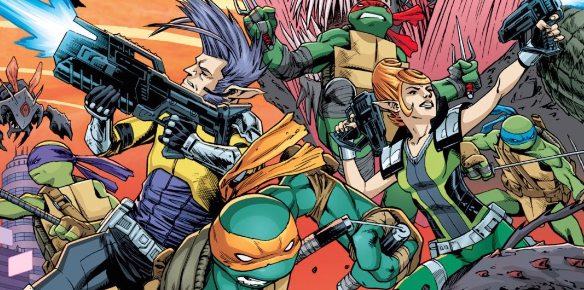
There’s a reason courtroom scenes are commonplace in stories these days. With a plaintiff’s life sometimes literally on the line, stakes are high and the margin for error is low. Additionally, in a lot of fictionalized courtroom stories, shocking truths are exposed and justice is served (or terribly undermined). Thus it comes as no surprise that the “Trail of Krang” is being labeled as the trial of the century, but does it actually pack the drama that we expect from a courtroom scene? Continue reading

Generations Sam Wilson Captain America & Steve Rogers Captain America 1: Discussion

by Patrick Ehlers and Ryan Mogge

This article contains SPOILERS. If you haven’t read the issue yet, proceed at your own risk!

slim-banner

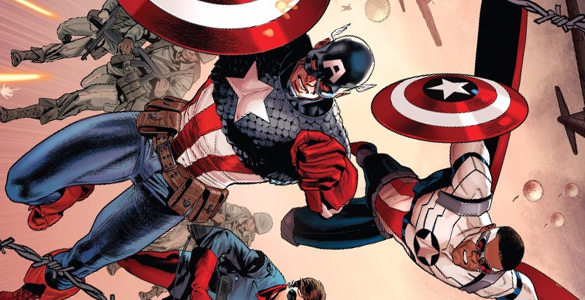
Patrick: One of the harsher truths of Secret Empire is that America was always run on an engine of hatred and fear. Racism, sexism, classism, fascism — neither Hydra Cap nor Donald Trump invented these things. They didn’t even popularize or legitimize them, they’re simply high profile embodiments thereof. It is increasingly easy to read the totality of American history as ugly and hateful, filled with crass opportunists, liars, and mass murderers. That can make the USA a hard hero to root for. With Generations Sam Wilson Captain America & Steve Rogers Captain America 1, writer Nick Spencer goes back in time, giving both Sam Wilson and his readers a lifetime to reconsider the value in fighting for what may, at times, appear to be a lost cause. Continue reading