Multiple Multiple Men in Multiple Man 1

by Drew Baumgartner

Multiple Man 1

This article contains SPOILERS. If you haven’t read the issue yet, proceed at your own risk!

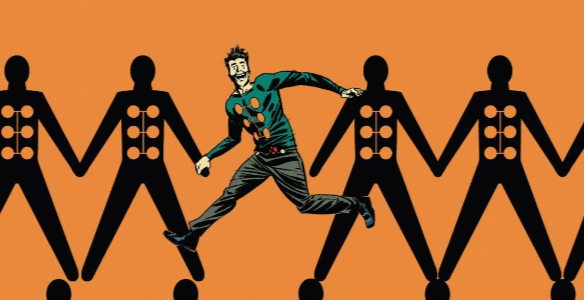
The X-Men represent a particularly confusing corner of the Marvel Universe. It would be hard enough to keep the ever-growing list of characters straight even without all of the time travel, shape-shifting, and body-doubling shenanigans. I suppose mileage varies depending on how familiar one is with all of those characters and timelines, but for me, the most readable X-Men stories tend to strip things down: a few characters, a specific problem, and clearly defined parameters that limit the solutions. Unfortunately, Multiple Man 1 doesn’t do a great job of laying out any of those components. Continue reading

Saga 53: Discussion

by Spencer Irwin and Taylor Anderson

This article containers SPOILERS. If you have not read the issue yet, proceed at your own risk!

Spencer: In recent months our Saga coverage has focused quite a bit on how Fiona Staples and Brian K. Vaughan have been taking their time, luxuriating in a slower pace and revealing more and more about their characters as they move pieces into place, setting up for a no doubt explosive finale. That said, no matter how much build up they have, grand confrontations don’t work the same way in Saga as they do in many other similar pieces of media; there’s no monologue-and-metaphor-filled matches of will, no intricately choreographed fight scenes, no thirty episode long battles as Namek slowly burns in the background. Instead, Saga’s finales reflect real life violence. They’re quick, brutal, often random, and care very little about the events that have led up to them or who’s right or wrong.  Continue reading

Doctor Aphra 21 Highlights The User and The Used

by Michael DeLaney

This article contains SPOILERS. If you haven’t read the issue yet, proceed at your own risk!

slim-banner

I have been constantly struggling with my feelings in regards to the titular Doctor Aphra. Under writer Simon Spurrier, Aphra has become a more Deadpoolian character than she might have been before: riding the line between amusing and despicable. Dastardly villain or loveable rogue? Still uncertain. However Star Wars: Doctor Aphra 21 makes one thing clear: Aphra will do anything to survive. Continue reading

Babs Can Afford to Trust in Batgirl 24

By Drew Baumgartner

Batgirl 24

This article contains SPOILERS. If you haven’t read the issue yet, proceed at your own risk!

Quick, what distinguishes Batgirl from Batman? The specifics may have changed over time, but one of the key components of her current incarnation is that she’s a bit more street level, tackling cases that impact her local community as opposed to ones that threaten the entire city, country, world, or fabric of reality as we know it. Her relationship to commissioner Gordon is also more fraught, as her closeness with him in civilian life complicates her interactions with him in her costumed life. And then there’s her compassion. Batman can be a bit flexible on this front — in some stories, he goes out of his way to help would-be criminals make smarter choices, in others, he goes out of his way to break as many of their bones as possible — but Batgirl almost invariably leads with empathy. It’s an approach that can occasionally blow up in her face, as it does in issue 24, but never so much that she can’t course-correct. Continue reading

Eddie Learns He Knows Nothing in Venom 3

by Patrick Ehlers

This article contains SPOILERS. If you haven’t read the issue yet, proceed at your own risk!

slim-banner

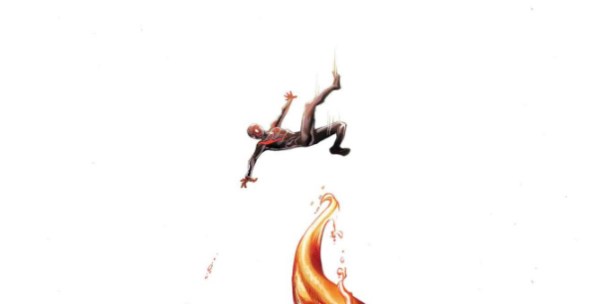
I played a lot of Magic: The Gathering in middle school. I woke up thinking about it, I fell asleep thinking about it, I viewed everything through the lens of Magic. Friends were people I played Magic with, and school was just something I had to do before I could play again. I was in love: for almost three years, that game completed me. In 1995, my friends and I went to Gen Con in Chicago, a massive hobby-store convention, which mostly meant Magic and Warhammer. That’s when I realized just how miniscule my obsession actually was. I wasn’t a Magic expert, I was a kid with a hobby in a convention center full of adults who had been living this nerdiness since before I was even born. Magic opened me up to a love of gaming and fantasy, but for these folks, it was the culmination of their lifestyle. Issue 3 of Donny Cates and Ryan Stegman’s Venom gives Eddie Brock his very own Gen Con ’95 moment as he comes face to face with the god of the symbiotes. Continue reading

Batman 49 is the Anti-“The Killing Joke”

by Patrick Ehlers

This article contains SPOILERS. If you haven’t read the issue yet, proceed at your own risk!

slim-banner

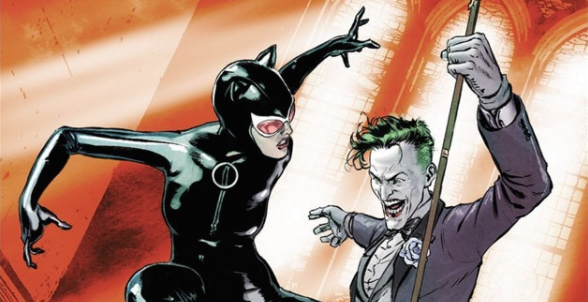
Tom King and Mikel Janin’s Batman 49 gives Catwoman and Joker an opportunity to discuss the role humor plays in both their lives and the greater Batman franchise. Joker’s goal in all of this is to get a laugh out of Selina, and by the end of the issue, she obliges him with a joke of her own and a chuckle. Sounds like Killing Joke, right? Here’s the thing – King gets us there by trading in connection, nostalgia and shared history, where Alan Moore and Brian Bolland got there by trading in misery. The result is an inversion on the classic story, and an update on the storytelling values in Batman and in comics in general. Continue reading

James Bond The Body 6: Discussion

by Drew Baumgartner & Mark Mitchell
James Bond The Body 6

This article contains SPOILERS. If you haven’t read the issue yet, proceed at your own risk!

slim-banner

You are driving a bus with 12 passengers on it. At the first stop, half of the passengers get off and nine more get on. At the second stop, a third of the passengers get off and two more get on. At the third stop, one quarter of the passengers get off and seven more get on. What color are the bus driver’s eyes?

Traditional

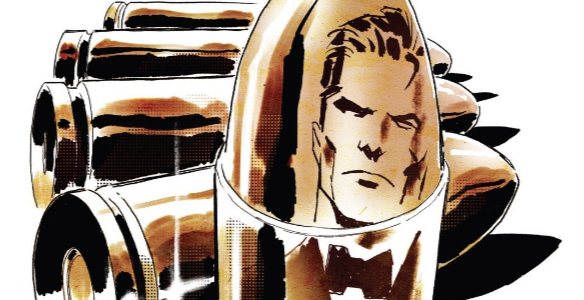
Drew: Misdirection is a simple consequence of our limited attention. We can only focus on so many details at once, so if we’re misled about which of those details are important, we can easily miss what’s actually important. This old brain teaser illustrates the point perfectly, introducing the fact that we are driving the bus as an inconsequential detail before distracting us with a bunch of numerical information that seems like it is probably the point of the puzzle. Only, the solution to the puzzle requires that we divided our focus in the opposite way, remembering the one detail that seemed irrelevant to what we assumed was a math problem. James Bond: The Body 6 does something similar, laying out a detailed explanation of the case Bond spent the previous five issues skirting the edges of while the actual action plays out in the background. It’s a clever trick, disguising action as exposition, allowing Aleš Kot and Luca Casalanguida to play out their final reveal and villain showdown simultaneously, skipping the falling action right to the moment Bond can reflect on his role in everything. Continue reading

Genuine Jump Scares in Infidel 4

by Drew Baumgartner

Infidel 4

This article contains SPOILERS. If you haven’t read the issue yet, proceed at your own risk!

slim-banner

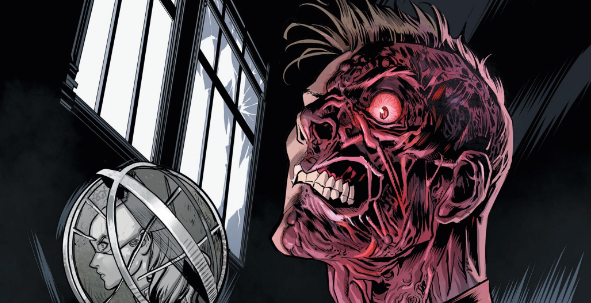
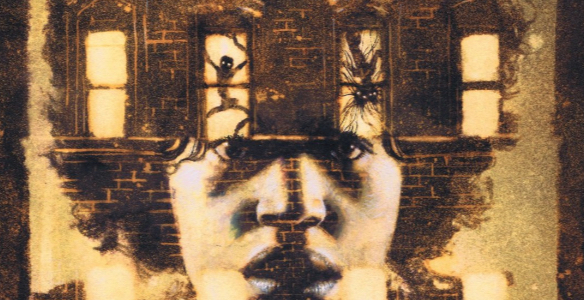
I’m so enamored of Infidel‘s social commentary, it’s easy to neglect just how skillful of a haunted house story it is. And I say that as someone who isn’t into horror generally or horror comics, specifically. I’m sure the social commentary elements help make the ghouls of this series feel so insidious, but this series manages to be scary far beyond its concepts. That is, the effectiveness of the horror relies on the skills of writer Pornsak Pichetshote and artist Aaron Campbell, and issue 4 perfectly demonstrates how they deliver scares in totally unexpected ways. Continue reading

Impossible Decisions at Impossible Ages in Runaways 10

By Spencer Irwin

This article contains SPOILERS. If you haven’t read the issue yet, proceed at your own risk!

Teacher: Daria, what about your goal?
Daria: Uhmmm, I don’t have any.
Teacher: Oh come, Daria! You must have some goal.
Daria: My goal is not to wake up at forty with the bitter realization that I’ve wasted my life in a job I hate, because I was forced to decide on a career in my teens.

Daria, Gifted

Society asks a lot of teenagers, especially when it comes to big decisions. These same children who aren’t allowed to drink, vote, or often even have a say in how they present themselves to the world are expected to commit to a career path, often burying themselves in debt to do it; it’s a daunting decision for anyone, but especially for young people who aren’t quite sure who they really are and what they want out of life yet. None of the young heroes (or “villains”) of Runaways 10 are contemplating college at the moment, but they’re nonetheless faced with similarly difficult, life-altering decisions that they simply just aren’t ready, or even qualified, to make yet. Continue reading

The Poetry of Days of Hate 6

by Drew Baumgartner

Days of Hate 6

This article contains SPOILERS. If you haven’t read the issue yet, proceed at your own risk!

en·jamb·ment
/inˈjambmənt, enˈjam(b)mənt/
noun

  1. (in verse) the continuation of a sentence without a pause beyond the end of a line, couplet, or stanza.

Comics has its share of unique jargon, but much of the vocabulary we use when analyzing it is borrowed. More often than not, we’re borrowing language from the world of film and photography, where we might understand issues of the relative location and sizes of images within the panel as matters of placing a camera in a physical space. We’ll also draw parallels to prose, as the language — and especially narrative modes — of comics can often resemble that of a novel. But prose isn’t the only literary media, and while it’s lamentably rare, comics can draw from the world of poetry, as well. Aleš Kot and Danijel Žeželj’s Days of Hate has always lent itself to elegant turns of phrase, but canny use of the decidedly poetic device of enjambment turns issue 6 into a goddamn love poem. Continue reading