The Amazing Spider-Man 3

amazing spider-man 3Today, Patrick and Drew are discussing The Amazing Spider-Man 3, originally released June 25th, 2014.

Patrick: If you go back and read our discussions on Superior Spider-Manyou’ll notice that one thing keeps popping up over and over again: what it means to be a hero. The concept of Otto’s identity, and how it melded with the concept of Spider-Man, was something that we brought up on a bi-monthly basis. I mean, if you look at our very first discussion of the series, Drew starts with the line “What does it mean to be good?” Writer Dan Slott was so good at putting Otto in situations that challenged both his heroism and his villainy, and it changed who Spider-Man is and how Spider-Man operates. With Peter Parker back in the driver’s seat, it’s becoming clear that some of those changes don’t wash away with a quick mind re-swap. Issue 3 finds Spider-Man — and everyone else — dealing with this latest discrepancy, and not everyone’s so happy with the restored status quo. Continue reading

Superman 32

Alternating Currents: Superman 32, Drew and ScottToday, Drew and Scott are discussing Superman 32, originally released June 25th, 2014.

Drew: When I was five years old, I told my then four-year-old cousin that he was adopted. Nobody had told me that he was, and certainly nobody told me that I wasn’t supposed to tell him, but he was immediately distraught, running to his mother to assure him I was lying. A young kid’s relationship to his parents is his whole world, and the thought that there might be something unusual about it is understandably upsetting. Totally unintentionally, I put my aunt in an incredibly awkward position, forcing her to confront a truth outside of her terms, when her son was already distressed by the idea. Complicating the issue was that his brother is not adopted, which only creates more potential for feelings of alienation. Superman has long been the poster child for adoption, but what if his adopted home had its own “last son” that seemed to be every bit as “super” as he is? Might Clark grow a chip on his shoulder about being “the adopted one”? These are exactly the questions Geoff Johns and John Romita Jr. set up in Superman 32, stopping just shy of showing us the answers. Continue reading

The Private Eye 7

private eye 7

Today, Patrick and (guest writer) Richie Root are discussing The Private Eye 7, originally released June 20th, 2014.

Patrick: If there’s one thing all high concept stories suffer from, it’s a strained Third Act. So much of our fun up to that point has revolved around realizing a unique, compelling world. When it comes right down to executing on all of the promises laid out in the previous chapters, thematic beats have to take a backseat to action beats. Even when a sci-fi story finds a way to make that final moment a clever twist that asks questions which reinforce the central theme (like in Looper or The Matrix or Blade Runner), the meat of the Third Act is frequently less about the important ideas in action and just settles on being “in action.” When that action is executed with the grace and style of Private Eye‘s creative team, well, maybe that ain’t such a bad thing. Continue reading

Thunderbolts 27

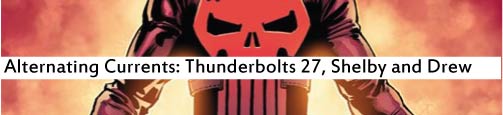
thunderbolts 27Today, Shelby and Drew are discussing Thunderbolts 26, originally released May 28th, 2014.

Shelby: It’s really hard to write about a new creative team on a title; how do you manage to discuss the book as a stand-alone piece without comparing it to the previous issues? It’s even harder when you liked the title before the change, because now you have to make sure you stay objective. If there are things I dislike about the new team, is it because I genuinely dislike it, or is it just because it’s different from how it used to be? I’m faced with this dilemma now as I consider the first issue of Thunderbolts without Charles Soule at the helm, and some of the decisions Ben Acker and Ben Blacker have made with this book definitely have me scratching my head.

Continue reading

Fables 141

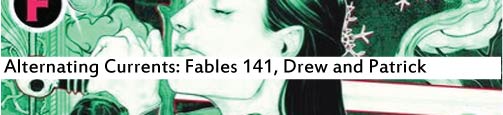
Alternating Currents: Fables 141, Drew and PatrickToday, Drew and Patrick are discussing Fables 141, originally released June 18th, 2014.

Drew: Long before I ever read a page of Fables, I remember thinking that populating a story with only folktale characters would be incredibly limiting. I had dismissed it as a total gimmick, doomed to occupy a very closed-off little world. Turns out, this couldn’t have been further from the truth. Indeed, the massive world-building that Bill Willingham seems to toss off in every single issue has quickly become my favorite aspect of the series. Every detail can support its own myth, creating a nested, telescoping world that seems virtually infinite. Those myths-within-myths can lend even the more mundane “putting the pieces in place” issues a great deal of action — though with Willingham crafting the dialogue, even the talking heads sequences in this issue are thrilling. Continue reading

Batman Eternal 11

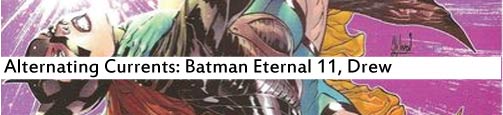
batman eternal 11Today, Drew leads a discussion on Batman Eternal 11, originally released June 18th, 2014.

Drew: Happy belated Fathers’ Day, everyone! I know I’m close to a week late, but hey, it’s not like your my dad, right? Okay, I may have missed the moment there, but Batman Eternal 11 actually hits a bit closer to the mark, landing only four days after the actual holiday. Still seem a little late? Consider how non-topical other comics tend to be. It makes sense; a six-issue arc may span a matter of days of narrative time, but would cover six months in real time — how do you sync that up to fixed holidays? It’s still done from time to time, but it’s usually relegated to one-off anthologies, or even commemorating events a few months after the fact. There are a few notable exceptions, which manage the feat largely by synching their narrative rate to their release schedule, like The Long Halloween or 52, two series to which Batman Eternal obviously owes a great debt. The weekly format truly gives the writers an opportunity to line events up on the calendar, giving us just a bit more to relate to in the pages. Far from hackneyed or forced, this issue reveals one of the primary perks of such a large ensemble cast: it’s easy to find occasion-appropriate themes when so many plates are spinning at once. Continue reading

Wonder Woman 32

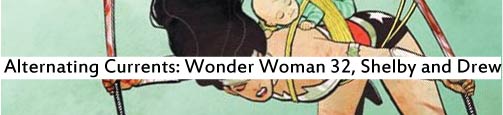
wonder woman 32Today, Shelby and Drew are discussing Wonder Woman 32, originally released June 18th, 2014.

Shelby: Often times for me, the hardest part about writing any of these posts is this very intro. I always want to find some overarching theme in the issue, or one relevant anecdote from my past to broadly introduce the issue. I used to write the intro last on a regular basis, so I could find that one theme as I was writing. I couldn’t possibly use that approach with this post, however. Brian Azzarello has given me so many individual moments to get excited about this issue, the best I can do at coming up with a unifying theme is to marvel at how beautifully the pieces fit together to create the whole.

Continue reading

Weekly Round-Up: Comics Released 6/11/14

round upLook, there are a lot of comics out there. Too many. We can never hope to have in-depth conversations about all of them. But, we sure can round up some of the more noteworthy titles we didn’t get around to from the week. Today, Drew and Patrick discuss Hulk 4, Uncanny X-Men Special 1, Shutter 3, Starlight 4, Green Lantern Corps 32, and Justice League United 2.

slim-banner4What if this is like math? Or algebra? You know, you add a plus douchebag to a minus douchebag, then you get, like, zero douchebags.

Jesse Pinkman, Breaking Bad

Drew: Comic book readers are pretty permissive when it comes to explaining away absurd nonsense. I mean, the starting point of most issues is that there’s a nearly impervious guy from a made up planet flying around Earth, or a guy who turns into the unjolly green giant every time he stubs his toe, which I think requires a pretty high tolerance. Of course, in order to give those absurd heroes a conflict that could last a whole issue, many writers have resorted to even more absurd problems, which in turn require even more absurd solutions, requiring even more absurd problems, devolving into an arms race of comic book nonsense that punishes any investment in it. Or, if you ad a plus nonsense absurdity to a minus nonsense absurdity, you aren’t left with all that much. I’ve never had a great word for this phenomenon, but going forward, I might just call it “Hulk 4.” Continue reading

She-Hulk 5

Alternating Currents: She-Hulk 5, Drew and MichaelToday, Drew and guest writer Michael are discussing She-Hulk 5, originally released June 11th, 2014. 

slim-bannerThe film went from a Japanese Saturday matinee horror flick to more of a Hitchcock, the less-you-see-the-more-you-get thriller.

Stephen Spielberg on Jaws

Drew: I don’t care about authorial intent. It seems totally logical to me — I can’t presume to know what an author’s intent was, so I don’t know why I would bother caring about it — but I often find myself confronted by people who don’t see it that way. The author clearly didn’t intend that, so why am I talking about it? In those instances, I like to point them to the production of Jaws — specifically, the way the malfunctioning Shark puppet affected Spielberg’s choices. His intent was to show the shark a bunch, but circumstances forced him to reserve those shots for key moments, relying more on suspense than jump-out-of-your-seat moments. It makes for a compelling viewing experience, but one that’s virtually unrelated to anyone’s intent. That is, an analysis focusing on the authorial intent of Jaws would dismiss a key element of the final product as if it were a flubbed line, or a member of the crew in frame, some unaccounted-for artifact of the filming process. It would be easy to similarly dismiss a guest artist as a similar artifact of comic books, a decision borne more out of necessity than of creative mojo, but that would ignore the effect those changes have on the reading experience, which — as is the case in She-Hulk 5 — can be quite profound.

Continue reading

Secret Avengers 4

secret avengers 4Today, Spencer and Drew are discussing Secret Avengers 4, originally released June 11th, 2014. 

Spencer: I’m a big proponent of comics being goofy, and due to my embracing the sillier aspects of comic books, I’ve been a big fan of Secret Avengers thus far. Still, it’s way too easy for “silly” to cross some sort of line, becoming corny or cringe-worthy or sometimes just tonally jarring. I liked last month’s issue a lot more than Drew and Shelby did, but I still have to agree with them that some of the issue’s more bizarre jokes felt out of place amongst the drama of the story itself. That’s not a problem in issue four, though. Gone are the random (if funny) throwaway gags; instead, Ales Kot and Michael Walsh embrace the inherent ridiculousness of their cast and the world they live in without ever betraying the high stakes of the mission itself. Continue reading