The Gordons Investigate Together in Batgirl 21

By Drew Baumgartner

Batgirl 21

This article contains SPOILERS. If you haven’t read the issue yet, proceed at your own risk!

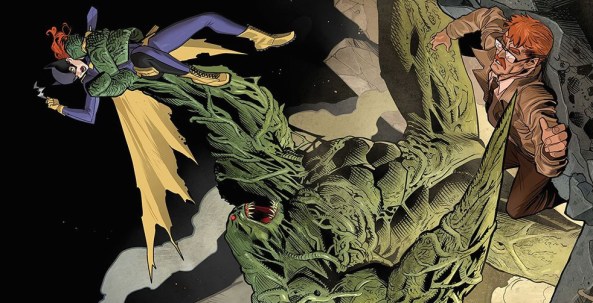
One of my favorite anecdotes (not mine), involves some confusion at an Arby’s drive-thru — a woman orders orange juice and drives away with a cup full of au jus. Of course, the entire premise of that story requires us to accept that anyone would order orange juice at an Arby’s, but I like the punchline enough to justify that minor suspension of disbelief. And that really is how I think about suspension of disbelief: if it’s justified — even retroactively — I’ll happily go along for the ride; if not, then the very odd detail of the orange juice at the Arby’s drive-thru probably shouldn’t be there. Such is the case with Batgirl 21, which finds both Babs and Jim independently investigating the same supernatural phenomenon, but never quite justifies their choices. Continue reading
Kill or be Killed 17: Discussion

By Drew Baumgartner and Ryan Desaulniers

Kill or be Killed 17

This article contains SPOILERS. If you haven’t read the issue yet, proceed at your own risk!

Don’t bury the lede.

Journalism, Traditional

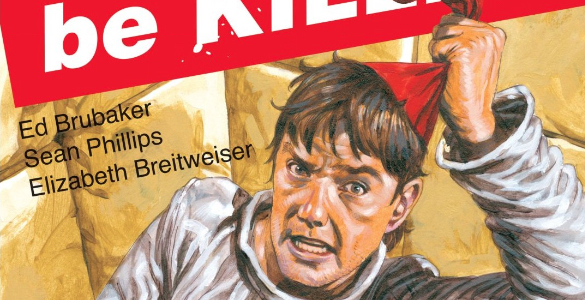
Drew: Is journalism the opposite of storytelling? Maybe these terms are too sticky to parse, but it’s interesting to me that one of the cardinal rules of journalism — putting the most dramatic part of the story at the start of the article — is essentially the opposite of the basic narrative structure, where the climax arrives very close to the end of a story. Actually, the difference may lie less in where the “climax” (for lack of a better word) occurs as where it’s allowed to occur. While narratives tend to have the climax in their final act, it is by no means as hard-and-fast a rule as “don’t bury the lede,” and precisely where the climax fits in that final act is decidedly more flexible than absolutely, positively occurring in the first paragraph. It’s a simple matter of the purposes of these art forms — the kinds of tricks storytellers use to surprise us or keep us in suspense are totally inappropriate in a newspaper article designed to inform us of what happened where. And it’s those wrinkles in form, unique to storytelling, that make Ed Brubaker and Sean Phillips’s Kill or be Killed 17 such a delight. Continue reading

Out of Sync Spider-Men in Peter Parker the Spectacular Spider-Man 302

by Taylor Anderson

This article contains SPOILERS. If you haven’t read the issue yet, proceed at your own risk!

In Back to the Future, Doc tells Marty that he can’t interact with a younger or older version of himself because it could disrupt the fabric of spacetime. In other stories, if someone sees themself from another time, it might cause things to explode. In yet other stories, characters can see their future or past selves and everything is A-OK. This is the case in the Spectacular Spider-Man 301, which means Past-Peter and Present-Peter can battle bad guys together. Sounds like a two for one special, but is this special event worth it? Continue reading

Sticking Close to the Source Material in Labyrinth Coronation 2

By Mark Mitchell

This article contains SPOILERS. If you haven’t read the issue yet, proceed at your own risk!

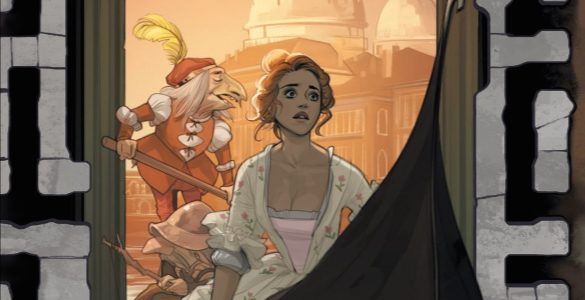
In this site’s Best Writers of 2017 list, we praised Simon Spurrier as one of the best — if not the best — world-builders in comics today. So it’s not that Labyrinth Chronicles 2 is bad or boring or otherwise deficient, it’s just that it feels like a waste of Spurrier’s considerable talents. At this point, the world of Labyrinth Chronicles is defined by the movie on which it’s based, and even though there is some opportunity for invention (The Owl King and Sir Skubbin are original creations), Spurrier seems boxed in by the creative choices of a film made over 30 years ago. Continue reading

Saga 50: Discussion

by Taylor Anderson and Ryan Mogge

This article containers SPOILERS. If you have not read the issue yet, proceed at your own risk!

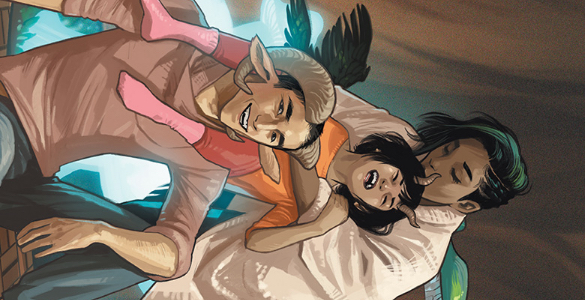
Taylor: Back in August, my wife and I packed up all of our worldly belongings and moved from Chicago to Denver. We’ve greatly enjoyed our new digs for the most part, but this doesn’t mean the transition was without its trials. I had lived in Chicago for nearly ten years, so moving to a new city meant saying goodbye to a lot of things and people I knew. I feel lucky to have undergone this momentous change with my wife, who has been a rock through it all. Point is, when you go through a big change, it’s always nice to have someone by your side, as Saga 50 illustrates. Continue reading

It’s Not Fun Being a Cassandra in Lumberjanes 48

by Taylor Anderson

This article contains SPOILERS. If you haven’t read the issue yet, proceed at your own risk!

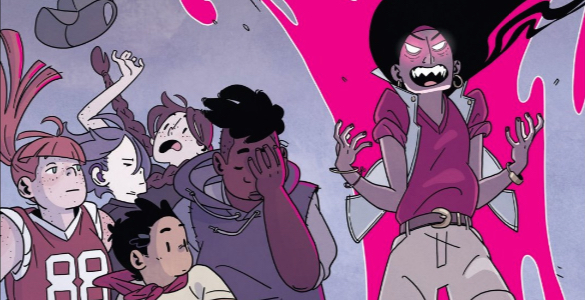
In the grand scheme of things, it’s tempting to think that any conversation that centers on horoscopes is going to be pretty innocent, right? Well, not so fast. There have been multiple occasions when, for some reason or another, I’ve found myself talking horoscopes with someone who believes they’re real while I’m convinced they’re a load of crap. If anything else, it’s the vaguery of horoscopes that gets me. If a horoscope isn’t specific in any way, then of course a person can find ways to connect it to their own life. But if horoscopes were eerily accurate, would that change my mind? Continue reading

Finding Another Way in Teenage Mutant Ninja Turtles 80

By Spencer Irwin

This article contains SPOILERS. If you haven’t read the issue yet, proceed at your own risk!

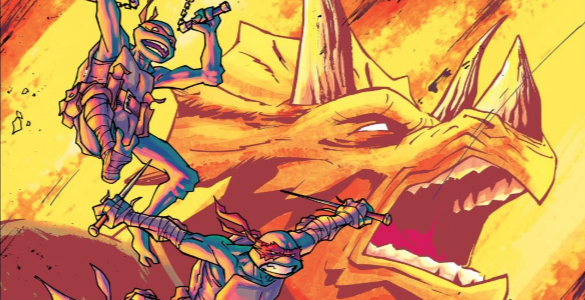
Of the many crimes The Man of Steel committed against Superman, its greatest was having him snap Zod’s neck at the end of the film. Superman is a hero who not only doesn’t kill, but who is always supposed to find another way, a better way, to deal with his problems. Forcing him into a situation where his only option is to kill not only shows a grave misunderstanding of the character, but a lack of imagination on the part of the writers. Teenage Mutant Ninja Turtles 80 places Splinter in the role of Man of Steel‘s Superman, the “hero” who believes he has no choice but to kill, but the Turtles have to believe they can find another way to deal with the Triceratons. Writers Kevin Eastman, Bobby Curnow, and Tom Waltz reveal their priorities to be in line with the Turtles’ when they unveil that better way. Continue reading

There’s Power Hidden in the Style of Black Magick 11

by Drew Baumgartner

Black Magick 11

This article contains SPOILERS. If you haven’t read the issue yet, proceed at your own risk!

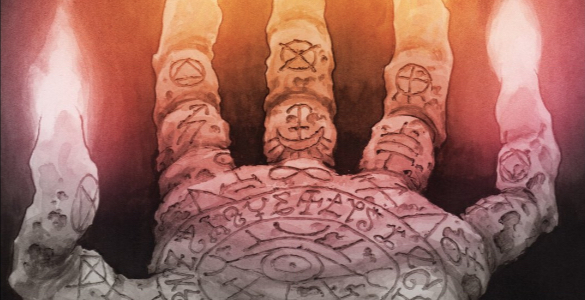
As a medium, comics are limited to two dimensions and single moments in time, but those are really the only limitations. Even so, it can be easy to forget that comics art can be anything but representational, as so many mainstream comics tend to default to some much more restrictive rules. This is particularly strange given the popularity of supernatural or superhuman powers in comics. In a medium with infinite possibilities, these powers tend to be depicted in the same ways, again and again; a hard punch (like, a really hard punch), a big explosion (like, a really big explosion, a massive spaceship (like, a really massive spaceship), etc. It takes a much more thoughtful, much more subtle hand to actually take advantage of the medium’s possibilities to represent the otherworldly, which is exactly what Nicola Scott does in Black Magick 11, cashing in some of the stylistic choices she’s made from the beginning of the series to really sell the magic at hand. Continue reading

How Camera Angles Raise Stakes in Despicable Deadpool 297

by Patrick Ehlers

This article contains SPOILERS. If you haven’t read the issue yet, proceed at your own risk!

slim-banner

Superheroes have an insane amount of mobility. Whether they’re fwipping around on spider webs, or flying through the air, or just brooding on a gargoyle on top of a skyscraper, there’s always a sense that the whole city is laid out before them. Artists can achieve this effect with dynamic camera angles, revealing the city below, and hopefully inducing a touch of vertigo in their readers. Despicable Deadpool 297 shows just how effectively Mike Hawthorne can use those same techniques to sell a change of setting and raise the stakes in Wade’s non-stop-slay-a-thon Continue reading

Dark Nights: Metal 6: Discussion

by Spencer Irwin and Mark Mitchell 

This article contains SPOILERS. If you haven’t read the issue yet, proceed at your own risk!

slim-banner

Spencer: Now that the series has come to an end, I can safely say that I have very mixed feelings about Dark Nights: Metal as a whole. So much of this event has been about embracing gonzo, bonkers, throwback action, but much of that fun is buried under attempts to overexplain every aspect of the (often impossible to follow) plot. The stakes of the event never fully sank in for me, as aside from artist Greg Capullo’s hellish landscapes, most of the nightmarish aspects of the Dark Multiverse were buried away in tie-in issues, while the main series focused on fun, but straightforward action beats. That said, there were a few areas where this series shined, and Dark Nights: Metal 6 exemplifies them all. It’s a strong metaphor for embracing hope and community over nihilism and isolation, a powerful reminder of stories’ ability to inspire, and an ode to the past (and future) of the DC Universe. Continue reading