Moonshine 9: Discussion

by Patrick Ehlers and Drew Baumgartner

This article contains SPOILERS. If you haven’t read the issue yet, proceed at your own risk!

Hence, the enlightened ruler is heedful, the good general full of caution. This is the way to keep a country at peace and an army intact.

-Sun-Tzu, The Art of War

Patrick: Risk is terrifying. It’s so often the barrier to achieving anything worth achieving. And there’s a safety, a presumption of success by default, that comes from risking nothing. Sun-Tzu preaches measured responses and caution in all action. That same caution is as big a benefit for the characters of Brian Azzarello and Eduaro Risso’s Moonshine 9. Continue reading
Don’t Trust Dead Hand 1

By Patrick Ehlers

This article contains SPOILERS. If you haven’t read the issue yet, proceed at your own risk!

Detective Kujan: Who the hell is Keyser Sösz?

Verbal: Ohhh, fuck!

The Usual Suspects

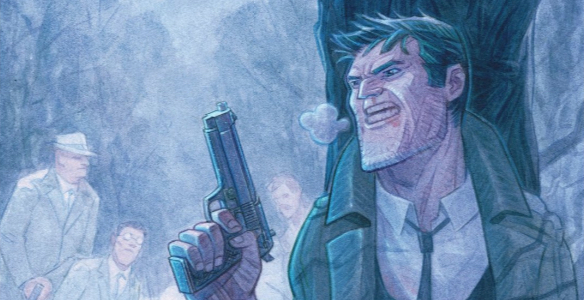
The quality of any mystery or narrative twist is going to depend entirely on how much the reader trusts the reality they are presented with. Brian Singer uses a charismatic storyteller and the fog of ancient crime myths in The Usual Suspects. The ending is a twist that works, but only because the audience has been lied to from the beginning. Kyle Higgins and Stephen Mooney take a different approach to mystery in Dead Hand 1, telling the audience everything and letting an abundance of information shroud the actual mystery. Continue reading

Expressive Lettering Fills in the Gaps in Despicable Deadpool 298

by Patrick Ehlers

This article contains SPOILERS. If you haven’t read the issue yet, proceed at your own risk!

slim-banner

“All that people care about is the look. There’s figures on this: 70% of what people react to is the look, 20% is how you sound, and only 10% is what you say.”

-Eddie Izzard, Dressed to Kill

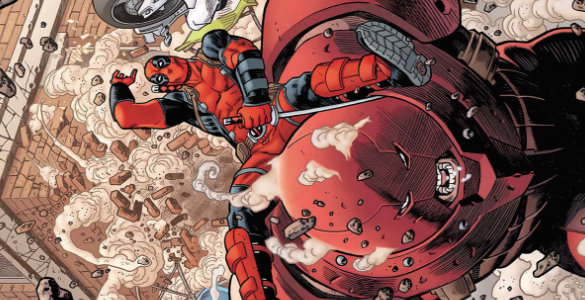
Here’s something that’s true about comics: it’s a medium full of speaking characters that we will never actually hear speaking. By Izzard’s math, that means there’s a full fifth of a character’s essence we’re never really going to get through images and words on the page. As Deadpool pulls out all the stops to finally achieve suicide-by-mercenary, so too does the creative team pull out all the stops to express the height of his desperation. All the usual gears are spinning perfectly: Gerry Duggan’s writing is as simultaneously tight and chaotic as ever, and Mike Hawthorne’s impeccable layouts convey an almost grueling understanding of the setting of this issue-long brawl. But I want to focus on that elusive final 20% — “how you sound” — with Joe Sabino’s excellent lettering in this issue. Continue reading

Pacing as Character in All-New Wolverine 33

By Patrick Ehlers

This article contains SPOILERS. If you haven’t read the issue yet, proceed at your own risk!

I love the idea of popping into a character’s far-flung future. It’s a way of taking a character’s essence and teasing out the results of a life lived in that essence — the ultimate if-then statement. If you’re a violent loner, then you end up alone and wracked with guilt. It’s all effect, and the cause is understood to be part of the character’s DNA. All-New Wolverine 33 kicks off the “Old Woman Laura” story, and writer Tom Taylor and artist Ramon Rosanas show the result of Laura’s legacy of positivity and leadership. Even in a world that was rocked by Doom World Wars, there’s still joy, prosperity, sorority and productivity in Laura’s future. Continue reading

Virginity and Values in Betrothed 2

By Patrick Ehlers

This article contains SPOILERS. If you haven’t read the issue yet, proceed at your own risk!

Last month, Mark likened Betrothed to a manga series, citing a number aesthetic and thematic similarities. That observation is astute, but perhaps incomplete. Writer Sean Lewis and artist Steve Uy aren’t just playing the greatest hits of the manga medium, they’ve got the sheet music for The Hero’s Journey on the stand in front of them, and are dutifully playing every note Maestro Campbell wrote. The second step on this journey is the Refusal of the Call to Adventure, so that is precisely what Kieron and Tamara do in the second issue of Betrothed. Continue reading

Daredevil 600: Discussion

by Patrick Ehlers and Ryan Desaulniers

This article containers SPOILERS. If you have not read the issue yet, proceed at your own risk!

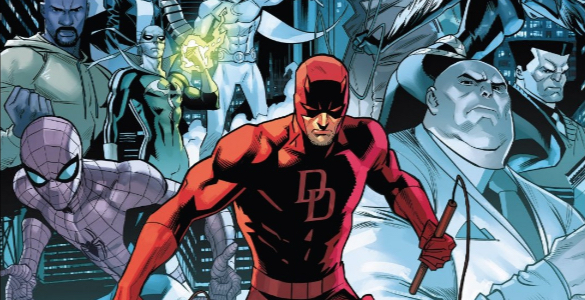
Patrick: Where does power come from? I’ve been seriously grappling with this one since Trump was elected to the White House, but this question obviously extends waaaay beyond that fucking monster. Does power ultimately come from money? From social connections? From one’s willingness to sacrifice their friendships? From violence? From non-violence? As the battle between Wilson Fisk and Daredevil reaches a fever pitch, questions of where either of them gets their power are posed right alongside the question of where Daredevil 600 gets its power. This is a six-hundredth issue, after all — so what makes this one special? Continue reading

Analog 1: Discussion

By Patrick Ehlers and Drew Baumgartner

This article contains SPOILERS. If you haven’t read the issue yet, proceed at your own risk!

Patrick: I listen to a lot of Slate’s Trumpcast. Y’know, because the president has me in a nearly constant state of low-key panic, and I feel utterly powerless to stop our democracy from crumbling, so like, might as well listen to a podcast about it. One of the things that comes up on the show pretty often is the idea that we need to let go of the idea that there is one smoking gun that will implicate the administration and the president himself in collusion with the Russian government. There is no evidence so ironclad that it would force impeachment. Further, impeachment and removal from office would not address the systemic problems with corruption, bigotry, and foreign interference. There’s no “one solution” because there is no “one problem.” Gerry Duggan and David O’Sullivan’s Analog 1 takes a very specific speculative high-concept pitch, and gradually reminds the reader of everything else that is intriguing and terrifying about their world — there is no “one problem.” Continue reading

How Camera Angles Raise Stakes in Despicable Deadpool 297

by Patrick Ehlers

This article contains SPOILERS. If you haven’t read the issue yet, proceed at your own risk!

slim-banner

Superheroes have an insane amount of mobility. Whether they’re fwipping around on spider webs, or flying through the air, or just brooding on a gargoyle on top of a skyscraper, there’s always a sense that the whole city is laid out before them. Artists can achieve this effect with dynamic camera angles, revealing the city below, and hopefully inducing a touch of vertigo in their readers. Despicable Deadpool 297 shows just how effectively Mike Hawthorne can use those same techniques to sell a change of setting and raise the stakes in Wade’s non-stop-slay-a-thon Continue reading

Finding Purpose in the Journey in Lockjaw 2

By Patrick Ehlers

This article contains SPOILERS. If you haven’t read the issue yet, proceed at your own risk!

“Animals may not understand our every word, but when it comes to tone? They understand perfectly.”

-Ka-Zar, Lockjaw 2

Throughout this issue, D-Man repeatedly states his confusion about what’s going on. He doesn’t know what it takes to survive in the Savage Land, he doesn’t know what Lockjaw is really up to, he doesn’t know what “the Beast” is. And it’s not just a good running gag: he doesn’t know what the D in D-Man stands for anymore. Writer Daniel Kibblesmith gifts the reader with Dennis’ confusion, greedily keeping most of the series’ explanation and exposition off the page. We are left to intuit was is right and what is wrong, just like D-Man does. We’re reading tone — and we understand that perfectly. Continue reading

Racism, Homophobia and Hypocrisy in James Bond: The Body 3

By Patrick Ehlers

This article contains SPOILERS. If you haven’t read the issue yet, proceed at your own risk!

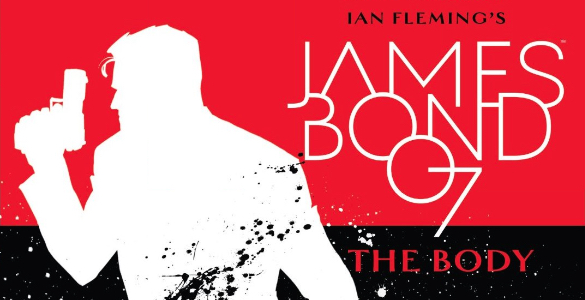
James Bond is an agent of the state. His actions seldom need to be motivated beyond “for Queen and Country.” We can infer some other values that the character holds from his choice of career. For example: he believes that violence can (and should) be used to bring about justice. He’s pro sex, but possibly in a way that devalues his relationships with his sexual partners. Issue three of James Bond: The Bond reveals another of Bond’s values — he hates white supremacy.

Or… is that it? The thing that seems to really get Bond going is the hypocrisy inherent in white supremacy. His appetite for sweet, violent, humiliating revenge seems to be fueled less by his desire to stamp out intolerance and more to do with people and organizations neither understanding nor practicing what they preach. Continue reading