Chilling Adventures of Sabrina 7: Discussion

by Ryan Mogge and Patrick Ehlers
This article contains SPOILERS. If you haven’t read the issue yet, proceed at your own risk!

slim-banner

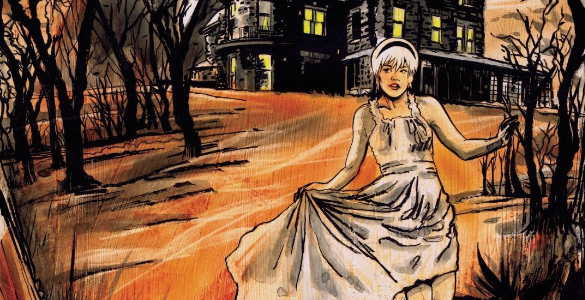
Ryan M: Writing in the point of view of a sociopath creates a set of problems. They will never have the kind of human connection or emotional growth that ground most stories. It’s why most serial killer stories are from the perspective of the detective on the case. It’s easy to alienate the audience when you allow a sociopath to tell the story. When these characters express an earnest truth about themselves, rather than make them more sympathetic, it emphasizes what’s “wrong” with them. Often, weaving in an undercurrent of irony or dark humor can make the character easier to take. Bret Easton Ellis’ American Psycho breaks up graphic tales of murder with pop music critiques. A tale of horror must offer the reader a break from the evil or suffer a tediousness that lessens the impact of the darkest moments. In Chilling Adventures of Sabrina 7, Roberto Aquirre-Sacasa and Robert Hack use humor to give release as Edward Spellman tells his life story.
Continue reading

Batman 26: Discussion

By Drew Baumgartner and Michael DeLaney

Batman 26

This article contains SPOILERS. If you haven’t read the issue yet, proceed at your own risk!

A single death is a tragedy; a million deaths is a statistic.

Joseph Stalin

Drew: Joseph Stalin likely never uttered this phrase, but while its provenance may be dubious, it’s hard to argue with its sentiment. We’ve all experienced this personally; individual deaths carry with them the nuance and beauty of the decedent’s death in a way that dozens of deaths simply can’t. Each of those deaths are felt singularly by the loved ones they affect, to be sure, but the rest of us can’t really fit the sum of those tragedies into our brain. They become, for lack of a better term, a statistic. This is why war stories are so rare in superhero comics — the higher death count doesn’t necessarily equal higher emotional stakes, so killing swaths of civilians runs the risk of making any one of those deaths lose whatever oomph it might have on its own. Writer Tom King seems keenly aware of how easy it would be for the victims of “The War of Jokes and Riddles” to become statistics, taking pains to emphasize just how deeply Batman feels each of those deaths. Continue reading

Wonder Woman 25: Discussion

By Michael DeLaney and Taylor Anderson

This article containers SPOILERS. If you haven’t read the issue yet, proceed at your own risk!

Michael: The concept of a higher power is one that many men and women struggle with at least once in their lives. One popular debate between believers and non-believers is the question “why does God let bad things happen to good people?” More to the point, “why does God let bad things happen?” After all of the trials and tribulations that she has gone through, Wonder Woman faces her gods and demands answers for it all. Continue reading

Clue 1: Discussion

by Spencer Irwin and Mark Mitchell

This article contains SPOILERS. If you haven’t read the issue yet, proceed at your own risk!

slim-banner

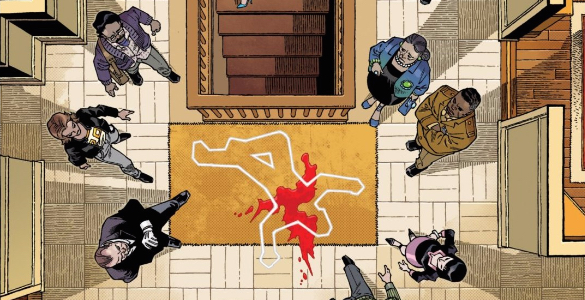
Spencer: I made as much fun of the Battleship movie as anyone, as well as of the other movies based off board games (such as Connect Four) announced around the same time, but even so, I’ve got to admit that basing a story off a board game isn’t automatically a bad idea — you just need the right game. The 1985 Clue film found a way to turn the game’s murder mystery concept into a compelling narrative, becoming a cult classic in the process. Can Paul Allor and Nelson Daniel’s new IDW adaptation of the game do the same? Continue reading

Secret Weapons 1: Discussion

by Patrick Ehlers and Drew Baumgartner

This article contains SPOILERS. If you haven’t read the issue yet, proceed at your own risk!

slim-banner

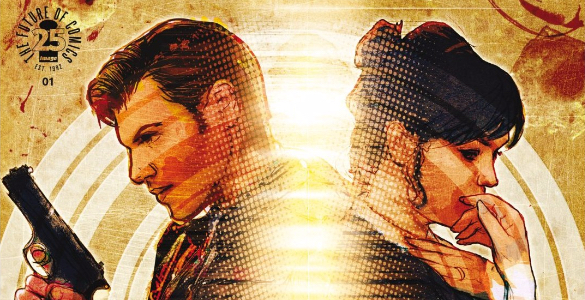
Patrick: Thwip! Bamf! Snikt! You know those sound effects: respectively, they mean a) Spider-Man shooting some web fluid, b) Nightcrawler teleporting away, and c) Wolverine deploying his claws. It is perhaps illustrative of the predictability of their superpowers that there are immutable sound effects that accompany them. You know exactly what it sounds like when Wolvie pops his claws, but you also know exactly what he can do with them. These powers are used in unsurprising ways to save the day, but what happens when the superheroes have powers that aren’t so easy to understand? Well, then you’ve got the residents of The Willow and the cast of Secret Weapons. Continue reading

Peter Parker: The Spectacular Spider-Man 1: Discussion

by Ryan Mogge and Ryan Desaulniers

This article containers SPOILERS. If you haven’t read the issue yet, proceed at your own risk!

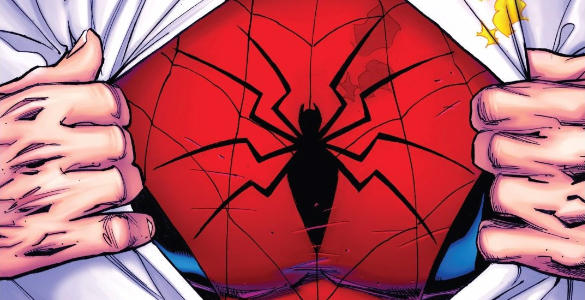
Ryan M.: How much background do you need to enjoy a single issue of an on-going serial? There is an argument that the answer is none. Most of us start out by just diving in, checking things out and then heading to Wikipedia or a very knowledgeable friend to help fill in the cracks. The serialized narrative is a moving train, you catch it when you can, and see what it has to offer. This can be one of the format’s strengths, giving the reader a feeling of discovery by entering a rich established world. You may have questions that aren’t answered or relationship dynamics you can’t understand, but you are seeing into a fictional world that is fully realized. It’s one of the reasons that origin stories can feel plodding. They are explaining why things are rather than showing what they become. In Peter Parker: The Spectacular Spider Man 1, Chip Zdarsky balances out that sense of history by giving the story a day-in-the-life feel with a few big turns that make it clear that a bigger story is evolving. Continue reading

Super Sons 5: Discussion

by Mark Mitchell and Michael DeLaney

This article contains SPOILERS. If you haven’t read the issue yet, proceed at your own risk!

slim-banner

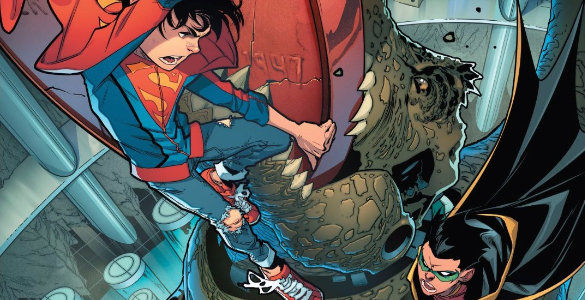
Mark: When I was about twelve years old, some friends and I got it in our heads that we deserved to go to a Six Flags theme park located two hours away from our city. We had just wrapped up a school assignment and were feeling pretty good about it; going to Six Flags was, to our minds, a reasonable reward for a job well done. My parents, for what I now recognize to be completely legitimate reasons, were quick to kibosh the idea — they weren’t interested in driving a Suburban full of sweaty pre-teens two hours to a theme park, driving two hours home, and then doing it all again later that night in order to pick us up. Plus, since I was twelve and had no money of my own to pay for park admission or food once I got in, they would basically be paying me $100 for the pleasure. All because me and my friends felt like we should be rewarded for completing our homework. I was furious.

Dealing with pre-teens and teenagers can be infuriating. They are, after all, categorically terrible; self-absorption coupled with crippling insecurity is a toxic combination. But it’s not their fault nature made them that way. Kids are constantly confronted with situations and decisions they are ill-prepared to face, lacking both the context and emotional experience to properly process and asses the situation. But that doesn’t make it any less irritating to be around them. Continue reading

Crosswind 1: Discussion

by Spencer Irwin and Taylor Anderson

This article contains SPOILERS. If you haven’t read the issue yet, proceed at your own risk!

slim-banner

Spencer: “Boys will be boys.” I can’t think of another phrase that seems so innocent, yet is in actuality so malicious. It does nobody any favors. It teaches men (and yes, for some reason this phrase is just as often — if not more often — applied to teenagers or grown men as it is children) that they have no control over their impulses and actions, while it simultaneously teaches women that they should just accept whatever men throw their way because men can’t help themselves, can’t be taught or trained or reasoned with. What started as a reminder of little boys’ natural boundless energy has become an excuse for misogyny, abuse — sometimes even murder. This phrase is also the only thing connecting the otherwise entirely disparate lives of Cason Ray Bennett and Juniper Elanore Blue, the dual protagonists of Cat Staggs and Gail Simone’s Crosswind. Continue reading

Silver Sufer 12: Discussion

by Drew Baumgartner and Patrick Ehlers

Silver Surfer 12

This article containers SPOILERS. If you haven’t read the issue yet, proceed at your own risk!

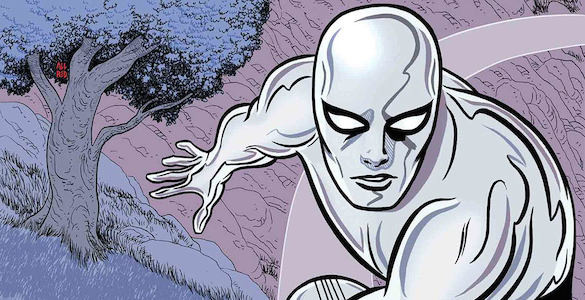
Drew: To say that Dan Slott, Michael Allred, and Laura Allred delight in the formal aspects of comics would be a profound understatement. The most indicative example must be issue 11 of the previous volume, which featured a kind of Möbius strip that readers had to consciously break out of. It’s the kind of innovation that might feel gimmicky to the passerby, but on closer inspection is so closely tied to the content of the story, it’s almost impossible to imagine it being handled any other way. In that case, Norrin and Dawn were stuck in a time loop, so the closed loop of the layout was essential to making that point literal. This issue finds Dawn stuck in time in a very different way, and the creative team manages to find a different technique to capture her stasis. Continue reading

Defenders 1: Discussion

by Taylor Anderson and Ryan Desaulniers

This article containers SPOILERS. If you haven’t read the issue yet, proceed at your own risk!

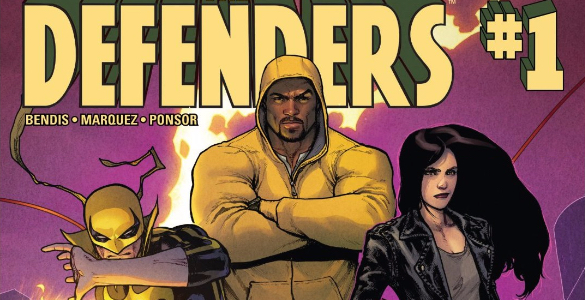
Taylor: When you think of the job comic book writers are tasked with, it’s damn near impossible to not stand in awe at what they accomplish. When writing for monthlies, authors not only have to come up with an engaging story, but something that stands out as unique. This is no easy task. Monthly comics have been around for the better part of a century, and many of the heroes who have titles today have participated in literally hundreds of story arcs. With that in mind, it’s impressive to consider the career of a writer as prolific as Brian Michael Bendis. Arguably the most recognizable name in comic book writing today, Bendis has written countless stories in his career, so at some point it becomes reasonable to question if he’ll ever cease to come up with new, entertaining stories. While it would be hyperbole to say Defenders 1 signals the beginning of the end for Bendis’s creativity, it’s hard to argue the lack of originality and inspiration in this first issue. Continue reading