Thor 1: Discussion

by Taylor Anderson and Patrick Ehlers
This article contains SPOILERS. If you haven’t read the issue yet, proceed at your own risk!

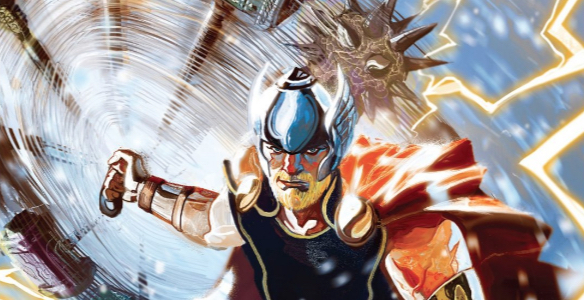
Taylor: When I’m teaching my students about tone and mood in class, my go-to lesson involves a Marry Poppins trailer. First I show them the original trailer for the movie and then I show them a trailer that Christopher Rule cut together, which makes the classic film look like a horror movie. It’s a great way of showing the kids that the same content can have a drastically different tone and mood based on how the artist presents the story. I was thinking of this as I read Thor 1, because the issue shares the same characters, settings, and even the same writer as the Mighty Thor, but it feels drastically different. It’s a textbook example of how a skilled writer can shift the tone of a story, and in this case, that shift is a refreshing change of direction for the Thor series. Continue reading

A Story Deepened by Shades of Gray in Darth Vader 17

by Spencer Irwin

This article contains SPOILERS. If you haven’t read the issue yet, proceed at your own risk!

Throughout their run on Darth Vader Charles Soule and Giuseppe Camuncoli have created (and/or reintroduced) a fascinating set of supporting and one-off characters, but for my money, the most intriguing is Jedi Master Ferren Barr. Last month Patrick already seemed suspicious of Barr’s methods, and in Darth Vader 17 the creative team doubles down on the shades of gray surrounding Barr. It’s the questions surrounding him and his methods that make Barr so interesting, especially as a Jedi. Continue reading

Character Drives the Drama in Marvel Rising Alpha 1

by Drew Baumgartner and Ryan Mogge

Marvel Rising Alpha

This article contains SPOILERS. If you haven’t read the issue yet, proceed at your own risk!

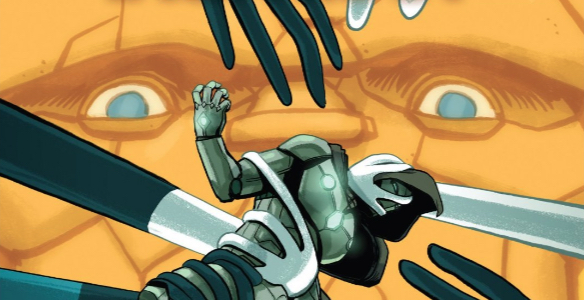
Drew: For most of my mid-20s, I worked for an academic summer program — basically, summer camp for nerds. As with most work with youth, the job was both rewarding and frustrating, with unexpected problems often interrupting the flow of what we might imagine a “normal” day to be. Indeed, those unexpected problems came up so regularly, that my boss’s regular refrain was “don’t let the urgent crowd out the important” — that is, don’t forget the part of the job that isn’t putting out fires. It’s straightforward advice, insisting that every part of the job is important, but I think it’s particularly salient when dealing with kids — you don’t want the loudest, most poorly-behaved students to command all of the attention, as the quiet, well-behaved students might be struggling just as much. It’s a hard balance to strike, especially for the college-aged students we hired as instructors, so I understand exactly why Doreen Green makes the missteps she does in Marvel Rising: Alpha 1. Continue reading

Doom’s Secret Origin in Marvel Two-In-One Annual 1

By Drew Baumgartner

Marvel Two-in-One Annual 1

This article contains SPOILERS. If you haven’t read the issue yet, proceed at your own risk!

Each is described as being the strongest man in the world and each as battling against “evil and injustice.”

Judge Augustus Hand (writing for the majority)
Detective Comics, Inc. v. Bruns Publications, Inc.

Augustus Hand served on the United States Court of Appeals for the Second Circuit from 1928 to his death in 1953, and just might be the most quoted judge when it comes to the definition of the superhero, owing to the decision he wrote when the Second Circuit ruled that Wonder Man did indeed constitute copyright infringement on Superman. His decision provided a revealing definition for the genre, insisting not just on superpowers, but a selfless, pro-social mission. Indeed, it’s not until after that decision that you see superheroes whose superpowers and pro-social mission are seen as separate things, with perhaps separate origins. That is, while Superman fought crime because he could, and Batman became a superhero specifically to fight crime, Spider-Man only picked up his pro-social mission after Uncle Ben died, well after he’d been using his powers for decidedly less selfless purposes. In that way, we might understand Marvel Two-In-One Annual 1 as a key part of Victor Von Doom’s superhero origin; it’s the story of how he became a good guy. Continue reading

The Tantalization of Other Timelines in Peter Parker: the Spectacular Spider-Man 305

by Taylor Anderson

This article contains SPOILERS. If you haven’t read the issue yet, proceed at your own risk!

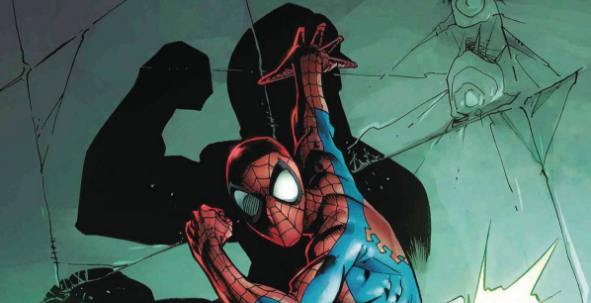
Every time I read a news story about a tweet our current commander in chief sends out, I can’t help but think how his predecessor or opponent in the election wouldn’t debase themselves in such a way. This inevitably leads me to wonder what an alternate timeline might look like where the current president didn’t win the election. What would the country look like? Would the oval office still be dignified and one that engenders respect and appreciation? I have some ideas about that, but I can never be sure exactly what that timeline holds. This idea, of other timelines, is tantalizing and one all people think about, and as such, it dominates the narrative of the Spectacular Spider-Man 305. Continue reading

Good vs. Evil in Astonishing X-Men 12

by Patrick Ehlers

This article contains SPOILERS. If you haven’t read the issue yet, proceed at your own risk!

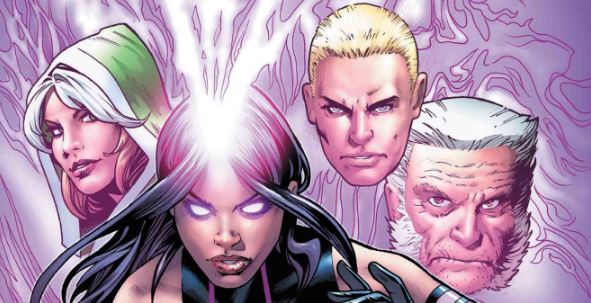
“Good vs Evil” implies that there are two sides — two warring factions — battling for the fate of the world. It’s a compelling image: a battlefield with good guys on one side and bad guys on the other. Good and evil are separate forces, and in our imaginations, represented by two different groups of people. While Charles Soule and Gerardo Sandoval’s Astonishing X-Men 12 still gives the reader avatars of light and darkness in the forms of X and The Night King, the armies fighting for each side are made up of all the same players. Old Man Logan is both a reformed ally-murderer and an irredeemable death machine; good and evil waging war within one mind. Continue reading

A Mid-Issue Shift Elevates Hunt for Wolverine: Weapon Lost 2

By Drew Baumgartner

Hunt for Wolverine Weapon Lost 2

This article contains SPOILERS. If you haven’t read the issue yet, proceed at your own risk!

Listen, I know there were crime procedurals before Law & Order (and there have been plenty since), but that show was such a mainstay of my formative pop-culture years that I can’t help but think of it every time I encounter a new fictional criminal investigation. What’s remarkable to me about that show is how entertaining it could be in spite of having an entirely rote structure (it was so set in stone, in fact, that they decided to enshrine it in the very title of the series). That is, the drama was never in whether they caught the culprit (they always did), or whether they would be convicted (they were found guilty or pled out the vast majority of the time), but in how they did it — or more precisely who was doing it. Individual details of the case might be interesting, but only inasmuch as they prompted quips from Briscoe or righteous indignation from McCoy. The procedural is an excuse to watch detectives do what they do best, so giving those detectives big, distinct personalities makes or breaks the whole exercise. In this way, Charles Soule has truly stacked the deck in his favor, cramming four larger-than-life investigators into tight quarters and giving them a hard case to chew on. Continue reading

(Re)defining the Hulk in The Immortal Hulk 1

by Drew Baumgartner

The Immortal Hulk 1

This article contains SPOILERS. If you haven’t read the issue yet, proceed at your own risk!

It might be stating the obvious to suggest that the Hulk’s identity is fraught, but I don’t mean it in the Jungian dualistic sense. Obviously, the tension between Bruce Banner and the Hulk is the primary source of drama for the character, but the Hulk has long suffered from a different kind of identity crisis, in that no two writers ever seem to agree on who and what he is. Is he a senseless destructive force, or is he capable of reason? Is he a monosyllabic brute, or a brilliant physicist? I’ve only occasionally checked in on Hulk’s solo series over the past five or so years, and I’ve seen takes that pretty much run the gamut, if that’s any indication of how rapidly and wildly consecutive runs can change the character. And to be clear, I don’t necessarily see this as a weakness — I’d argue that the flexibility of superheroes to fit the themes different creative teams are most interested in exploring is a huge part of their longevity — but I do think it demands a strong statement of purpose at the start of a run; something to clarify exactly what kind of Hulk we should expect to see. Something like Al Ewing and Joe Bennett’s The Immortal Hulk 1, which introduces the specifics of this particular iteration with remarkable efficiency. Continue reading

Deadpool 1 Honors the Past and Embraces the Future

By Michael DeLaney

This article contains SPOILERS. If you haven’t read the issue yet, proceed at your own risk!

“Honor the past, celebrate the present and embrace the future.”

Traditional

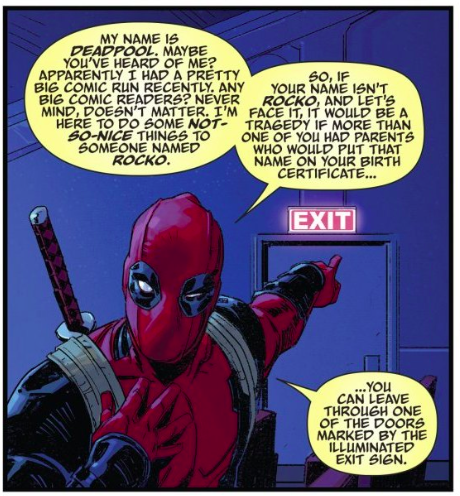
Gerry Duggan’s Deadpool is dead, long live Gerry Duggan’s Deadpool! Duggan wiped the slate clean for future Deadpool creators by having the Merc with the Mouth wipe his own painful memories from his mind. Surprisingly, Skottie Young makes note of this mind wipe in Deadpool 1 — both in dialogue and in the opening credits pages.

Deadpool is still breaking the fourth wall, still has a big ego, and in light of his memory loss, he’s just going to have to assume that his recent comic book run was “pretty big.” Continue reading

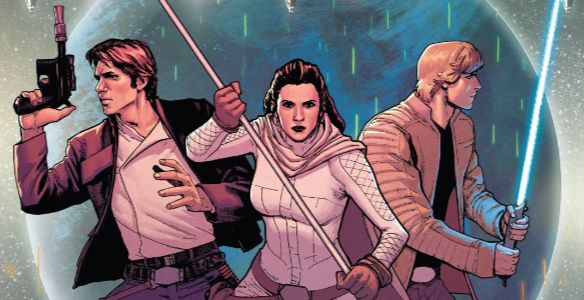
Star Wars 49: Discussion

By Patrick Ehlers and Taylor Anderson

This article contains SPOILERS. If you haven’t read the issue yet, proceed at your own risk!

Patrick: If there’s one part of the Star Wars formula I’ve had the hardest time connecting to on a personal level, it’d have to be the huge battles between spaceships.  Don’t get me wrong: I think the ships look cool, and the Millennium Falcon is so near and dear to my heart that I almost cried during its reveal in The Force Awakens. But there’s something about two factions of cold, gray, lifeless ships zipping through space and shooting blasters at each other that feels remarkably impersonal. With Star Wars 49, writer Kieron Gillen and artist Salvador Larroca set out to stage the mother of all space battles at the birth of the Rebel Armada. By linking the ships to the characters, the creators create a sense of emotional continuity that makes this one of the best space ship battles I’ve ever seen. Continue reading