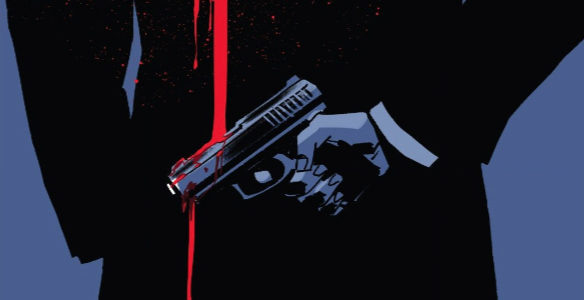
The Inevitable in Despicable Deadpool 299

by Patrick Ehlers

This article contains SPOILERS. If you haven’t read the issue yet, proceed at your own risk!

slim-banner

“Always do this. Tell the audience what you’re going to do. Do it. And then tell them it has been done.”

Stan Laurel via Jerry Lewis via Conan O’Brien on Jay Leno’s The Tonight Show

Conan went on to explain, “If anyone knows what the hell he’s talking about, please tell me, because it’s been ringing in my head for years.” It’s a strange piece of advice, especially to be passed down through a line of comedians. Comedy is based on the unexpected, right? But there’s another kind of humor that comes from obviously broadcasting what’s about to happen and then delivering on it. It’s a kind of dramatic irony — the audience knows what’s going to happen only because of their superpower of being an audience. Despicable Deadpool plays into the dramatic irony of the title “The Marvel Universe Kills Deadpool,” and quietly asserts that the creative team intends to deliver on everything it’s been setting up for the last three issues. Continue reading
An Episodic Reprieve in The Further Adventures of Nick Wilson 4

By Drew Baumgartner

The Futher Adventures of Nick Wilson 4

This article contains SPOILERS. If you haven’t read the issue yet, proceed at your own risk!

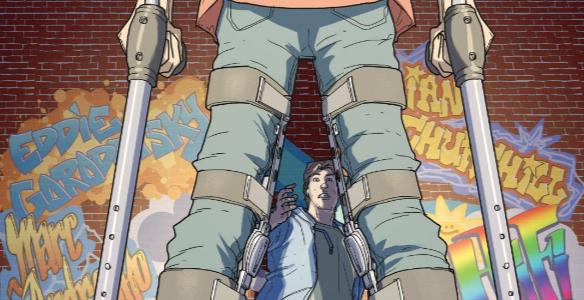
Comics and TV both exist on a spectrum between fully serialized and fully episodic storytelling modes. And any given series will move a bit within that spectrum, often to great effect — a typically heavily serialized story will offer up a beautifully self-contained installment, or a typically episodic one might find extra emphasis from that occasional “to be continued…”. As a miniseries, my expectations of serialization in The Further Adventures of Nick Wilson are even stronger, with each episode building to whatever conclusion writer Eddie Gorodetsky has engineered. Which makes issue 4’s episodic nature so refreshing — we couldn’t have seen it coming. Continue reading

The Virtue of Justice in Usagi Yojimbo: The Hidden 2

By Michael DeLaney

This article contains SPOILERS. If you haven’t read the issue yet, proceed at your own risk!

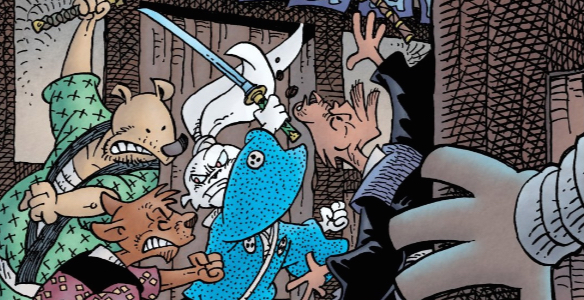
In a world of glorified anti-heroes we often forget the merits of the old fashioned, tradtional hero. Usagi Yojimbo: The Hidden 2 leans on the classic archetype of the law-abiding do-gooder in Inspector Ishida, who is in charge of the murder case that Usagi Yojimbo is working on. Continue reading

Lazarus 27: Discussion

By Spencer Irwin and Ryan Desaulniers

This article contains SPOILERS. If you haven’t read the issue yet, proceed at your own risk!

Spencer: An interlude is meant to be a break, a diversion, something different from the norm. In the case of Lazarus 27 — specifically billed as part one of a two-part interlude — it means that Greg Rucka and Michael Lark are taking a break from the story of Forever Carlyle to instead focus on her brother Jonah. Jonah’s adventure isn’t just an interlude for readers, though; it’s one for Jonah as well, a chance for him to experience a lifestyle far different than anything he’s ever seen before. Unfortunately, like most interludes, I fear this experience may be a temporary one for Jonah. Continue reading

Family in Descender 29

by Ryan Desaulniers

This article contains SPOILERS. If you haven’t read the issue yet, proceed at your own risk!

You can choose your friends but you sho’ can’t choose your family…

Harper Lee, To Kill a Mockingbird

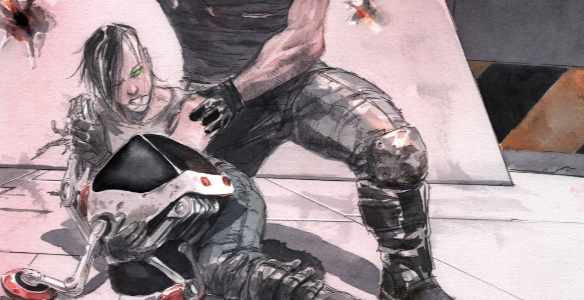
How do you define “family?” The answer to this may differ drastically depending on a number of factors, but as subjective as the idea is, many social and medical science disciplines use “family” as a basic unit of study. A UNESCO report claims family to be “a kinship unit and that even when its members do not share a common household, the unit may exist as a social reality.” That strikes me an appropriately broad definition, but could we include robots in it? Descender 29 returns to the “present” after three issues chronicling the first interactions with the eponymous machines which may have created organic life in this universe to a galaxy on fire, but despite the huge plot pieces moving here, the development and dissolution of family units takes center stage. Continue reading

Recurrent Lyrics and Actions Empower Scott in Mister Miracle 8

By Patrick Ehlers

This article contains SPOILERS. If you haven’t read the issue yet, proceed at your own risk!

A lot of Mister Miracle stands on the foundation of process and repetition. The nine-panel grid is established early and repeated on every page. All nine panels will be committed to a single action. Then the next nine panels are committed to a different action. This repetition leads to the feeling of being trapped, both for Scott Free and for the reader. But issue 8 finds writer Tom King introducing a sort of rosetta stone for how to find joy and contentment in the inescapable repetition. “Hush, Little Baby.” Continue reading

The Personal Mythology of Batman: Creature of Night 3

by Michael DeLaney

This article contains SPOILERS. If you haven’t read the issue yet, proceed at your own risk!

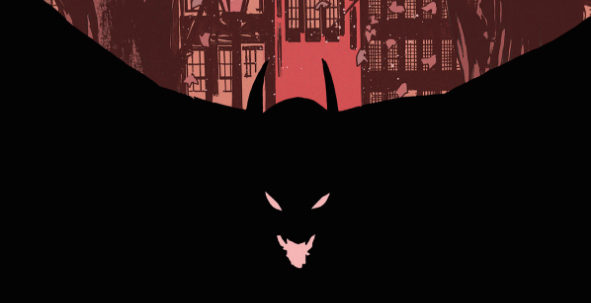
Whether we realize it or not, Americans like to mythologize our lives. Exposure to different forms of fiction and historical accounts feed into our egos, ascribing significance and meaning where otherwise there is none. Kurt Busiek and John Paul Leon’s Batman: Creature of Night 3 mythologizes it’s protagonist’s life literally and figuratively. Continue reading

Ms. Marvel 29: Discussion

by Taylor Anderson and Ryan Mogge

This article contains SPOILERS. If you haven’t read the issue yet, proceed at your own risk!

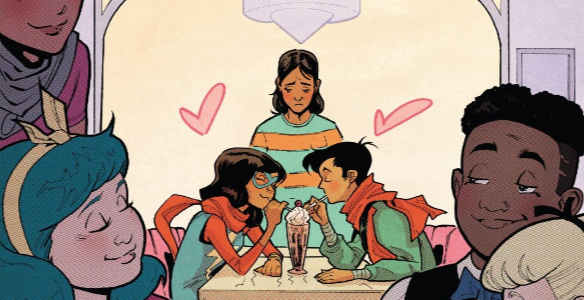
Taylor: There’s a reason why Archie comics are still around almost 80 years after the first issue was published. The lives of teenagers, to a certain extent, will always be the same, and Archie comics have traditionally done a pretty good job of chronicling what it’s like to be a high-schooler. In particular, the series’ focus on the romantic and emotional lives of its characters is what has made it an enduring title. After all, it’s not necessarily your AP Biology class you remember so much as the crush who happened to sit next to you in it. But it would be a mistake to think that Archie comics have cornered the market when it comes to teen dramas, or, as Ms. Marvel 29 shows, that teen dramas can’t include super heroes. Continue reading

The Illusion of Control in James Bond: The Body 4

By Spencer Irwin

This article contains SPOILERS. If you haven’t read the issue yet, proceed at your own risk!

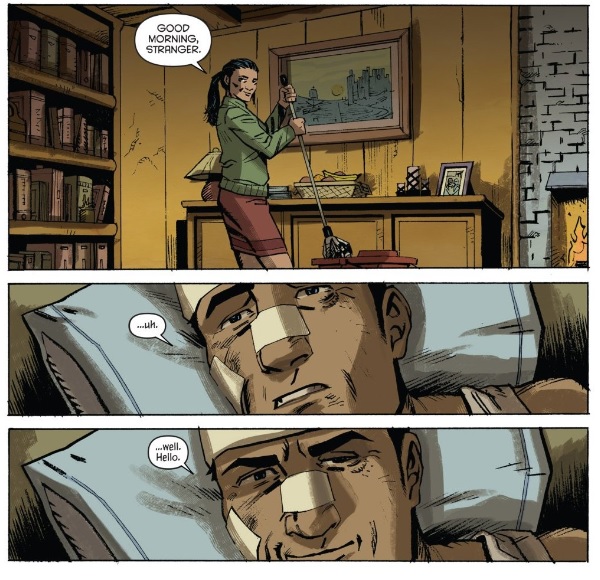
We all know what happens when James Bond meets a beautiful woman. It’s one of the most (in?)famous aspects of the franchise, and it’s an assumption creators Ales Kot and Eoin Marron clearly lean into when their injured Bond runs into a woman named Moira early in James Bond: The Body 4. Even Bond himself, if only momentarily, thinks he knows exactly how things are going to play out.

It never happens. Moira isn’t a conquest; she’s a complicated woman with her own desires and internal life that Bond can barely begin to fathom. That’s really the idea behind this entire issue: James Bond is a professional who thinks he understands how the world works, but control is far more elusive than he ever truly realized. Continue reading

Failure Defeated by Pure Action in Daredevil 601

By Patrick Ehlers

This article contains SPOILERS. If you haven’t read the issue yet, proceed at your own risk!

Daredevil is a punching bag. I know all superheroes suffer — conflict is the engine of story, and masked dudes with superpowers have to really be put through the ringer for a desensitized audience to feel anything. But Matt Murdock is a special case: his default state seems to be “just got beat up.” I mean, look at the cover to this issue. No one’s going to ask “oh no, is Matt gonna be okay?” Yeah, sure — he’ll be fine. He always bleeds from the face when he’s working on a plan. So part of what makes Daredevil 601 feel so unsettling is how smoothly everything goes for the Mayor Without Fear. Continue reading