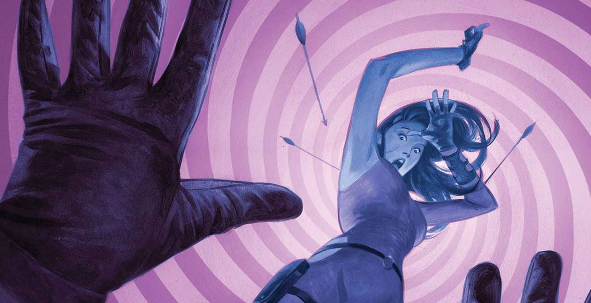
The Use of Flashback in Hawkeye 8

by Taylor Anderson

This article contains SPOILERS. If you haven’t read the issue yet, proceed at your own risk!

You see it a lot in movies and TV shows nowadays, the flashback or flashforward in time. Its popularity with artists is understandable, though — when you only have so much time to devote toward character development, why not take a shortcut and use a flashback to show what motivates a character? Just because this is an easier way to develop a character doesn’t mean it’s easy, however. In Hawkeye 8, the use of flashback isn’t damning, but it also adds relatively little to the story at the same time. Continue reading
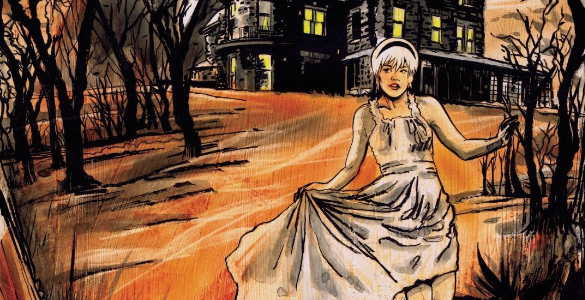
Chilling Adventures of Sabrina 7: Discussion

by Ryan Mogge and Patrick Ehlers

This article contains SPOILERS. If you haven’t read the issue yet, proceed at your own risk!

slim-banner

Ryan M: Writing in the point of view of a sociopath creates a set of problems. They will never have the kind of human connection or emotional growth that ground most stories. It’s why most serial killer stories are from the perspective of the detective on the case. It’s easy to alienate the audience when you allow a sociopath to tell the story. When these characters express an earnest truth about themselves, rather than make them more sympathetic, it emphasizes what’s “wrong” with them. Often, weaving in an undercurrent of irony or dark humor can make the character easier to take. Bret Easton Ellis’ American Psycho breaks up graphic tales of murder with pop music critiques. A tale of horror must offer the reader a break from the evil or suffer a tediousness that lessens the impact of the darkest moments. In Chilling Adventures of Sabrina 7, Roberto Aquirre-Sacasa and Robert Hack use humor to give release as Edward Spellman tells his life story.

Continue reading

Dramatic Irony in Star Wars 33

by Taylor Anderson

This article contains SPOILERS. If you haven’t read the issue yet, proceed at your own risk!

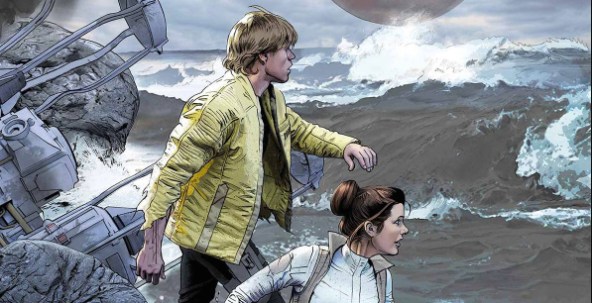
There are a lot of upsetting things that happen in The Empire Strikes Back: the Rebellion loses its primary base,Han is frozen in carbonite, and Luke finds out Darth Vader is his father. For all that, the perhaps the most disturbing part of the movie happens early on when Leia kisses Luke on the mouth in an act that borders on incest. That Leia and Luke didn’t know they were siblings when this happens doesn’t make the kiss any less disturbing, but you have to wonder why Leia even thought about it in the first place. Continue reading

Green Arrow 26 Invests in Two Different Kinds of Team-Ups

by Spencer Irwin

This article contains SPOILERS. If you haven’t read the issue yet, proceed at your own risk!

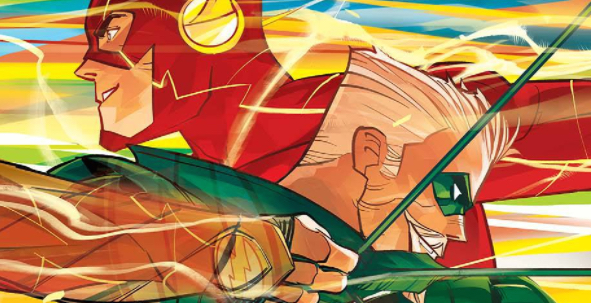
The power and dangers of money have been an ongoing theme throughout Benjamin Percy’s tenure on Green Arrow, which is why the Ninth Circle make such effective villains for his Oliver Queen. Their bizarre supernatural backstory is by far their least interesting facet; they’re most fascinating because they’re supervillain bankers, primarily using the power money brings to achieve their goals rather than brute force or even coercion. Like most bankers, they also invest in other organizations to achieve mutual goals — but since they’re supervillains, so are their partners. Continue reading

Diablo House 1 is Anger Fuel and Little Else

by Patrick Ehlers

This article contains SPOILERS. If you haven’t read the issue yet, proceed at your own risk!

The first time I heard Rage Against the Machine, it was on a tape my friend Leann popped into the stereo of my 1989 Toyota Tercel. She played “Killing In The Name” and I just straight up didn’t understand what I was hearing. The song is so angry, wearing resentment and outrage as an outfit instead of as an accessory. There’s very little nuance or subtlety to the refrain “fuck you, I don’t do what you tell me,” and at 16 I thought the song was emotionally immature. Twenty years later, I may still agree with that evaluation, but I also recognize the importance of expressing a single emotion so clearly, so singularly, and so powerfully all at once. Diablo House 1 is very much like “Killing In The Name,” a story singularly focused on expressing the evils of greed and ambition. Continue reading

Shifting Tone in All-New Wolverine 22

by Drew Baumgartner

All-New Wolverine 22

This article contains SPOILERS. If you haven’t read the issue yet, proceed at your own risk!

The tonal range of Tom Taylor’s All New Wolverine is truly remarkable. We’ve seen issues of high drama and irreverent fun, all of which gives this series a depth of emotional experience that at least approaches real life. Moreover, the range allows Taylor to wield tone with a nuance that is rare in superhero comics, juxtaposing and combining them within issues to evoke ever more specific emotions. The surprising tonal twist in issue 22 is far from the most subtle Taylor has ever pulled, but I’ll be darned if it isn’t effective. Continue reading

The Unstoppable Wasp 7: Discussion

By Taylor Anderson and Spencer Irwin

This article contains SPOILERS. If you haven’t read the issue yet, proceed at your own risk!

Taylor: Nadia Pym isn’t the first person to don the Wasp moniker. Long before she became the Unstoppable Wasp, Janet Van Dyne was rocking a set of insectoid wings and shrinking down to microscopic sizes. The accolades Janet earned as Wasp are long, but suffice it to say that, as a founding member of the Avengers, her superhero resume is pretty well stacked. With such an impressive background, it’s interesting to consider what Janet thinks about Nadia, the love child of her husband with another woman and in many ways the younger version of herself. In bold fashion, Unstoppable Wasp 7 answers this question by shifting its narrative perspective and centering the action on the Wasp that started it all. Continue reading

Jon Feels More Like Damian in Superman 26

by Michael DeLaney

This article contains SPOILERS. If you haven’t read the issue yet, proceed at your own risk!

Filling in for a regular creative team on a comic book is hard all around, for the readers and creators alike. Pete Tomasi and Patrick Gleason take a break for Superman 26 and writer/artist team Michael Moreci and Scott Godlewski sub in.  I didn’t love the previous “Black Dawn” story arc, but it was Tomasi/Gleason story so it jibed with what had lead up to that point. One of the biggest things working against Superman 26 is Moreci’s characterization. Continue reading

Batman 26: Discussion

By Drew Baumgartner and Michael DeLaney

Batman 26

This article contains SPOILERS. If you haven’t read the issue yet, proceed at your own risk!

A single death is a tragedy; a million deaths is a statistic.

Joseph Stalin

Drew: Joseph Stalin likely never uttered this phrase, but while its provenance may be dubious, it’s hard to argue with its sentiment. We’ve all experienced this personally; individual deaths carry with them the nuance and beauty of the decedent’s death in a way that dozens of deaths simply can’t. Each of those deaths are felt singularly by the loved ones they affect, to be sure, but the rest of us can’t really fit the sum of those tragedies into our brain. They become, for lack of a better term, a statistic. This is why war stories are so rare in superhero comics — the higher death count doesn’t necessarily equal higher emotional stakes, so killing swaths of civilians runs the risk of making any one of those deaths lose whatever oomph it might have on its own. Writer Tom King seems keenly aware of how easy it would be for the victims of “The War of Jokes and Riddles” to become statistics, taking pains to emphasize just how deeply Batman feels each of those deaths. Continue reading

The Page Becomes the Prison in Black Bolt 3

by Patrick Ehlers

This article contains SPOILERS. If you haven’t read the issue yet, proceed at your own risk!

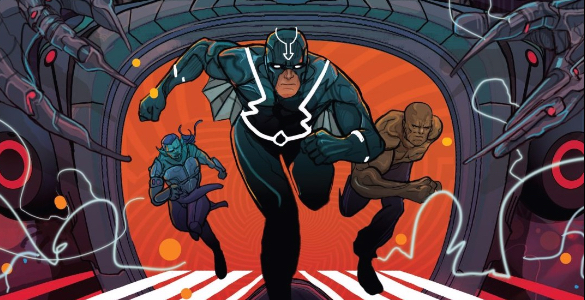
Black Bolt is trapped in a sci-fi prison so trippy, I’m not sure how to refer to it. Is it a a prison out of time and space? Oooh! Maybe some kind of psychic labyrinth! It’s a space between dimensions or beyond death or beside reality — anywhere you can’t quite describe without feeling like a huge dork. But as tough as it is to describe the space, the physicality of it is massively important. It’s a prison, after all; if the readers don’t have a sense of the jail being broken, what the fun in a jail break? That’s where artist Christian Ward steps in and grants every indescribable room a stunning clarity. I may never be able to tell you what this space is, but there’s never any confusion about what the room-to-room experience is for Black Bolt and his new friends. Continue reading