How The Unbeatable Squirrel Girl 37 Hides Everything in Plain Sight

By Drew Baumgartner

Unbeatable Squirrel Girl 37

This article contains SPOILERS. If you haven’t read the issue yet, proceed at your own risk!

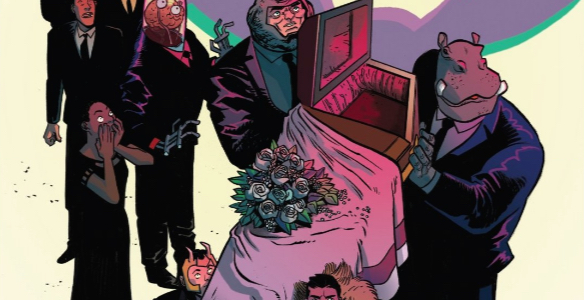
Doreen Green’s honesty is a key part of her character. It allows her to find nonviolent solutions to so many of her conflicts, helping her adversaries find a better path forward. But it also means she’s not great at subterfuge. It’s a weakness that Ryan North and Derek Charm lean into hilariously, as Doreen and Nancy don some truly absurd costumes in order to infiltrate Squirrel Girl’s own funeral.
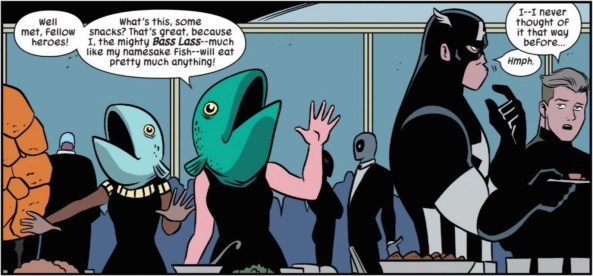
Bass Lass and Fish Miss

As silly as these costumes are, they also reinforce Doreen’s natural honesty — she’s simply incapable of selling a lie convincingly. It’s a philosophy that North and Charm use to inform the whole aesthetic of the series, which tends to overshare and lampshade niggling details we might have otherwise overlooked. But unlike Doreen’s compulsive honesty, North and Charm can use our trust against us, landing a thrilling twist in this issue’s final page. Continue reading
Feature Panels Orient the Action in Extermination 3

by Drew Baumgartner

Extermination 3

This article contains SPOILERS. If you haven’t read the issue yet, proceed at your own risk!

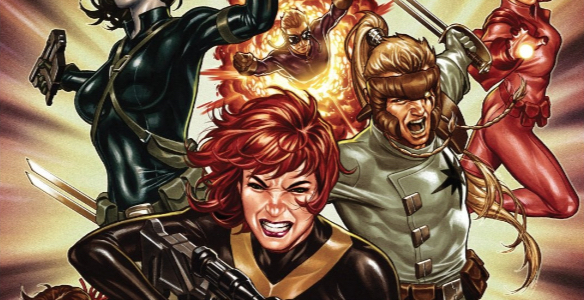
Tony Zhou’s Every Frame A Painting channel might just be my favorite outlet for analysis of visual media. Zhou tends to frame his videos very narrowly — such as the “How to do Visual Comedy” video excerpted above — but the lessons can be applied much more broadly. Which is my half-explanation for why I chose that particular video to kick off my analysis of Extermination 3 — not because this issue has anything to do with visual comedy, but because artist Pepe Larraz does such a brilliant job inventively eschewing lazy visual conventions. Continue reading

The Amazing Spider-Man Annual 1 Presents a Feminist History

by Drew Baumgartner

Amazing Spider-Man Annual 1

This article contains SPOILERS. If you haven’t read the issue yet, proceed at your own risk!

Pixar

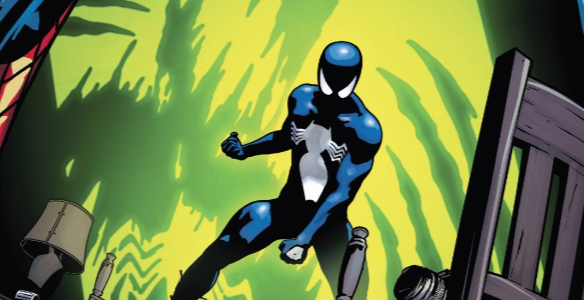
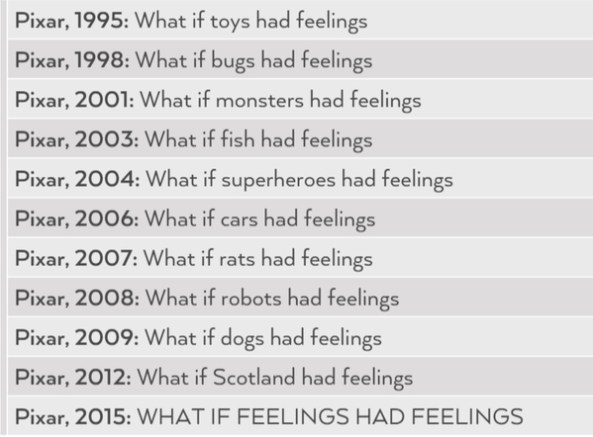
As a kid, I always suspected the inanimate objects in my life had secret lives of their own. It wasn’t so much that I thought they got up and walked around when I wasn’t looking, but that they had feelings and aspirations and friends that they cared about. That was the bit about Toy Story that really hit me when it came out — that my toys were desperate for my love and attention, and they felt neglected when I turned my attention elsewhere. Worrying about the feelings of inanimate objects speaks to some of my most well-worn neuroses, but I’d defend those early experiences as helping me practice sympathy for other humans. I hesitate to call Toy Story a feminist history, since the marginalized perspective it adopts is entirely fictional, but it certainly has the shape of a feminist history, cuing us (or, at the very least, eight-year-old me) into the heretofore ignored plight of children’s toys. (To be clear: “feminist history” isn’t the history of feminism, but feminist approaches to history — approaches that highlight otherwise overlooked perspectives and narratives in history.) With Amazing Spider-Man Annual 1, Saladin Ahmed and Garry Brown achieve something similar, retelling the classic arc “Alien Costume Saga” from the perspective of the Venom Symbiote. Continue reading

It’s Power vs Responsibility in The Amazing Spider-Man 5

by Drew Baumgartner

Amazing Spider-Man 5

This article contains SPOILERS. If you haven’t read the issue yet, proceed at your own risk!

O, it is excellent
To have a giant’s strength, but it is tyrannous
To use it like a giant.

William Shakespeare, Measure for Measure

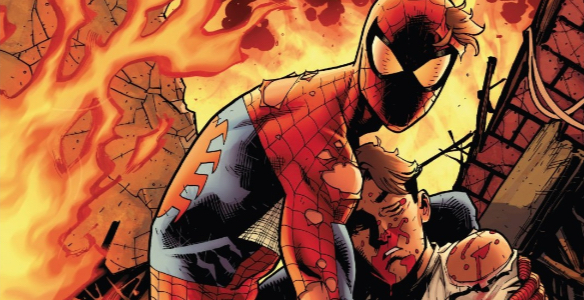
We tend to define power optimistically — we might list the duties of say, the President of the United States, for example, with the expectation that they’ll wield their power responsibly. But there’s another (perhaps more timely) way to define power, not by the amount of good it allows someone to do, but by the amount of harm it allows someone to inflict. Try as we (or Uncle Ben) might to link the two, power and responsibility are independent variables. That is, “With great power must also come great responsibility” isn’t a statement of some inviolable rule of the world, but a goal to strive towards. That’s why the “must also” part is so essential (and so missed from Sam Raimi’s Spider-Man) — it makes it clear Uncle Ben isn’t just stating a fact. Indeed, that power can be separated from responsibility is precisely what this first arc of Nick Spencer and Ryan Ottley’s Amazing Spider-Man has focused on, demonstrating the inefficacy of either without the other. Continue reading

How Directionality Sells the Drama in Ms. Marvel 34

by Drew Baumgartner

Ms. Marvel 34

This article contains SPOILERS. If you haven’t read the issue yet, proceed at your own risk!

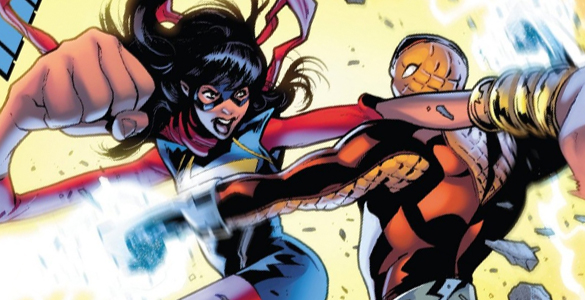
The only limits in comics are those of the imagination and the page itself. That sounds grandiose, but I genuinely believe that to be true. There are no CGI budgetary restrictions or limits of practical effects that could make a shot or a sequence impossible (though time constraints may make big crowds on horseback less likely), no locations on earth (or off) that can’t be used, no detail to small that can’t be captured in a panel. That means comics are a medium with nearly infinite potential for flashy epicness, which can easily hog our attention. But its the fundamentals — nearly universal to all storytelling — that ultimately make a comic sing: characters, clarity, and heart. Sometimes those flashy elements can help connect us to those fundamentals, but sometimes it’s the simpler details that sell the story. Such is the case with G. Willow Wilson and Nico Leon’s Ms. Marvel 34, which utilizes one of the most basic givens in the medium to remarkably effective results. Continue reading

Imposter Syndrome in The Dreaming 1

by Drew Baumgartner

The Dreaming 1

This article contains SPOILERS. If you haven’t read the issue yet, proceed at your own risk!

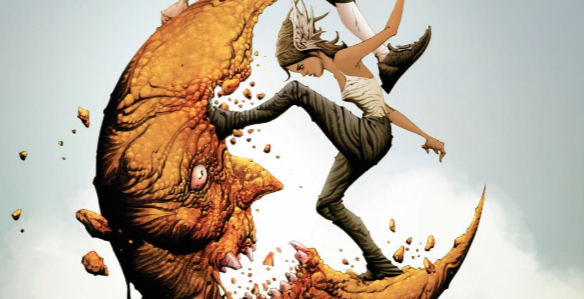
The Lord of the Dreaming has abandoned his post, leaving his realm in the hands of his followers and beneficiaries. That’s the premise of The Dreaming, but it’s also a reasonable explanation of “The Sandman Universe” group, where a handful of hand-picked creators have been given the keys to the settings and characters Neil Gaiman created back before Vertigo was even a glimmer in Karen Berger’s eye. I’m fascinated at Gaiman’s mentorship role here, and how Si Spurrier and Bilquis Evely have addressed those real-world elements as meta-commentaries in the narrative, but I’ll limit the focus here to how they address the notion of reverence for what has come before. Continue reading

How Layouts Drive Tension in Death of the Inhumans 3

by Drew Baumgartner

Death of the Inhumans 3

This article containers SPOILERS. If you have not read the issue yet, proceed at your own risk!

Deep, thoughtful analysis is a rarity in the world of comics criticism. While it’s easy enough to dismiss itinerant continuity policing or grumbling about plot-holes as braindead drivel, there’s a much more insidious kind of shallow analysis that suggests that there are simple aesthetic rules that govern the medium. It may be possible to identify trends that are true for even a very large sample of comics, but there are just as many exceptions to those “rules.” Truly deep analysis, on the other hand, can introduce us to new analytical tools that can be applied to many other comics, even if the conclusions we draw from those applications have no universal trend. Such is the case with Matt Fraction’s “cover version: daredevil 230 and cutting techniques,” one of my favorite comics analyses of all time. I highly recommend taking the time to read that piece, but the short explanation for why I love it so much is that it introduced me to ideas I had never encountered before. Most important was the thought that the invisible structures that guide our reading experience might be only just invisible, and that we can unearth them by paying close attention to things like panel counts and layouts. Fraction identifies a triangle motif in Daredevil 230 that is obvious enough on some pages, but on others just loosely describes the areas of the layouts we might most pay attention to. Using those same techniques, I recognize a similar pattern on some pages of Death of the Inhumans 3, though they elicit a decidedly different effect. Continue reading

Depth of Field in Hunt for Wolverine: Dead Ends 1

By Drew Baumgartner

Hunt for Wolverine Dead Ends 1

This article contains SPOILERS. If you haven’t read the issue yet, proceed at your own risk!

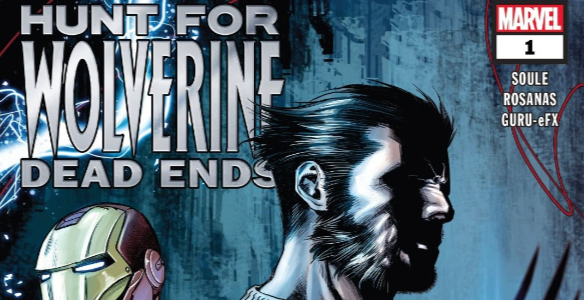
I remember someone once telling me that they mostly evaluate a comics artist based on the detail of their backgrounds. That always felt like an odd facet to fixate on (especially with so many others to factor in), but it’s hard to deny that richly detailed backgrounds are dazzling. It allows artists to flex not only their attention to detail, but their capacity for deep perspective, lending a sense of lived-in reality to their settings. But it’s also time consuming — even the most detail-prone artists will pick their moments, reserving sprawling cityscapes and the likes for big splash pages, and making choices that compress the depth of field elsewhere. Time is an understandable driver of level-of-detail, but it doesn’t always coincide with storytelling in a meaningful way. With The Hunt for Wolverine: Dead Ends 1, artist Ramon Rosanas finds a much more thematically resonant way to use his depth of field, lending Charles Soule’s villain reveal an unsettling otherworldliness. Continue reading

Historicizing the Present in Harbinger Wars II 4

by Drew Baumgartner

Harbinger Wars 2 4

This article contains SPOILERS. If you haven’t read the issue yet, proceed at your own risk!

All those innocent contractors hired to do the job were killed! Casualties of a war they had nothing to do with. All right, look, you’re a roofer, and some juicy government contract comes your way; you got the wife and kids and the two-story in suburbia — this is a government contract, which means all sorts of benefits. All of a sudden these left-wing militants blast you with lasers and wipe out everyone within a three-mile radius. You didn’t ask for that. You have no personal politics. You’re just trying to scrape out a living.

Randal, Clerks

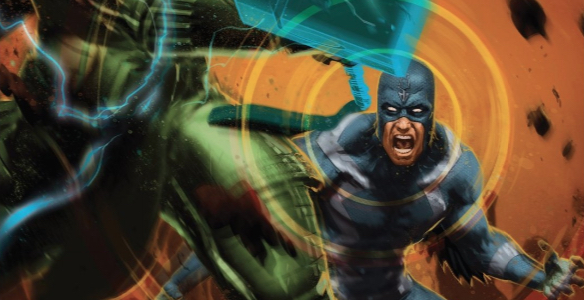
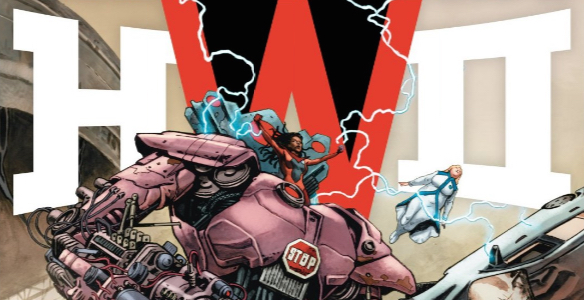
Violence is never a good look. Self-defense may justify it in some cases, but any innocents caught in the crossfire tar even the most noble motives. It turns heroes into villains and obscures the line between good and evil. I’ve had the luxury of thinking of this as a hypothetical question for most of my life, the kind of moral quandry characters might be confronted with in comics, but not exactly an active concern in my day to day life. But in a country facing the rise of white-supremacists, I can’t tell you how many think pieces I’ve read in the past two years debating the morality of punching nazis. More broadly, the questions are about when violence is justifiable, and how much collateral damage we’re willing to accept of said violence. These are exactly the questions everyone is weighing in Harbinger Wars 2 4, though they’re far from the only “ripped from the headlines” commentary in the issue, which paints a startlingly nuanced portrait of our times. Continue reading

Shot Compositions Sell the Relationships in The Wild Storm 16

by Drew Baumgartner

The Wild Storm 16

This article contains SPOILERS. If you haven’t read the issue yet, proceed at your own risk!

We met Angela Spica at a weird point in her life. While she was (mostly) passing as an eccentric engineer, her relationship to the world changed when she revealed her stolen transkeletal drysuit. That moment marked her as a fugitive, but she was already becoming something different before that, as her cybernetic makeup marks her as something more than “human.” That’s how she fell in with a group of oddities and aliens, but The Wild Storm 16 makes the case for Jenny Mei Sparks as a more natural peer. Their first meeting here doesn’t offer much more than the two simply sizing each other up, but Jon Davis-Hunt’s shot choices suggest that the two are on the same level — a stark contrast to the other big meeting in this issue. Continue reading