Moonshine 9: Discussion

by Patrick Ehlers and Drew Baumgartner

This article contains SPOILERS. If you haven’t read the issue yet, proceed at your own risk!

Hence, the enlightened ruler is heedful, the good general full of caution. This is the way to keep a country at peace and an army intact.

-Sun-Tzu, The Art of War

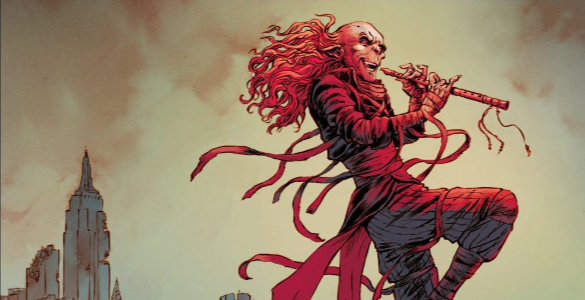
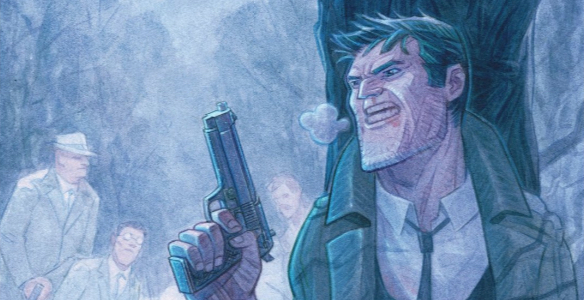
Patrick: Risk is terrifying. It’s so often the barrier to achieving anything worth achieving. And there’s a safety, a presumption of success by default, that comes from risking nothing. Sun-Tzu preaches measured responses and caution in all action. That same caution is as big a benefit for the characters of Brian Azzarello and Eduaro Risso’s Moonshine 9. Continue reading

The Timeline Skews in Batman 45

By Drew Baumgartner

Batman 45

This article contains SPOILERS. If you haven’t read the issue yet, proceed at your own risk!

Here’s the present, 1985, the future, and the past. Prior to this point in time, somewhere in the past…the time line skewed into this tangent…creating an alternate 1985. Alternate to you, me, and Einstein…but reality for everyone else.

Doc Brown, Back to the Future Part II

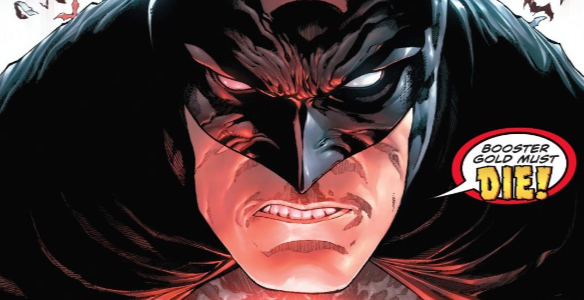
We’re all familiar enough with the notion of alternate timelines and the butterfly effect by this point that any reasonable time-traveler would have to fear ever changing past events — indeed, it’s a sci-fi concept so ubiquitous, even Abe Simpson thought to offer Homer a warning about it on his wedding day. And yet, we still like to imagine “what if” scenarios about making different decisions in only our own pasts, but those of fictional characters. The most well-known “what if” story in superhero comics might well be “For the Man Who Has Everything,” Alan Moore and Dave Gibbon’s clever parable about fantasy wish fulfillment. Superman’s fantasy necessarily focuses on his own experiences on a non-exploded Krypton, but the absence of Superman would obviously have profound effects back on Earth. That is, there are butterfly effects in that fantasy timeline we never see, that a Krypton-based Kal-El wouldn’t even know about. Cleverly, Tom King and Tony Daniel open on the butterfly effects of their alternate timeline in Batman 45 before circling back to explain how and why this alternate timeline was created in the first place. Continue reading

Hope Springs Eternal in Captain America 700

by Drew Baumgartner

Captain America 700

This article will contain SPOILERS. If you haven’t read the issue yet, proceed at your own risk!

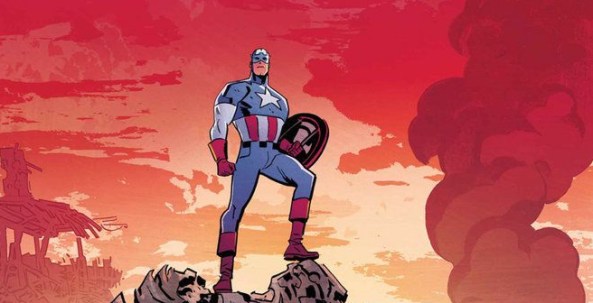
Superheroes don’t get endings. They might die, sure, but are inevitably resurrected months, years, or decades down the line. And they’re brought back for the same reason superheroes don’t get endings: there’s always another story to tell (and another dollar to be made telling it). Fans may sometimes get jaded about this — especially when a hero is killed off for the umpteenth time — but that lack of closure keeps superheroes in a holding pattern in the middle of the hero’s journey. They may have momentary successes, sure, but they never get to kick up their heels at the end of a career well-served. You know, unless you can find some kind of alternate universe/timeline workaround that allows your hero some sense of closure while still allowing him to carry on the fight tomorrow. That’s exactly the kind of workaround Mark Waid and Chris Samnee cook up in Captain America 700, giving Steve the kind of heroic end he can only have if there’s some kind of trick. Continue reading

An Early Start Sets Crude 1 on an Unusual Course

by Drew Baumgartner

Crude 1

This article contains SPOILERS. If you haven’t read the issue yet, proceed at your own risk!

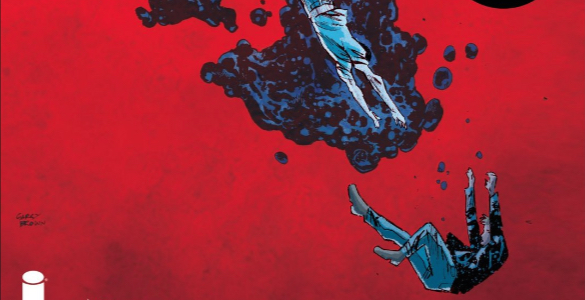
Every story is a mystery at its start. Themes, settings, characters, and their motivations are all unknown to us at the outset, so the opening chapters of stories are often defined by which of these questions they answer, and which they leave open. In that way, a story ultimately defines what its hanging questions are by where it begins. Does it open generations before the protagonist is born or on the day of the inciting incident? Does its scope start wide and zoom in, or does it start in tight and zoom out? Or, more to the point in many mainstream comics, do we meet the protagonist before or after their loved one is murdered, propelling them on some kind of quest for justice/vengeance? With Crude 1, Steve Orlando and Garry Brown’s choices on where and when to start their narrative reveal a great deal about what they think is interesting about their narrative, but in doing so, may have buried the lede. Continue reading

Teenage Mutant Ninja Turtles 81: Discussion

By Drew Baumgartner and Taylor Anderson

Teenage Mutant Ninja Turtles 81

This article contains SPOILERS. If you haven’t read the issue yet, proceed at your own risk!

Drew: Homicidal mutants. Power-hungry ninja clan leaders. Aliens bent on world domination. The Teenage Mutant Ninja Turtles franchise has had a ton of villains over the years, but they all tend to share one thing in common: obvious evilness. IDW’s incarnation has done a great deal to complicate and question the morals and perspectives of those familiar villains, but never so much to make the Turtles frame the choices of their adversaries as “misguided.” Which is precisely why Splinter’s slow heel turn has added so much depth to the series. It’s fine for the Turtles to be battling an evil, cackling warmonger when they’re appearing on a Saturday morning cartoon, but in this age where people seem to believe there are “very good people on both sides” of every argument, we may need more nuanced depictions of evil. The road to Hell, they say, is paved with good intentions, which is all anyone seems to have in this series at the moment. You know, besides the Rat King. Continue reading

X-Men Red 3 Offers a Portrait of Our Time

by Drew Baumgartner

X-Men Red 3

This article containers SPOILERS. If you haven’t read the issue yet, proceed at your own risk.

…it occurred to me that instead of them just being heroes that everybody admired, what if I made other people fear and suspect and actually hate them because they were different? I loved that idea; it not only made them different, but it was a good metaphor for what was happening with the civil rights movement in the country at that time.

Stan Lee on creating the X-Men

That the mutants of the Marvel universe are reviled and oppressed has long made them an allegory for any number of minorities the world over, which in turn makes the X-Men an allegory for any number of civil rights activists. Much has been written about the MLK/Xavier and Malcolm X/Magneto parallels, but as the twentieth century churned on, those movements coalesced less and less around recognizable figureheads. These movements weren’t leaderless, by any means, but the leaders were no longer the household names they were in the early ’60s. X-Men comics responded in kind, broadening its cast and bringing in an array of perspectives to cover the more diffuse push for civil rights across the globe. This made the X-Men generalists in terms of their symbolic power — maybe they were drawing parallels to the gay rights movement, or apartheid, or even the holocaust. But that generalist nature may also have blunted any one of those parallels, limiting how specific any one of them can truly feel.

Or so I thought. I’d come to accept the X-Men as a broad comment on the nature of oppression and activism, but never turned to it for “ripped from the headlines” representations of discrete real-world events. Maybe I (and the rest of the world) wasn’t paying enough attention to real-world events to recognize them. Maybe those events weren’t being covered in the way they have been over the past few years. Whatever the case, I was completely bowled over by the unapologetic allegory for Charlottesville that Tom Taylor and Mahmud Asrar present in X-Men Red 3. Continue reading

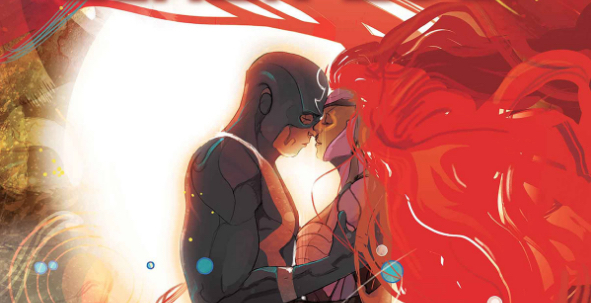
Reconciling with the Past in Black Bolt 12

By Drew Baumgartner

Black Bolt 12

This article contains SPOILERS. If you haven’t read the issue yet, proceed at your own risk!

The superhero genre is littered with emotionally scarred men. Whether it’s a murdered loved one or a superpower-generating freak accident, trauma of one kind or another is a ubiquitous motivator for superheroes. Indeed, for most characters, that tragic backstory is so central to who they are and why they fight that it’s all but impossible to truly confront it — remove the psychological pain, and you “solve” the character’s motivating problem, effectively ending their story. So most of these characters are doomed to never resolve their issues. But what if why they fight has little to do with their trauma? What if that emotional baggage isn’t their motivating force? What if a superhero could confront their problems without destroying the conflicts that make them a hero in the first place? These are questions posed by discerning fans for decades, but rarely have those questions been answered as effectively as they are in Saladin Ahmed and Christian Ward’s Black Bolt 12. Continue reading

Analog 1: Discussion

By Patrick Ehlers and Drew Baumgartner

This article contains SPOILERS. If you haven’t read the issue yet, proceed at your own risk!

Patrick: I listen to a lot of Slate’s Trumpcast. Y’know, because the president has me in a nearly constant state of low-key panic, and I feel utterly powerless to stop our democracy from crumbling, so like, might as well listen to a podcast about it. One of the things that comes up on the show pretty often is the idea that we need to let go of the idea that there is one smoking gun that will implicate the administration and the president himself in collusion with the Russian government. There is no evidence so ironclad that it would force impeachment. Further, impeachment and removal from office would not address the systemic problems with corruption, bigotry, and foreign interference. There’s no “one solution” because there is no “one problem.” Gerry Duggan and David O’Sullivan’s Analog 1 takes a very specific speculative high-concept pitch, and gradually reminds the reader of everything else that is intriguing and terrifying about their world — there is no “one problem.” Continue reading

Peter’s Problems Outpace His Growth in Amazing Spider-Man 798

by Drew Baumgartner

Amazing Spider-Man 798

This article contains SPOILERS. If you haven’t read the issue yet, proceed at your own risk!

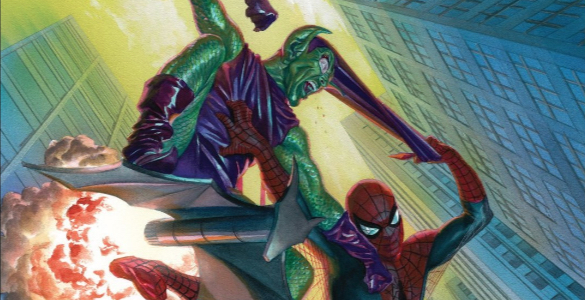
I had a college professor who liked to talk about “the ascending spiral groove thang” — the notion that we tend to cycle through the same problems, but always with our previous experience informing each new iteration, turning that cycle into a kind of spiral staircase. It’s an elegant idea that helps turn the hopelessness of facing down the same issues again and again feel like an opportunity for improvement. It’s an idea that Peter Parker embodies almost perfectly, vowing to improve (if never quite perfect) the decisions that led to the deaths of his loved ones. But what if those problems have an ascending spiral groove thang of their own? What if Peter’s problems are getting smarter and more mature along with him? That’s exactly what he’s up against in Amazing Spider-Man 798, as Norman Osborn returns with the Carnage symbiote. Continue reading

A Glass Half-Full of Pessimism in Days of Hate 3

by Drew Baumgartner

Days of Hate 3

This article contains SPOILERS. If you haven’t read the issue yet, proceed at your own risk!

Drew: The heuristic we use for optimism and pessimism — whether a glass is seen as half full or half empty — focuses on the language we use to frame a description. But that’s not necessarily the difference between an optimist and a pessimist. If we could construct some kind of neutral description of an amount of water in a glass, you could still have disagreement about whether that is good or bad, whether it will improve or get worse, and what exactly caused this state in the first place. Moreover, in this day and age, you might have people disagreeing about the facts of how much water is in the glass at all. These are the distinctions Aleš Kot and Danijel Žeželj make between Amanda and Xing’s accounts of their relationship in Days of Hate 3. Continue reading