Kingpin’s Trumpocracy in Daredevil 598

by Michael DeLaney

This article contains SPOILERS. If you haven’t read the issue yet, proceed at your own risk!

Nick Spencer had his take on Trump’s America in Secret Empire and now Charles Soule holds the mirror up to our current national nightmare in Daredevil 598. Wilson Fisk is the mayor of New York City and like Trump, he’s planning on making America great again…for the bad guys. Continue reading

Fluid Stakes Keep Hawkeye 15 Breezy

By Drew Baumgartner

Hawkeye 15

This article contains SPOILERS. If you haven’t read the issue yet, proceed at your own risk!

That’s a dumb joke, but it’s one of my all-time favorites. It doesn’t make any sense — Bender should know that the person he’s talking about is standing directly in front of him — but the reveal to us is just so perfect. It’s the kind of joke that really only works in visual media, taking advantage of the limits of our perspective we all take for granted. We assume we understand who is in the scene because of who we’ve been shown, but anybody could feasibly be lurking just off-camera. That kind of perspective twist is part of what gives Kelly Thompson and Leonardo Romero’s Hawkeye such a distinct voice, as our perspective telescopes to best suit the scene. Indeed, as issue 15 demonstrates, they can shift perspective both literally and figuratively to goose just about anything. Continue reading

Welcome Nuance Enriches Batman: White Knight 5

by Spencer Irwin

This article contains SPOILERS. If you haven’t read the issue yet, proceed at your own risk!

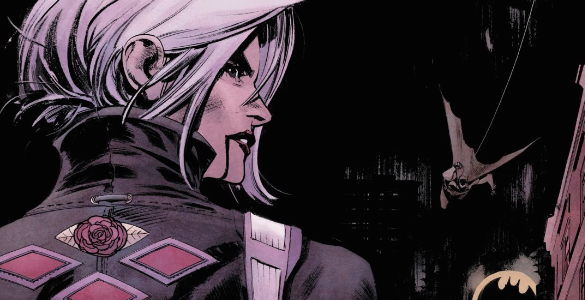
This is the first installment of Batman: White Knight where Batman has really felt like Batman to me. Sean Murphy digs into the character’s nuances in a way that he hasn’t in previous issues. This is the Batman who will buy Harley Quinn a dress and support her sincere, if bungled, efforts to reform, because under his gruff exterior he truly does care about people, even villains. This is the brilliant detective who has managed to piece together a good 95% of Neo-Harley’s plan when most of the other heroes barely even realize she has a scheme at all. Even Batman’s failed attack on Neo-Harley that closes the issue — which results in the destruction of one of Gotham’s bridges and Batman becoming a fugitive — is motivated by Neo-Harley’s personal attack on him and a desire to protect his family, not wild, unreasonable vengeance. This isn’t the gruff madman of previous issues — this is a complex Batman who still wants what is best for Gotham City. He’s just blinded by his hatred of the Joker. Continue reading

Bridging the Gap Between the Old and the New in Star Wars 43

by Mark Mitchell

This article contains SPOILERS. If you haven’t read the issue yet, proceed at your own risk!

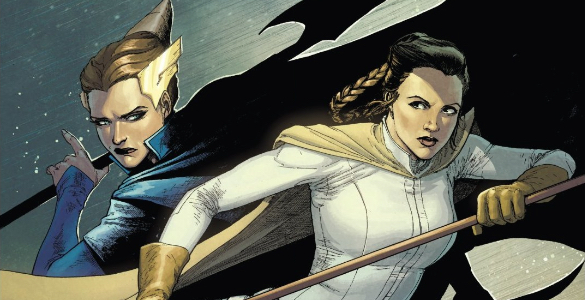
I’ve always considered Marvel’s Star Wars comic to be an extension of the Original Trilogy — a way to continue telling stories with the characters and within the framework that most fans are familiar with — but Kieron Gillen and Salvador Larroca’s Star Wars 43 surprises by also acting as a satisfying coda to 2016’s Rogue One. From closing the book (for now) on Jedha to calling back to Princess Leia’s final line in the film, Star Wars 43 neatly bridges the gap between “old” Star Wars and “new” Star Wars in way that fulfills the promise of post-George Lucas single canon Star Wars cross-media world-building.

And as sterile and filled with corporate buzzwords as that all sounds, it’s effective when it works.

Continue reading

Superhero Action Monopolizes Black Lightning: Cold Dead Hands 4

by Drew Baumgartner

Black Lightning Cold Dead Hands 4

This article contains SPOILERS. If you haven’t read the issue yet, proceed at your own risk!

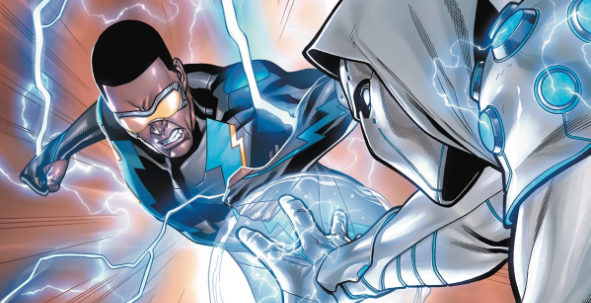
Is there a limit to how subtle a superhero story can be? I’m certainly not of the mindset that tights and flights have to be bombastic or simple, but it seems obvious to me that, say, “being able to punch really hard” isn’t a solution that can be applied to every problem. Creators have found countless was to get subtler beats into their superhero work, but at some point, “being able to punch really hard” must come up, or the story might as well not feature a superhero. I’ll often regret that necessity when stories jerk away from compelling subtleties for generic action, which is unfortunately what Black Lightning: Cold Dead Hands 4 is all about. Continue reading

X-Men Red 1: Discussion

by Spencer Irwin and Ryan Desaulniers

This article contains SPOILERS. If you haven’t read the issue yet, proceed at your own risk!

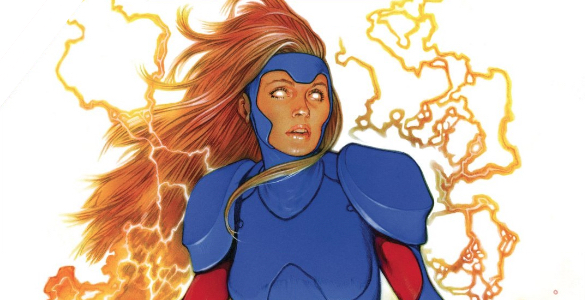
Spencer: What are the X-Men best known for? I’d honestly say that there’s two answers to this, because while thematically the X-Men are most often used to explore discrimination and social justice, in execution they’re just as well known for their unwieldy cast, soap opera dramatics, and byzantine continuity. I think what I like most about Tom Taylor and Mahmud Asrar’s debut issue of X-Men Red is how heavily it leans into that first aspect, while ignoring the latter almost entirely. There’s plenty of character within these pages, of course, but this is first-and-foremost a title with a mission and a message. Continue reading

Snow as Setting and Tone in Black Bolt 10

By Patrick Ehlers

This article contains SPOILERS. If you haven’t read the issue yet, proceed at your own risk!

Not only is it cliche to say that setting of a story becomes its own character, it’s also inaccurate. I don’t care how much you think New York City is a character in [whatever movie you’re talking about], characters have wants, desires, arcs — characters can change and be changed by the story. A location cannot. A good setting can be incredibly additive, coloring in emotional information and setting an appropriate tone, but, y’know — isn’t a character. In Black Bolt 10, writer Saladin Ahmed and artist Christian Ward use the ancient Inhuman city of Orollan, nestled away in Greenland, to emphasize the cold lonely journey Black Bolt has been on since issue 1. Continue reading

Letting the Moment Linger in Infinity Countdown: Adam Warlock 1

By Taylor Anderson

This article contains SPOILERS. If you haven’t read the issue yet, proceed at your own risk!

After a particularly difficult class period the other day, I found myself in the teacher’s lounge staring at a clock for several minutes. Another teacher came in at some point and commented on what I was doing. When I explained I was just enjoying the silence of the moment after my class, they completely understood. Teaching — or any stressful job — is like that. After moments of stress, it’s nice to just rest a moment and let everything sink in. The same goes for when your reading an exciting comic. After a momentous event, it’s nice when the creators give you a moment to breathe and process what just happened. Not sure what I’m talking about? Luckily, the excellent Infinity Countdown: Adam Warlock 1 provides a great example of what I mean. Continue reading

Green Lanterns 40: Discussion

by Michael DeLaney and Mark Mitchell

This article contains SPOILERS. If you haven’t read the issue yet, proceed at your own risk!

Michael: Tim Seeley’s Green Lanterns has the DC logo on the cover, but it feels like a very Marvel series, particularly The Amazing Spider-Man. In the heyday of the Stan Lee/Steve Ditko era, ASM had socially relevant messages, long-running narratives, and, of course, the down-on-his-luck protagonist. The modern Amazing Spider-Man tales try that same type of storytelling with an occasional social media flair — to varying success. With ties to prior issues and the constant personal problems of our heroes, and a superhero dating app, Green Lanterns 40 fits right in with that ASM mold. Continue reading

Different Kinds of Powers and Responsibilities in Incognegro Rennaisance 1

by Drew Baumgartner

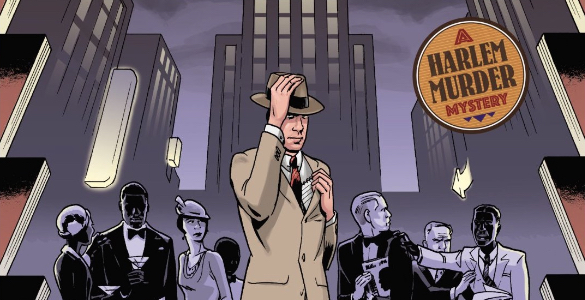
Incognegro Renaissance 1

This article contains SPOILERS. If you haven’t read the issue yet, proceed at your own risk!

Way back in August of 1962, Peter Parker learned that with great power must also come great responsibility. It’s an important lesson, though the fact that Peter’s “power” manifests as literal superhuman abilities seems to leave some readers confused about what their own responsibilities are. In the intervening years, our discourse on power has gotten a lot more nuanced than whether someone can or can’t stick to walls, which has in turn changed our expectations of individual responsibility. Of course, the predominantly white, predominantly male world of superheroes might not be the best place to explore the more subtle (but no less powerful) issues of power and responsibility that come along with race and gender, which is exactly what made Mat Johnson and Warren Pleece’s Incognegro so remarkable when it hit stands in 2008. Indeed, the obvious differences between Incognegro and the superhero genre may make the comparison seem absurd — and it may well be — but their prequel series, Incognegro: Renaissance, takes on the familiar (and appropriate) form of the superhero origin story, complete with its own call to action about power and responsibility. Continue reading