The Reader Knows Too Much in Action Comics 996

by Michael DeLaney 

This article contains SPOILERS. If you haven’t read the issue yet, proceed at your own risk!

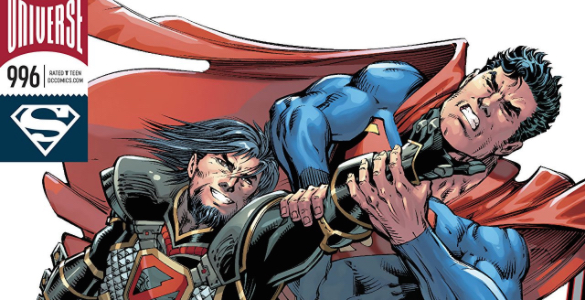
Action Comics 996 has me thinking about our expectations and interactions with an individual comic book issue. As readers, we are operating in a dimension above the characters on the comic book page. We are omniscient in that we know what Lois and Superman are up to in their separate times and spaces. Unlike Superman, we know that Zod’s son lies in wait for our hero because of Dan Jurgens’s cover for the issue. Since Lor-Zod’s appearance is a foregone conclusion, does that “spoil” the story at all? Does it diminish the final page reveal? Continue reading
Narrative Distance in The Wild Storm 11

by Drew Baumgartner

Wild Storm 10

This article contains SPOILERS. If you haven’t read the issue yet, proceed at your own risk!

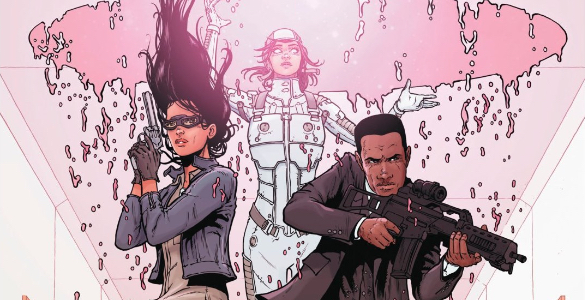
As readers, we’re all duly familiar with the narrative modes — third person omniscient, first person, objective observer, etc — we’re taught them from an early age, and are aware of them in basically all narrative writing. We’re far less aware of the narrative modes in visual storytelling, and lack the kind of common nomenclature to identify them that we have for literary narrative modes. But there’s no doubt that they profoundly influence our perceptions of visual media — there’s a profound difference between a camera shooting from over a character’s shoulder to one that is meant to literally represent their point of view, and we can feel that difference, even if we don’t have precise language to describe it. It allows visual storytelling to be much more visceral and subtle than prose, as we’re not necessarily consciously aware of its effects. With The Wild Storm 11, Warren Ellis and Jon Davis-Hunt exploit this feature of visual narrative for all its worth, keeping us at a distance from any of the events of the issue. Continue reading

Tapping Into the Raven of Old in Raven: Daughter of Darkness 1

by Spencer Irwin

This article contains SPOILERS. If you haven’t read the issue yet, proceed at your own risk!

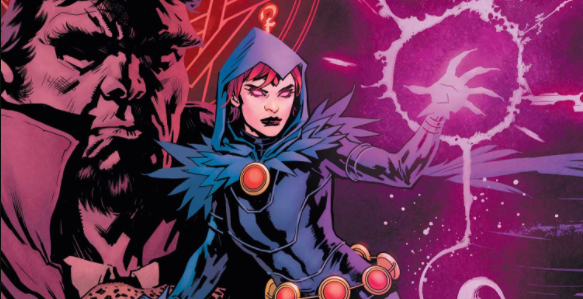
When talking about the three new characters he co-created at the outset of The New Teen Titans, writer Marv Wolfman has said that, while he’d probably eventually run out of ideas for Cyborg and Starfire, he felt like he could continue on writing Raven stories forever. I find it sweet and admirable to see how Wolfman has stuck to that nearly 40 years later, continuing to pen the occasional new Raven story even as the character has changed so much from the one he originally conceived.  Continue reading

Doomsday Clock 3: Discussion

by Spencer Irwin and Michael DeLaney 

This article contains SPOILERS. If you haven’t read the issue yet, proceed at your own risk!

Spencer: What’s the most controversial element of the original Watchmen? For my money, it’s the pirate comics. I understand and appreciate the in-universe reasons for choosing pirates, and I understand their function in reflecting the themes of the story in a sort of parallel narrative, but I’ll admit that, while many readers consider them sacred, I’ve skipped them in all my subsequent Watchmen rereads. To me, those segments have always felt tantamount to the supplemental material in the back of each issue, something extra and non-essential, important more as an intellectual exercise than as an interesting narrative, or an interesting part of the overall Watchmen narrative, in their own right. Issue three of Geoff Johns and Gary Frank’s Doomsday Clock introduces this semi-sequel’s own version of the pirate comics: the noir movie. I have similar issues with these segments as well. Continue reading

Camp, Parody, and Political Edge in Batgirl 19

By Mark Mitchell

This article contains SPOILERS. If you haven’t read the issue yet, proceed at your own risk!

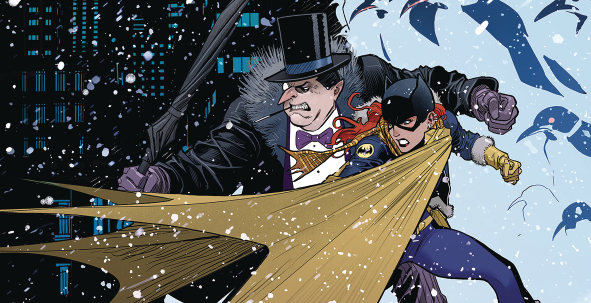
Last July, I wrote at length about Batgirl 13’s full-armed embrace of the campy spirit emblematic of the Batman TV show of the 1960’s, and with Batgirl 19 Hope Larson, Chris Wildgoose, and Jose Marzan Jr. continue to lean into that care-free aesthetic. Continue reading

Form Trumps Myth in Hal Jordan and the Green Lantern Corps 37

By Patrick Ehlers

This article contains SPOILERS. If you haven’t read the issue yet, proceed at your own risk!

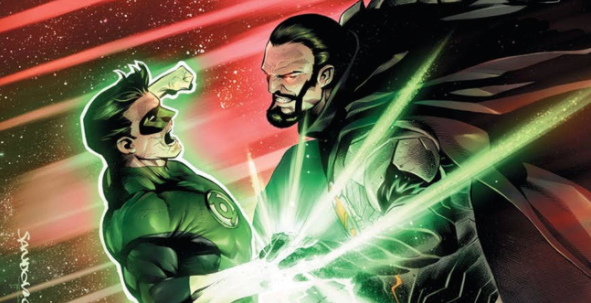
My Green Lantern fandom often feels like a relic from a time before I truly understood what I loved about comics. I love the limits of the medium — the way an artist has to imply light and sound and movement and time all on a still page which literally possesses none of these qualities. So much of a comic story, for me, is in how it is told, rather than what it’s telling. But Green Lantern is a myth-making franchise, and the moment-to-moment storytelling can often be measured by the twists and connections it makes to its own winding history. Hal Jordan and the Green Lantern Corps 37 eschews that entirely, pulling one of Superman’s Big Bads into the ring for some refreshingly innovative visual storytelling. Continue reading

A Friendship-Strengthening Crossover Concludes in Super Sons 12

by Spencer Irwin

This article contains SPOILERS. If you haven’t read the issue yet, proceed at your own risk!

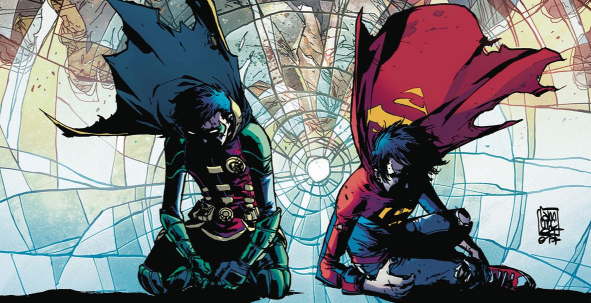
I’ve been reading Peter Tomasi and Patrick Gleason’s collaborations for the better part of a decade now, and there’s one thing I’ve learned — even when I’m not fully taken by one of their plots, the emotions behind their stories always ring true. That’s what makes Super Sons 12 by far the best chapter of the “Super Sons of Tomorrow” storyline: it’s far more concerned with the emotions of all the characters involved than it is the time-traveling, hypertime-shattering plot. Continue reading

The Big Brother of Steel in Superman 39

By Michael DeLaney

This article contains SPOILERS. If you haven’t read the issue yet, proceed at your own risk!

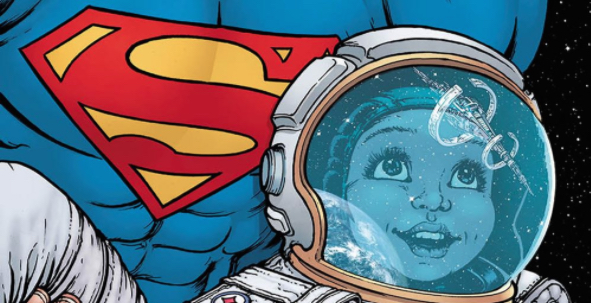
With DC’s recent announcement that The Man of Steel will be regaining his red trunks, it looks like they’re embracing the the classic Superman of yore. Another example is Superman 39, which centers around Superman spending the day with young cancer patients. If that’s not golden age wholesome, then I don’t know what is. Continue reading

Batman 39: Discussion

By Drew Baumgartner and Mark Mitchell

Batman 39

This article contains SPOILERS. If you haven’t read the issue yet, proceed at your own risk!

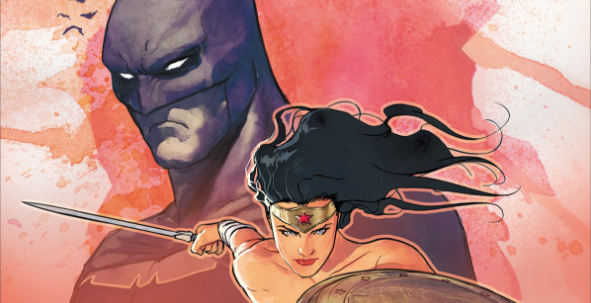
Drew: Hey, so what is fidelity? I think we all understand the general concept, but the exact borders of the definition are not entirely well defined. If your significant other dies, for example, very few people would classify moving on to another relationship as “cheating,” so we might fairly define “death” as one of the hard edges of fidelity. But what if they’re just presumed dead — say, on a desert island for years and years? Do we consider Helen Hunt’s marriage in Cast Away to be cheating on Tom Hanks? What if it had been Tom Hanks who forged the new relationship (on the island, somehow) — he knows he’s not dead (and could reasonably assume Helen Hunt isn’t), but do the rules of fidelity extend to seemingly hopeless circumstances of languishing in a remote corner of the world? These are certainly unlikely hypotheticals, but unlikely hypotheticals are what superhero comics are all about, and exactly what Batman 39 needs in order to maybe-kinda-sorta justify Batman and Wonder Woman hooking up. Continue reading

An Overdue Spotlight Turns on Laney Lan in New Super-Man 19

by Mark Mitchell

This article contains SPOILERS. If you haven’t read the issue yet, read on at your own risk!

When New Super-Man premiered, Laney Lan, the book’s Lois Lane equivalent (whose name my iPad always wants to autocorrect like she’s a local area network), was primed to play a prominent role in the series — Kenan Kong had goo-goo eyes for her, and her plucky reporting skills promised to help Kenan unravel the mysteries of his family. But somewhere along the way, series creator Gene Luen Yang seemingly lost interest in repeating the ideas of Superman beat for beat, or perhaps just couldn’t find room for Laney as the book began to sprawl. But as Yang prepares to relaunch New Super-Man as New Super-Man and the Justice League of China, Mariko Tamaki and Richard Friend’s one-off New Super-Man 19 circles back to turn a spotlight on Laney — maybe as a taste of a larger role in the story going forward, or maybe as a last hurrah for a character who never quite had a place.

Continue reading