Silver Surfer 14: Discussion

by Spencer Irwin and Drew Baumgartner
This article containers SPOILERS. If you haven’t read the issue yet, proceed at your own risk!

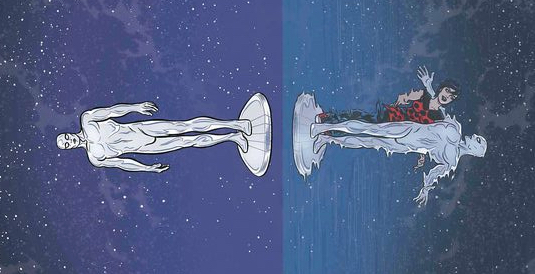
Spencer: When it comes to weaving together long-term plots and storylines spanning years and years, Dan Slott might just be the best there is right now — if not in all of comics, then almost certainly in mainstream superhero books. Silver Surfer 14 is Slott (and Michael and Laura Allred) firing on all cylinders, bringing two volumes’ worth of stories to an immensely satisfying ending. It not only resolves and honors everything that’s come before, but continues to put all the qualities that have made Silver Surfer such a quality read on full display: wonder, adventure, joy, love, and pure emotion — oh, and some metatextual fun, too. Continue reading
Generation Gone 4: Discussion

by Ryan Desaulniers and Mark Mitchell

This article contains SPOILERS. If you haven’t read the issue yet, proceed at your own risk!

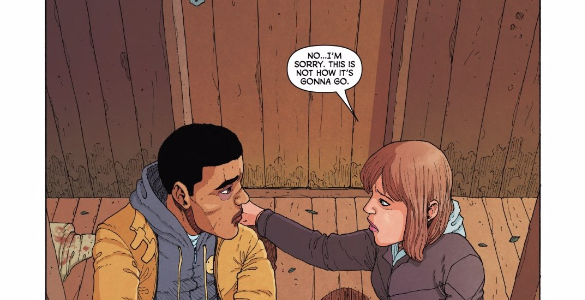
Ryan D: In the premiere issue of this series, Mr. Akio uses the image of the ouroboros as the symbol for his Project Utopia during his pitch to General West. While this motif appears without much fanfare, it hasn’t been until issue four of Generation Gone that the significance of the serpent eating its own tail begins to fulfill its own inherent meanings. Originally seen as iconography from an ancient Egyptian Book of the Dead, the ouroboros survived through medieval mysticism until finding its home in Renaissance alchemical texts and beyond. Throughout its tenure, it’s represented many things, with the common denominator being duality, and Ales Kot infuses this issue with a multitude of cyclicality and layered recurring through-lines. Continue reading

Discussion: Mighty Thor 700

by Taylor Anderson and Patrick Ehlers

This article contains SPOILERS. If you haven’t read the issue yet, proceed at your own risk!

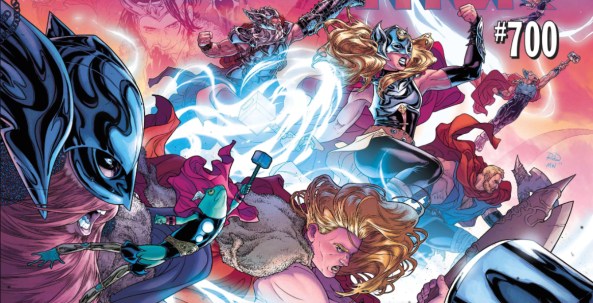
Taylor: Midway through the extra large, special 700th issue of Mighty Thor, Karnilla, Queen of the Norns, asks which ingredient is the most essential in the makeup of a Thor. It’s a good question, and one that writer Jason Aaron has been exploring ever since he took over the reigns of Thor some 60 issues ago. While Aaron has posed various answers to this question multiple times, he’s never come outright and revealed to readers what exactly makes a Thor Thor. That is, he’s never done that until now. Using the 700th issue as his podium, Aaron waxes poetic on the nature of Thor, presenting us with not so much a new Thor narrative, but a grand tapestry that relishes in pondering what Thor has been, currently is, and what it will always be. Continue reading

Deadpool vs. Old Man Logan 1: Discussion

by Michael DeLaney and Spencer Irwin

This article contains SPOILERS. If you haven’t read the issue yet, proceed at your own risk!

slim-banner

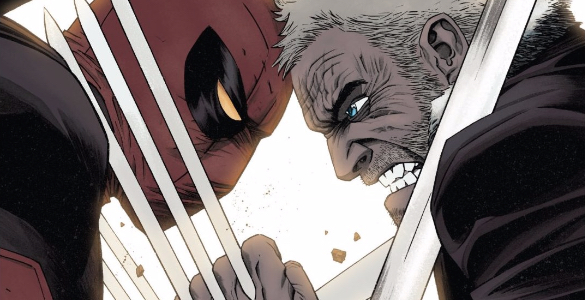
Michael: A common criticism of a piece of fiction is “nothing really happened.” The meaning of that blanket statement can vary depending on who the critic is and more specifically what they’re expecting. A great example of this is the Season 3 Breaking Bad episode “The Fly.” Critics praised the bottle episode as a brilliant character study while it left many audiences unimpressed with the fact that “nothing really happened.” While I try to appreciate the deeper meaning of a piece of work, I must say that in Deadpool vs. Old Man Logan 1…nothing really happens. Continue reading

Teenage Mutant Ninja Turtles Universe 15: Discussion

By Drew Baumgartner and Patrick Ehlers

Teenage Mutant Ninja Turtles Universe 15

This article contains SPOILERS. If you haven’t read the issue yet, proceed at your own risk!

Drew: The Teenage Mutant Ninja Turtles have always been the perfect outcasts in a medium made for outcasts. Well, saying that comics were “made” for outcasts isn’t entirely accurate, but it certainly had become a medium for outcasts — at least in the US — by the time the turtles were invented in the 1980s. We don’t really need to get into the causality of why comics fandom was perceived as a weird thing — the point is that it was. And in the age before the internet, someone with a “weird” hobby or enthusiasm for some obscure piece of pop culture might not know anyone else like themselves. While the rest of the world could connect over their religion, political party, or even local sports team, the average comics reader in 1984 might not have had anyone they knew who shared their interest. I don’t bring this up to pity the lot of the poor comics fan — heaven knows plenty of people were more isolated and actively persecuted — just to say that themes of not fitting in have always been an essential part of the TMNT makeup. This is a point that Erik Burnham and Sophie Campbell clearly understand, as their Teenage Mutant Ninja Turtles Universe finds several characters seeking their place in the world. Continue reading

Mister Miracle 3: Discussion

by Mark Mitchell and Michael DeLaney

This article containers SPOILERS. If you haven’t read the issue yet, proceed at your own risk!

Mark: How I feel about Mister Miracle 3 will ultimately depend on how the remaining 9 issues pan out, and if Tom King and Mitch Gerads are able to stick their landing. In isolation, I’m grossed out by King invoking the Holocaust and the genocide of more than 6 millions Jews in Nazi Germany not once, but twice, in this issue. The Holocaust is one of the modern era’s most visceral examples of mankind’s cruelty towards mankind, and as such it has become shorthand in media for “A Very Bad Thing.” Comparing fictional events to the Holocaust is cheap and easy, and doing so runs the risk of devaluing the real-life horrors experienced by real people and perpetrated by their fellow men.

Continue reading

Despicable Deadpool 287: Discussion

by Patrick Ehlers & Taylor Anderson

This article contains SPOILERS. If you haven’t read the issue yet, proceed at your own risk!

slim-banner

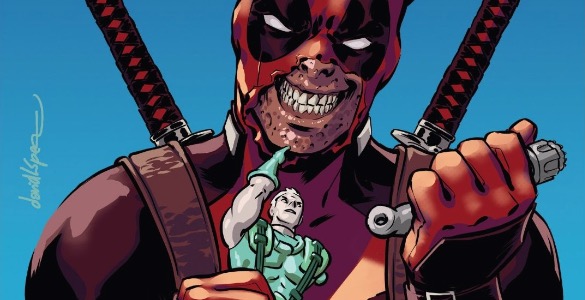
Patrick: There’s a principle in screenwriting called “save the cat.” That phrase refers to the act of unambiguous good a character needs to perform in order to win the audience’s sympathy. To use the idiom’s namesake as an example, as long as our hero has rescued a cat from a tree branch, any other morally dubious behavior can be forgiven. One shred of evidence that he’s a good guy is enough to trick our brains into believing that he must actually be good. This may sound like kind of a hack technique, but writers use it all the time, particularly since the rise of antiheroes. Our boy Wade Wilson gets them all the time — the audience can recoil at 95% of his actions, just so long as he protects a kid, helps and old lady, or saves a cat. Despicable Deadpool 287 throws that convention out the fucking window. This isn’t the hero Deadpool, this is the cut-throat, single-minded, merciless merc with the mouth. Continue reading

Batman: White Knight 1

by Ryan Desaulniers and Mark Mitchell

This article contains SPOILERS. If you haven’t read the issue yet, proceed at your own risk!

 He’s the hero Gotham deserves, but not the one it needs right now.

Jim Gordon, The Dark Knight

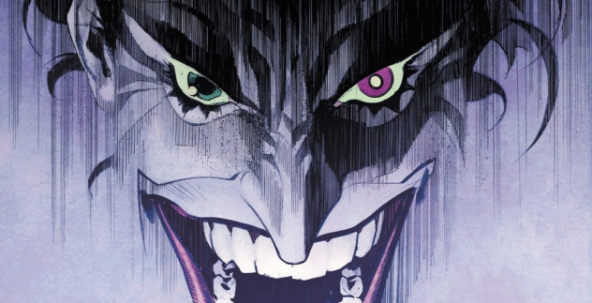
Ryan: Since that line was uttered in lamentation of Gotham’s corruption, I feel as if it’s almost become a canonical outlook on the Caped Crusader. The thing about that line, though, is that it’s purely subjective on Gordon’s part, and particular unto the circumstances of that Batman story in that film. And almost every statement can be used against the point for which it was originally made, right? Even scientists with objective data sets can use the same numbers to support the opposite side of an argument, or the same verse of scripture used to prove opposing points. In Batman: White Knight 1, Sean Murphy takes Jim Gordon’s iconic statement and uses it to sow the seeds of a Gotham wherein the Joker justifies his action with that logic, both as a villain and a hero. Continue reading

Hawkeye 11: Discussion

by Taylor Anderson & Patrick Ehlers

This article contains SPOILERS. If you haven’t read the issue yet, proceed at your own risk!

slim-banner

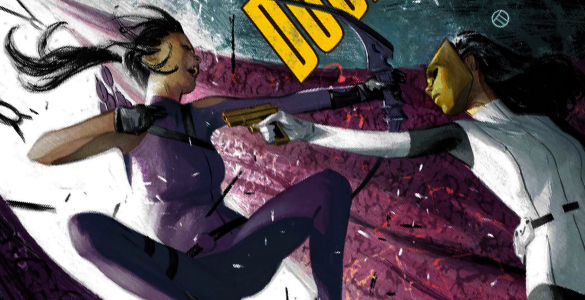
Taylor: If you read enough ancient ancient Greek myths you quickly realize that people have had complicated relationships with their parents since history began. Cronus was afraid his son Zeus would kill him and take over the world so he tried to eat him. Cronus failed. Zeus did indeed come to rule Mt. Olympus but not, without inheriting his father’s fear of his own children. Kate Bishop shares a similarly complicated relationship with her father, the only difference is that she doesn’t fear him so much as she fears to become him one day. This relationship is part of what defines Kate and the way she responds to it is fascinating in Hawkeye 11.

Continue reading

Batman 32: Discussion

by Drew Baumgartner and Michael DeLaney

Batman 32

This article contains SPOILERS. If you haven’t read the issue yet, proceed at your own risk!

I don’t know.

Teenager, Traditional

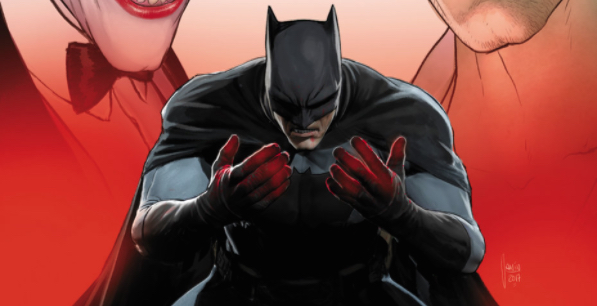
Drew: I used to work as an Assistant Dean for an academic enrichment program — basically, high-school students would come to a college campus for a few weeks over the summer to take some classes and get a feel for dorm living. The Dean’s office was there to keep kids out of trouble, or, more accurately, to address the trouble that the kids inevitably got into. Most of the time, the motives for their infractions were clear enough — they skipped class because it was boring or they tried to sneak into the girl’s dorm to see their girlfriend — but every so often, a kid would do something so inexplicable, the first question had to be “why?” And the answer, invariably, was “I don’t know.” Sometimes, our better judgement eludes us, allowing weird impulses or emotions to lead us to actions we can neither explain nor defend. It’s a phenomenon that teens are particularly prone to, with their hormonally-charged emotions and only-partially-developed impulse control, but it happens to adults, too (even sober ones). It is one of these moments that turns out to be Bruce Wayne’s “greatest sin,” as the climax of “The War of Jokes and Riddles” leads him to a rare flash of moral weakness. Continue reading