Moonshine 8: Discussion

by Drew Baumgartner and Patrick Ehlers
Moonshine 8

This article contains SPOILERS. If you haven’t read the issue yet, proceed at your own risk!

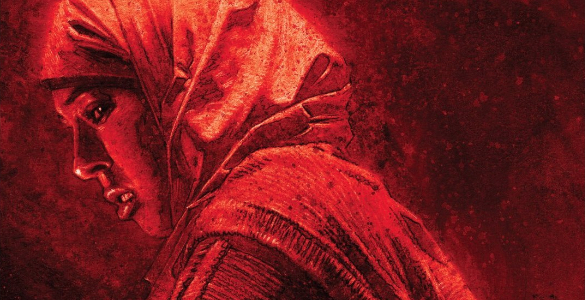
Dyin’? Boy, he can have this little life any time he wants to. Do ya hear that? Are ya hearin’ it? Come on. You’re welcome to it, ol’ timer. Let me know you’re up there. Come on. Love me, hate me, kill me, anything. Just let me know it.

Luke, Cool Hand Luke

Drew: It’s hard for me to read genre fiction through anything other than a deconstructionist lens. I mean, it’s hard for me to read anything through anything other than a deconstructionist lens, but this is especially true of genre fiction, where by definition conventions must be explicitly followed. Fortunately for me, that postmodern generic awareness is just as prevalent in creators as it is in audiences, so I’m never struggling to find multidimensional, self-aware, fully postmodern genre fictions. But the good ones, the ones that actually force me to reexamine the genres they’re deconstructing (rather than just having fun with some winking references), are few and far between. But Brian Azzarello and Eduardo Risso’s collaborations have always gone a step further. Beyond cute self-awareness or even symphonic use of references, Azzarello and Risso’s work offer new perspectives on the foundational genre pieces they take on. That is to say, their comics don’t just gain meaning from their references — their references gain meaning from the comics. They’re almost a purer form of postmodernism, digesting entire genres in a few issues, offering new readings to even the most familiar works of art. Continue reading

Infidel 1: Discussion

by Drew Baumgartner and Ryan Desaulniers

Infidel 1

This article contains SPOILERS. If you haven’t read the issue yet, proceed at your own risk!

The oldest and strongest emotion of mankind is fear, and the oldest and strongest kind of fear is fear of the unknown.

H.P. Lovecraft, Supernatural Horror in Literature

Drew: I’m not sure there’s anything we fear quite like the unknown. Whether it’s xenophobia or just things that go bump in the night, every fear is defined by the things we don’t (yet) understand. And while our society has legitimized the former (effectively forgetting that it’s as nonsensical as the latter) all fears spring from that same well of the unknown. Which is what makes Pornsak Pichetshote and Aaron Campbell’s Infidel so alluring; they’ve brought those fears back together, using supernatural elements to illustrate the more pressing real-world fears its characters live with. Continue reading

The Dangers of the Unknown in Curse Words 12

By Spencer Irwin

This article contains SPOILERS. If you haven’t read the issue yet, proceed at your own risk!

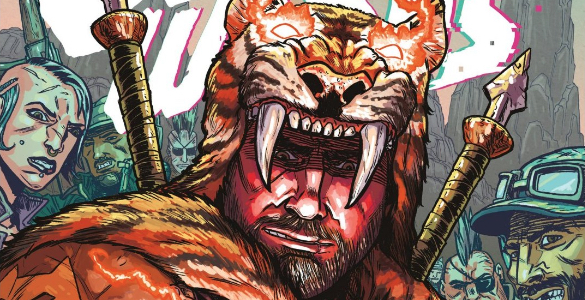
What is magic? In many ways it’s the unknown — mere mortals attempting to wield power beyond their comprehension, attempting to control and contain vast, foreign energy. At the end of Charles Soule and Ryan Browne’s Curse Words 12 Margaret puts her total faith in magic, despite not knowing what effects it may have on her. Why? Because when you define something with infinite possibilities as “magic” that definition makes it trustworthy? Because she trusts the source of this particular magic (Wizord and Ruby Stitch?)? That idea of who and what you can trust, and what you know and what you don’t, is one that runs throughout this entire issue. Turns out not everyone trusts the unknown quite as much as Margaret does. Continue reading

Grief is Messy in The Fix 11

By Patrick Ehlers

This article contains SPOILERS. If you haven’t read the issue yet, proceed at your own risk!

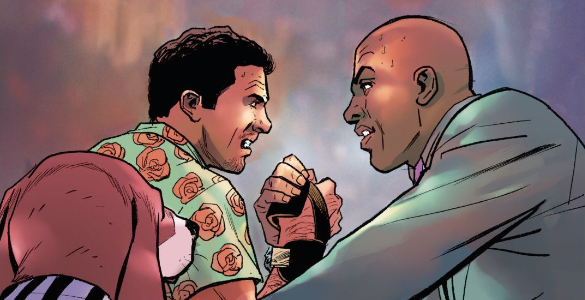
I know this is hypocritical immediately following a spoiler alert, but I don’t believe in spoilers. They’re something I respect because I know other people believe in them (like God), but the threat of a spoiler doesn’t change the articles I will read or the conversations I’ll have (huh, also like God). If a movie or tv show or book is so slight as to have the experience of it ruined by simply knowing what’s going to happen, it probably wasn’t worth experiencing in the first place. The Fix 11 starts with a seismic shift, fully acknowledging the trope that Nick Spencer and Steve Lieber are subverting for shock value. “Surprise” reads the narration box. But the surprise isn’t the point, the fall-out from the surprise is. Continue reading

Gideon Falls 1: Discussion

by Ryan Desaulniers and Mark Mitchell

This article contains SPOILERS. If you haven’t read the issue yet, proceed at your own risk!

…nothing is so alien to the human mind as the idea of randomness.

John Cohen

Ryan D: Pattern recognition plays an integral role in the human cognitive process, with comic books being a particular medium which simply wouldn’t work without that ability to see and recognize patterns in visual symbols, icons, and shapes, as our brains wrestle a slew of static visual images into a narrative. The images are coherent because they are created together purposefully to be consumed in relation to each other. However, the human brain can still find patterns where there is no direct correlation. In 1958, the term “apophenia” came into being to describe that ability to take unrelated things and tie them together with connections which might not exist. We can observe this phenomenon every day in the form of confirmation bias, or, in more extreme cases, the claims of paranoid schizophrenics who may find the most benign details to be irrefutable proof of a grandiose conspiracy. So what happens if two seemingly unrelated people in different parts of the world — one embroiled in this hunt for clues in an outlandish pattern, the other just trying to adjust to a new life — both find the horrifying answer to what seems to be delusion? Herein lies the crux of Gideon Falls 1 by Jeff Lemire and Andrea Sorrentino, backed by a decorated team on colors and lettering of Dave Stewart and Steve “SWANDS” Wands. Continue reading

Remixing the Familiar in Oblivion Song 1

by Drew Baumgartner

Oblivion Song

This article contains SPOILERS. If you haven’t read the issue yet, proceed at your own risk!

…there is no new thing under the sun.

Ecclesiastes 1:9

It’s unfortunate that pointing out that something isn’t entirely original is seen as a critique. In this postmodern age of the remix, surely we can all understand that nothing is “entirely original,” or at least isn’t made from entirely original parts. As with cooking, the excitement lies more in how the individual ingredients interact with one another than any one ingredient’s novelty. Such is the case with Robert Kirkman and Lorenzo De Felici’s new Oblivion Song, which smashes together several familiar premises and character motivations, but manages to produce something surprisingly refreshing. Continue reading

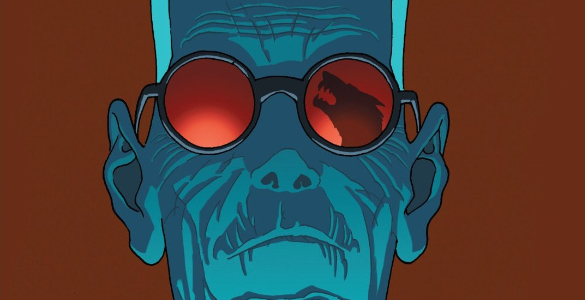
East of West 36: Discussion

By Drew Baumgartner and Taylor Anderson

East of West 36

This article contains SPOILERS. If you haven’t read the issue yet, proceed at your own risk!

American history is longer, larger, more various, more beautiful, and more terrible than anything anyone has ever said about it.

James A. Baldwin

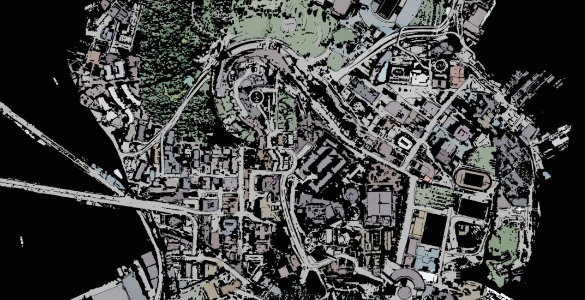
Drew: The sci-fi trappings of East of West can at times make its alternate history feel particularly exotic, but for better or for worse, much of its history resembles our own. I mean, sure, our own Civil War ended in just over four years, and there was no comet that brought with it an apocalyptic prophecy, but most of the makings of that world lie in the very real history of the antebellum United States. Indeed, the ugliest parts of East of West‘s history are based entirely on the truths of American slavery and Manifest Destiny — the legacies of which we’ve never truly reconciled as a nation. Case in point: the Union’s capitol is built on the literal bones of the Endless Nation, turning a symbol of our own shameful past into a potent image that had heretofore given the Union power over the Nation. It’s only by — again, literally — digging up that history that any progress can be made. Continue reading

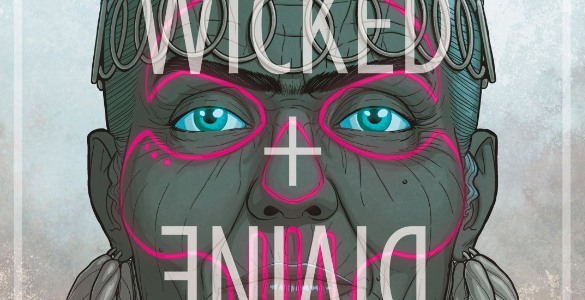
The Art of Doling Out Answers in The Wicked + The Divine 34

by Spencer Irwin

This article contains SPOILERS. If you haven’t read the issue yet, proceed at your own risk!

There are some stories that fall apart once they start giving out answers. Maybe all it had going for it was its mysteries, or maybe the mythology ended up dull or nonsensical, or maybe they spelled everything out in a long, listless exposition drop — the point is, the spark’s gone once the story reveals its secrets. Thankfully, The Wicked + The Divine is not one of those stories. Kieron Gillen and Jamie McKelvie turn doling out answers into an art-form, finding ways to fascinate even when revealing truths to their cast that readers already know. Continue reading

You Always Hurt The Ones You Love in Saga 49

by Spencer Irwin

This article contains SPOILERS. If you haven’t read the issue yet, proceed at your own risk!

Jane: You’re willing to have [your story] published and read by strangers, but you don’t want your best friend to see it?
Daria: Thank you for understanding.

Daria, The Story of D

I’ve never been all that good at communicating with my parents, especially when it comes to details about my life. It isn’t because I don’t like them or we don’t get along, but because I care so much about what they think about me that I’m terrified I’ll upset or disappoint them. It’s the same reason it’s easier for me to share my writing with, or even sing karaoke in front of, strangers than friends — people who actually know and care about you, whose opinions you respect, can hurt you far more than anyone else. Saga 49 finds more cast members than ever crammed into tight quarters, which makes the wounds they inflict upon each other all the more painful. Continue reading

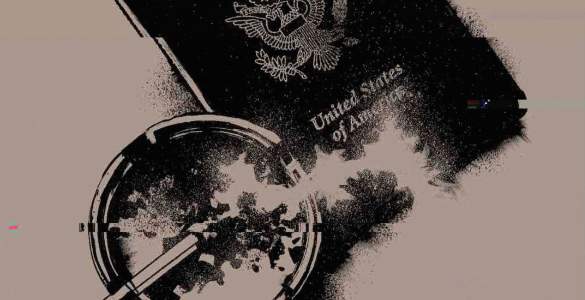
Normalcy in Days of Hate 2

by Patrick Ehlers

This article contains SPOILERS. If you haven’t read the issue yet, proceed at your own risk!

Patrick: After a first issue that went out of its way to show how drastically the world has changed in the not-too-distant future, Days of Hate 2 slows way down to emphasize just how normal the lives of its main characters are. This is every bit as terrifying as a country openly at war with itself. Issue 2 is also much more illustrative of the times in which we currently live. We don’t recognize ourselves as “in-crisis” because we can still call our parents and make plans to go to that lobster place with them on Wednesday. Writer Ales Kot and artist Danijel Zezelj double down on normalcy, shortening the narrative distance between “what if I was in this situation” and “I am in this situation.” Continue reading