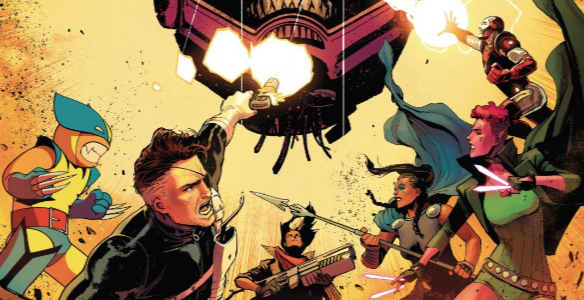
Everybody Has Their Role to Play in Exiles 5

by Spencer Irwin

This article contains SPOILERS. If you haven’t read the issue yet, proceed at your own risk!

slim-banner

Since the very first issue of Exiles the Tallus, an interdimensional, time-traveling gauntlet, has been calling the shots, pulling our heroes from reality to reality with its own agenda in mind. In many ways, it’s the true mastermind behind the defeat of the Time Eater, having charted a path towards victory and collecting heroes and allies all with vital and specific roles to play in its plan. Early on in the series this sometimes felt like it robbed the characters of their agency, but as we reach the finale of Saladin Ahmed and Javier Rodriguez’s story in Exiles 5 that couldn’t be further from the truth. It’s interesting to see the role each Exile has to play, but far more interesting to see them all embrace their roles enthusiastically and of their own volition. Continue reading

Idol Worship in She Could Fly 1

by Drew Baumgartner

She Could Fly 1

This article contains SPOILERS. If you haven’t read the issue yet, proceed at your own risk!

Is familiarity the opposite of idolatry? I suspect it’s only possible to idolize a celebrity or public figure because they’re unknown. Because we’re unfamiliar with their annoying habits or bad smells, we mythologize them as some kind of immaculate demigod, incapable of error. It’s easy to come up with a certain political example, but this is true for most public figures, from Elon Musk to Taylor Swift. We only know so much about these people, and in the cases where we like them, our brain rushes in to fill the rest with perfection. This is obviously the case for Luna Brewster, who has pinned her imagination to a mysterious woman seen flying over Chicago. Continue reading

The Responsibility of the Witness in Daredevil 605

by Patrick Ehlers

This article contains SPOILERS. If you haven’t read the issue yet, proceed at your own risk!

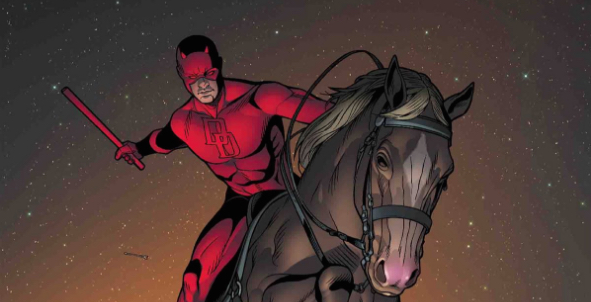
Charles Soule and Mike Henderson’s Daredevil 605 begins with Wilson Fisk raising from his hospital bed to attempt to regain control of New York City. Even dressed in a hospital gown and dragging an IV pole behind him, Fisk backs Foggy into a corner. It looks like Fisk is going to get his way, but ends up collapsing to the ground — it turns out that he wasn’t well enough to exert himself so much. But he made a choice to stop letting Matt Murdock run New York City, rather that simply witnessing it from the safety of his hospital room. While the sun sets on this Wilson Fisk story after three pages, the remainder of the issue plays out that same fundamental question over and over again: what responsibility does a witness have to interfere with whatever they are witnessing? Continue reading

The Many Irreconcilable Definitions of Redemption in The Unbeatable Squirrel Girl 34

By Spencer Irwin

This article contains SPOILERS. If you haven’t read the issue yet, proceed at your own risk!

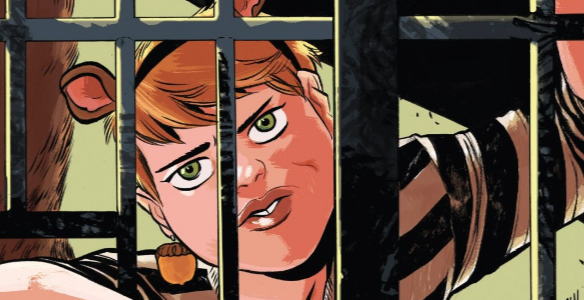
Kraven the Hunter is not only the very first enemy Doreen Green defeated way back when Ryan North and Erica Henderson launched The Unbeatable Squirrel Girl, but he’s also the first enemy she reformed. Unlike the other villains whose lives Doreen has helped turn around, Kraven has continued to pop up as a recurring character ever since, allowing the creative team to explore life after redemption and just what, exactly, Kraven looks like as a “good guy.” With this image now firmly in place, North and artist Derek Charm use The Unbeatable Squirrel 34 to muddy and complicate it in fascinatingly complex and nuanced ways. What redemption means for Kraven may not be the same for Doreen, or Spider-Man, or the police, or the people of NYC, and there may simply be no way to reconcile these various viewpoints.  Continue reading

Amazing Spider-Man 1: Discussion

By Drew Baumgartner and Patrick Ehlers

Amazing Spider-Man 1

This article contains SPOILERS. If you haven’t read the issue yet, proceed at your own risk!

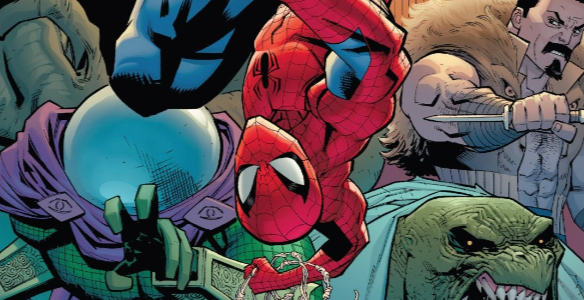
Drew: If you only had one word to describe Spider-Man, what would it be? Strength? Responsibility? Verbosity? These are all great answers, each with plenty of classic Spidey stories that emphasize those characteristics, but they aren’t quite perfect. Plenty of heroes are as strong and/or responsible, and a few even talk as much as Spider-Man, but there’s something else that makes him unique. With Amazing Spider-Man 1, Nick Spencer and Ryan Ottley offer up their own answer — one I had never considered, but feels obvious on reflection: Karma. Beyond his powers and the responsibilities that come with them, Spider-Man is a person plagued by the consequences of his past mistakes. Continue reading

Superman 1: Discussion

by Spencer Irwin and Patrick Ehlers

This article contains SPOILERS. If you haven’t read the issue yet, proceed at your own risk!

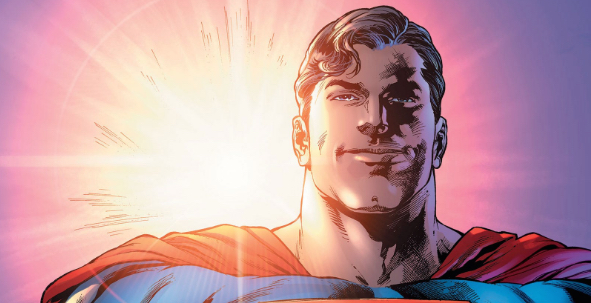
Spencer: One of the biggest criticisms I’ve seen thrown around about Superman as a character is that he’s “too powerful,” that nothing can challenge a man who can quite literally juggle planets. There’s a bit of truth to this, to be sure, but it’s a narrow criticism, one that only takes into consideration physical challenges; the most interesting Superman stories are the ones that challenge him morally, ethically, or in ways that make his physical abilities useless. Superman 1 is such a story, an issue that finds the character at his most physically competent, yet feeling more lost and helpless than ever before.  Continue reading

The Martian Migraines and Cosmic Confusion ofJustice League 3

By Michael DeLaney

This article contains SPOILERS. If you haven’t read the issue yet, proceed at your own risk!

Great superhero epics always have a touch of mystery: an unseen enemy, the villain’s elaborate master plan or the occasional gigantic conspiracy. Does the simultaneous inclusion of multiple mysteries add to the excitement of such an adventure, or does it simply distract? These are the types of questions I face when reading a book like Justice League 3. Continue reading

Sensational Irony in The Immortal Hulk 2

by Patrick Ehlers

This article contains SPOILERS. If you haven’t read the issue yet, proceed at your own risk!

What scares you in media? I mean, we’ll all flinch at a well-timed jump scare: a sting of music, a flash of light, and suddenly we’re face to face with a monster. That’s a scare based on your senses, the creators manipulating your biological responses like buttons on a controller. Writer Al Ewing and artists Joe Bennett, Ruy José and Paul Mounts use sense-based scares as a smokescreen for the real horrors of The Immortal Hulk 2: irony.

This issue is so thematically compact and wonderful, it’s one of those rare superhero comics I’d recommend to anyone with a passing interest in The Hulk or horror comics. Even as Banner’s narration dips into some Civil War II plot nonsense, everything you need to understand the issue is contained within these 20 pages. Continue reading

Death Of The Inhumans 1: Discussion

By Ryan Mogge and Patrick Ehlers

This article contains SPOILERS. If you haven’t read the issue yet, proceed at your own risk!

Ryan: Narration can be a crutch, a device used to add exposition where story cannot carry itself, the epitome of “show don’t tell.” However, when it’s done well, it can be fantastic. In Death of the Inhumans 1, the narration’s tone and point of view work in concert with the story as it unfolds. At times, it feels as though the visual and the narration are two paths that run alongside one another and intersect intermittently. They inform each other and create a balance that elevates both elements to something more nuanced and affecting. Continue reading

Superman Fails to Find a Better Way in Man of Steel 6

by Drew Baumgartner

Man of Steel 6

This article contains SPOILERS. If you haven’t read the issue yet, proceed at your own risk!

Superman always finds a better way.

Superman purist, Traditional

I’m paraphrasing pretty heavily here, triangulating a sentiment from the dozens of arguments I read (and participated in) in the wake of Zack Snyder’s Man of Steel, but the idea that Superman can always come up with a solution that doesn’t involve murder is a ubiquitous one in Superman fandom. And I agree with that idea as it applies to that film — Superman certainly could have at least attempted something else (or the movie could have done a better job convincing us that he had exhausted his options) — but something about “always finding a better way” doesn’t quite feel like Superman to me. His moral compass true, and he’ll never fail to aim for a solution that satisfies his sense of what’s right and wrong, but the thought that he always comes up with a solution would rob those morals of any real consequence. While some Superman stories might resemble Sherlock Holmes in that “seeing how he solves it is the fun” kind of way, one of the most interesting things about Superman having such a strong morality is that it might be tested or bear some emotional cost. That’s a point Brian Michael Bendis and Jason Fabok leverage twice in Man of Steel 6, as Superman fails to “find a better way” in both his superheroing and family lives. Continue reading