The Virtues and Dangers of Information in Paper Girls 22

By Spencer Irwin

This article contains SPOILERS. If you haven’t read the issue yet, proceed at your own risk!

Like with most of Brian K. Vaughan’s books, one of Paper Girls’ best qualities is its letter column. Issue 22’s column ends on one of the more interesting letters the series has received; Vaughan’s avatar, Dash-Dash Dot, rightly calls out the writer for his regressive politics and use of cringeworthy expressions like “beta male,” but as much as I hate to admit it, I also found the writer echoing some criticisms I myself have stated on occasion, particularly his assertion that “twenty issues in, and [the Paper Girls] (and the reader) still don’t know what is happening, or why, or what to do about it.”

I haven’t been shy in calling Paper Girls out on its nearly impenetrable lore and over-arcing plot myself — thankfully, the characters, art, and the individual stories of each arc are strong enough to make Paper Girls a must-read comic despite those larger flaws. But this most recent arc has made it more clear than ever that Vaughan — and Paper Girls itself — has a complicated relationship with information, and that no matter how frustratingly paced its doling out of information may sometimes be, it’s a deliberate, meaningful choice. Continue reading
Star Wars 50: Discussion

By Patrick Ehlers and Taylor Anderson

This article contains SPOILERS. If you haven’t read the issue yet, proceed at your own risk!

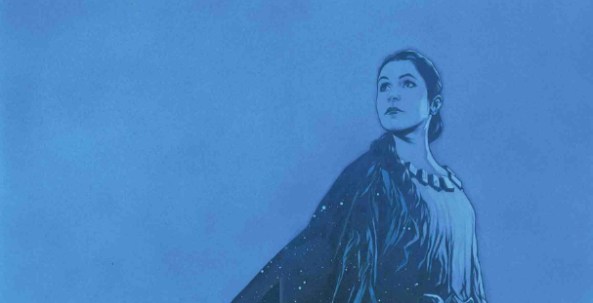
Patrick: With the conclusion of the “Mutiny on Mon Cala” story arc, things are looking up for our heroes. And why wouldn’t they? One of the features of Marvel’s interquel Star Wars series is that we know an awful lot about both the past and future of these characters. There’s a dramatic irony baked into the entire concept of this series. Any time Luke, Han, and Leia are in mortal danger, we can override our fears for their safety by simply remembering that they all live to fight another day. But that’s only half of it, right? We also know that the Rebels are on the run by The Empire Strikes Back. Writer Kieron Gillen and artists Salvador Larroca and Giuseppe Camuncoli use the oversized issue 50 to pivot from inevitable safety to inevitable danger. Continue reading

Captain America 1 Addresses the Change We Wish We Didn’t See

by Drew Baumgartner

Captain America 1

This article contains SPOILERS. If you haven’t read the issue yet, proceed at your own risk!

If we could change ourselves, the tendencies in the world would also change. As a man changes his own nature, so does the attitude of the world change towards him. […] We need not wait to see what others do.

Mahatma Gandhi

You might be more familiar with this quote as it is often paraphrased, “Be the change that you wish to see in the world.” It’s a (hilariously self-actualized) misquote that kinda sorta captures the sentiment of the original, paring a nuanced sentiment down to something that could fit on a bumper sticker. But we only need to think about the cheery optimism of that bumper sticker for a moment to see the pessimism inherent in it. We can be the solution to the world’s problems, sure, but only because we’re already the cause of them. We need to change because we are what the world is — any problems in it are caused by us (whether by malice, ignorance, or complacency).

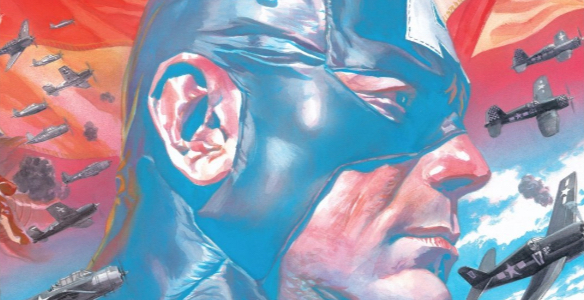
It’s a lesson many Americans learned (too late) after Donald Trump was elected. Not because we voted for him, but because we thought not voting for him was enough. We thought we were the solution to the problems we saw in the world, but didn’t appreciate how we were also the problem. We saw the battle over the future of this country as an “us vs. them,” failing to understand that there is only an “us,” that we can only be the solution when we accept that we are the problem. We thought fascism was a thing that happened in other countries, and that America would band together to reject it. We were wrong. Few people understand this (or have articulated it quite as clearly) as Ta-Nehisi Coates, which makes him the ideal writer to tackle Captain America, a series also coming to terms with its own in-universe convulsions of fascism. Continue reading

Deadpool is Back to Merc’ing in Deadpool 2

By Michael DeLaney

This article contains SPOILERS. If you haven’t read the issue yet, proceed at your own risk!

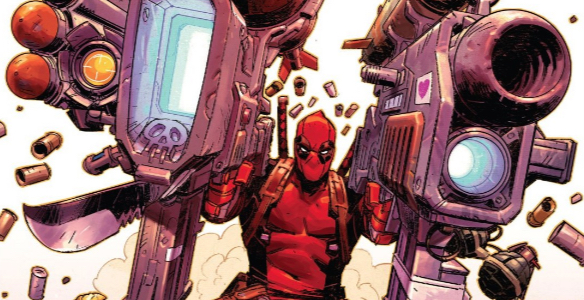
Deadpool is often characterized as the bane of the superhero community’s existence: he’s the last guy that they want to ask for help. That said, the Avengers set must derive some guilty pleasure when they get to cut loose and rip Wade Wilson’s regenerative body apart. At least, that’s what I gather from Skottie Young and Nic Klein’s Deadpool 2. Continue reading

How to Maintain a Balanced View of Technology in Nightwing 46

by Spencer Irwin

This article contains SPOILERS. If you haven’t read the issue yet, proceed at your own risk!

slim-banner

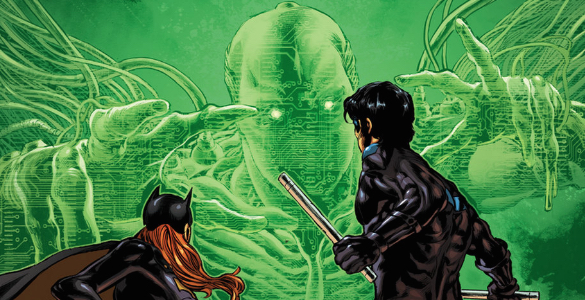
I’ve spent a lot of time recently making fun of “Alexa” and other similar voice activated assistants — the idea of willingly installing what ultimately amounts to a wire-tapping device in my own home seems patently absurd to me. Yet, I can’t deny the fact that I carry a smartphone with me at all times, a device that not only has similar surveillance abilities, but the power to track my every movement as well. I guess the question I should really be asking, then, isn’t “why would someone willingly buy a device like this?,” but “what would it take to make someone willingly buy a device like this?” Sometimes it’s convenience, sometime it’s the unparalleled access to information, and sometimes it’s simple denial. All these seem to be in play in Benjamin Percy, Christopher Mooneyham, and Lalit Kumar Sharma’s Nightwing 46, as Blüdhaven embraces technology that’s clearly attempting to data-mine the entire city. Continue reading

Themes and Team Make for a Dream in Squirrel Girl/Ms. Marvel 1

By Taylor Anderson

This article contains SPOILERS. If you haven’t read the issue yet, proceed at your own risk!

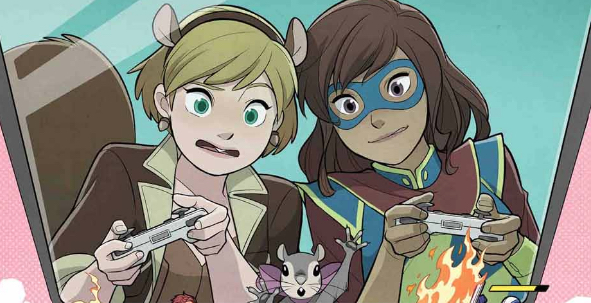
On paper, the team-up of Squirrel Girl and Ms. Marvel makes too much sense for it not to happen. Both heroes are young protagonists. Both are second tier Marvel heroes next to the headliner Avengers. And perhaps most importantly, both of their series are strikingly modern and fun. But just because a team-up makes sense in theory doesn’t mean it will really work in practice. Artistic differences and such often derail the best laid team-up issues. Baring this in mind, does Marvel Rising: Squirrel Girl/Ms. Marvel 1 strike gold or strike out? Continue reading

Cypher Drives the Action in Hunt for Wolverine: Weapon Lost 3

By Drew Baumgartner

Hunt for Wolverine Weapon Lost 3

This article contains SPOILERS. If you haven’t read the issue yet, proceed at your own risk!

One of my favorite insights in film criticism is that a shot can only have one subject. The subject can be (and often is) an individual, but the fascinating thing about a two-shot or group shot is that the individuals can’t be the subjects of those shots, so instead, the subject is their relationship. That is, when two characters are occupying a single shot, the subject of the shot isn’t either one of them, but their relationship to one another, whether it’s familial, antagonistic, friendly, or romantic. And I think we might be able to say something similar about ensemble stories. Or, at least, that the subject of an ensemble story can’t be several individuals. The subject can be anything from a character to a relationship to a theme, but there can be only one. So what is the subject if Hunt for Wolverine: Weapon Lost? Is it Daredevil, our narrator (and most recognizable character)? Is it Frank McGee and Misty Knight’s budding romance? Is it the group dynamics of this makeshift team? With issue three, Charles Soule and Matteo Buffagni seem to have settled on an unexpected option as their subject: Cypher. Continue reading

Catwoman 1: Discussion

by Spencer Irwin and Mark Mitchell

This article contains SPOILERS. If you haven’t read the issue yet, proceed at your own risk!

Spencer: I’ve only recently become familiar with Joëlle Jones, but it was immediately apparent from her work that she not only cares about fashion, but that she has a real talent for bringing it out on the page. It should be no surprise, then, that fashion — at least in a sense — seems to be one of the underlying themes of Jones’ Catwoman 1. I don’t necessarily mean fashion as in runways and models, although Jones’ take on Selina Kyle could certainly put Tyra Banks to shame — I mean fashion as in the idea of clothing, costumes, and disguises, what they mean to the public, and what they mean to the individuals wearing them. Continue reading

Batman 50: Discussion

by Drew Baumgartner and Michael DeLaney

Batman 50

This article contains SPOILERS. If you haven’t read the issue yet, proceed at your own risk!

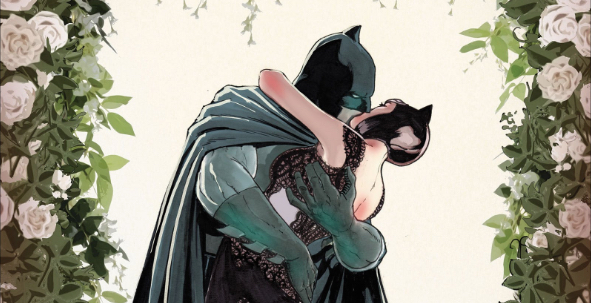
Drew: Bruce Wayne understands that his responsibilities as Batman demands sacrifice. He devotes his time, body, and earthly resources to his mission to fight crime, and generally takes that mission very seriously. All of which can look like he’s sacrificed his own happiness in order to be Batman. Or, more precisely, that his happiness is a necessary sacrifice for his existence. Batman’s drive, the argument goes, comes from his grief, anger, and sadness, so anything that blunts or dilutes those feelings weaken his mission. It’s a position DC Editorial staked out back in 2013, when Dan DiDio explained why Batwoman’s marriage could never happen, but it’s not necessarily a philosophy writer Tom King ascribes to. Indeed, King has argued that Batman’s happiness is a valuable source of drama, stating “There’s no conflict in having Batman be sad. There’s conflict in having Batman be happy.” That may mean King sees Batman’s happiness as only a temporary condition, but it’s obviously not out of the question. The point is, it’s a hotly debated topic, and one that King cleverly allows to play out in the pages of Batman 50. Continue reading

They Said What? in Doctor Strange 3

by Taylor Anderson

This article contains SPOILERS. If you haven’t read the issue yet, proceed at your own risk!

If you’ve ever had the fortune (or misfortune as it might be) of being an English major, you’ve likely entertained the idea of being a writer at some point in time — probably college. So you penned a couple stories that were mediocre at best and realized along the way that writing is actually quite difficult. Specifically, writing dialogue is a hard part of the process, if for no other reason than it is difficult to make it sound natural. This being so, I don’t blame Mark Waid for having hard time writing conversation in Doctor Strange 3, but his difficulty in writing it sure makes this issue hard to enjoy. Continue reading