Grayson 8

Alternating Currents: Grayson 8, Drew and Patrick

Today, Drew and Patrick are discussing Grayson 8, originally released March 4th, 2015.

Drew: I like to read into titles. We tend to boil down the difference between Superman and Action Comics to the creative teams involved, but I think the focus of every story is informed by its title. Luke Skywalker may feature prominently in Star Wars, but not in quite the same way he would if the movies were titled Luke Skywalker. In that same vein, when a story’s title is the protagonist’s name, we understand that story to necessarily be about that character. Oliver Twist may deal with poverty and exploitation, but the story is ultimately about a single orphan. In the month-to-month grind of comics, it’s sometimes easy to forget that Spider-Man is actually about Spider-Man (and not the criminal-of-the-month), but the best writers manage to keep the focus on the heroes, even as they’re put up against an endless lineup of threats. Tom King and Tim Seeley have never lost sight of Dick as the center of Grayson, but issue 8 reasserts that focus so strongly, we never feel lost — even as they yank the rug out from under us. Continue reading

Swamp Thing 40

swamp thing 40

Today, Drew and Spencer are discussing Swamp Thing 40, originally released March 4th, 2015.

Our revels now are ended. These our actors,
As I foretold you, were all spirits and
Are melted into air, into thin air:
And, like the baseless fabric of this vision,
The cloud-capp’d towers, the gorgeous palaces,
The solemn temples, the great globe itself,
Yea, all which it inherit, shall dissolve
And, like this insubstantial pageant faded,
Leave not a rack behind. We are such stuff
As dreams are made on, and our little life
Is rounded with a sleep.

William Shakespeare, The Tempest

Drew: I’ve always been frustrated by endings. Not necessarily because I want the story to continue, and not even because they’re done poorly (though they often are), but because the notion of “ending” draws attention to the limits of the narrative precisely when we want to savor every moment of the story itself. “Life goes on,” so the saying goes, but stories don’t — at least, not on the page. It’s a testament to this awkwardness that even William Shakespeare felt the need to lampshade it, defiantly pointing at the limits of the narrative itself in the hopes of elevating it beyond them. Charles Soule does something very similar in his Swamp Thing 40, turning this final issue into a postmodern commentary on endings in general. Continue reading

Daredevil 13

Alternating Currents: Daredevil 13, Drew and Patrick

Today, Drew and Patrick are discussing Daredevil 13, originally released February 25th, 2015.

Illusion, Michael. A trick is something a whore does for money…or candy!

George Oscar Bluth, Arrested Development

Drew: While I understand the distinction magicians make between “trick” and “illusion” — the former is about the techniques a magician uses, the latter is about the effect those collected techniques have on the audience — I think we’re perfectly justified in calling them “tricks.” The “illusion” — that a rabbit appears out of thin air, that a lady survives being sawed in half, that a card jumps to the top of the deck — dares us to believe that “magic is real,” but the actual techniques used to pull it off tend to be much more clever, if simpler, explanations. For me, an understanding of those tricks leaves me much more impressed about the illusion — knowing just how subtly they palmed the coin, or how convincing their false shuffle allows me to appreciate the actual craft that goes into what they’re doing. Indeed, any “magic” in the illusion lies in the skills of the magician, making knowing the trick more magical for me. Which I suppose is my way of asking forgiveness in focusing on the “tricks” of Daredevil 13, which pulls off an illusion so compelling, it’s hard to deny its magic. Continue reading

The Black Hood 1

Alternating Currents: The Black Hood 1, Drew and Patrick

Today, Drew and Patrick are discussing The Black Hood 1, originally released February 25th, 2015.

Drew: Superhero comics are a trope-filled medium. That’s doubly true of origin stories, which need to explain what would drive a normal person to dress up to fight crime. It turns out, there aren’t a whole lot of explanations out there. Was their family murdered in front of them? Were they the victim of some kind of science experiment gone wrong? Have they inherited some kind of mythical power? Every variation has been done, but so few have been done well. Indeed, the drive to get to the actual superheroics tends to leave origins rushed and expository — not the best recipe for a great story. The Black Hood 1 manages to avoid the tropes and the gratuitous exposition — while still taking its lead from regular guy to masked vigilante — trading our expectations in for some good old fashioned mystery. Continue reading

Lazarus 15

Alternating CurrentsL Lazarus 15, Drew and Patrick

Today, Drew and Patrick are discussing Lazarus 14, originally released February 18th, 2015.

…poetry is a short story missing 99 percent of the words.

Greg Rucka

Drew: I really wish I had the rest of the above quote, made by Rucka at the New York Comic Con in 2013, but to paraphrase, Rucka was suggesting that an intimate understanding of the form of short stories would prepare writers for every kind of writing except poetry. I’ve always seen a resemblance between Rucka’s taut comic work and great short stories, but what truly struck me about that quote was how it seemed to contradict the oft-quoted axiom that the required efficiency of short stories aligns them more closely with poetry than novels. This seeming contradiction may boil down to the inadequacy of our definition of “poetry”, but I couldn’t help but think of this quote as I read Lazarus 15, one of the most poetic comics I’ve ever read. Continue reading

She-Hulk 12

Alternating Currents: She-Hulk 12, Drew and Spencer

Today, Drew and Spencer are discussing She-Hulk 12, originally released February 18th, 2015. 

slim-banner

And if all others accepted the lie which the Party imposed – if all records told the same tale – then the lie passed into history and became truth. “Who controls the past,” ran the Party slogan, “controls the future: who controls the present controls the past.” And yet the past, though of its nature alterable, never had been altered. Whatever was true now was true from everlasting to everlasting. It was quite simple. All that was needed was an unending series of victories over your own memory.

George Orwell, Nineteen Eighty-Four

Drew: I fully appreciate what’s disturbing about historical revisionism — the above passage is undoubtedly the scariest thing I read in high school — but I’m less certain why people seem to be so opposed to similar revisions to fictional continuities. Retcons (or retroactive continuity) might be one of the most reviled devices in all of comicdom, but I honestly don’t understand why. Nobody is more invested in the idea that each issue matters than the publishers (or at least their marketing teams), so fears that a single retcon represents a first step on a slippery slope strike me as totally alarmist. Instead, publishers tend to use retcons to clean up continuities that have become overly complicated after decades of embellishment. Still, being told the opposite of a fact we know is unsettling, even if the “fact” describes something in a fictional world. It’s that exact phenomenon — that the facts both do and don’t matter — that makes She-Hulk 12 so much fun. Continue reading

Divinity 1

Alternating Currents: Divinity 1, Drew and Ryan

Today, Drew and Ryan are discussing Divinity 1, originally released February 11th, 2015.

My feeling is, story is the apple, plot is the arrow through it. (Or, story = mountain, plot = path through the mountain.)

Chuck Wendig

Drew: I’ve often attempted to distinguish between the “story” and “plot” of a narrative, but because those terms are often used interchangeably, I’ve never felt like I was being totally clear. Little did I know that Russian formalist Vladimir Propp had actually coined the specific terms I needed almost a century ago: fabula is the chronological events of the “story”, while syuzhet is the narrative arc as laid out in the “plot”. There are a great many stories where the distinction is trivial — the events of the story are presented in chronological order — but in a world full of flashbacks, flashforwards, and other chronological twists and turns, it’s helpful to be able to differentiate the two.

In most cases, the syuzhet is crafted to enhance the audience’s experience (to obscure a key detail of a mystery or to remind us of a detail as it becomes important), but it can also be used to reflect a character’s subjective experience of the fabula. LOST did this well, showing the audience proustian memories brought about by triggers on the island, but there are a few stories that take that concept a step further, where the character’s experience of the fabula is more explicitly achronological, allowing the syuzhet to track the fabula, even though neither is arranged chronologically. The “backwards” order of Memento simulates Leonard’s anterograde amnesia, and the “Watchmaker” chapter of Watchmen simulates Dr. Manhattan’s omnipotent experience of time. Matt Kindt and Trevor Hairsine’s new Divinity clearly has a great deal in common with that latter example, even if the subjectivity of the syuzhet is less explicit. Continue reading

Captain Marvel 12

Alternating Currents: Captain Marvel 12, Drew and Patrick

Today, Drew and Patrick are discussing Captain Marvel 12, originally released February 11th, 2015.

Thank you Mario! But our princess is in another castle!

Super Mario Bros.

Drew: Ah, the MacGuffin hunt; is there a more straightforward objective in all of fiction? Sure, that may also make it one of the most common objectives in all of fiction, but that hasn’t stopped it from generating some truly great stories. It’s just a clean, simple way to motivate characters to action. “We need the thing for reasons” is the general gist, but there’s actually a cleaner, simpler motivation if the MacGuffin was stolen from the hero. Now the “reasons” don’t need to be mired in mythology about the significance of the “thing” — getting back what is rightly theirs is more than enough justification for action. This is exactly the scenario Carol finds herself in in Captain Marvel 12, jettisoning any need for exposition in favor of high-flying space action. Continue reading

Secret Six 2

Alternating Currents: Secret Six 2, Drew and Spencer

Today, Drew and Spencer are discussing Secret Six 2, originally released February 11th, 2015.

Drew: At what point is it fair to form an opinion about a work of art? The conventional wisdom warns us not to judge a book by its cover, but at what point is it fair to judge? I’ve been told that the first chapter is enough, but I’ve seen others advocate for just the first page. I tend to be a bit more charitable than most — I’ve never walked out of a movie, but then again, I would probably not see a sequel of a movie I didn’t like. So, how do comics fit in to that? Is the first issue the first page of a story? The first chapter? The first movie? Single issues rarely give a complete story (at least nowadays), but also offer a convenient point to stop and reflect. After two issues, we may not have a great idea of what Secret Six will actually be like, but maybe we have enough to form an opinion about it. Continue reading

Happy Presidents’ Day!

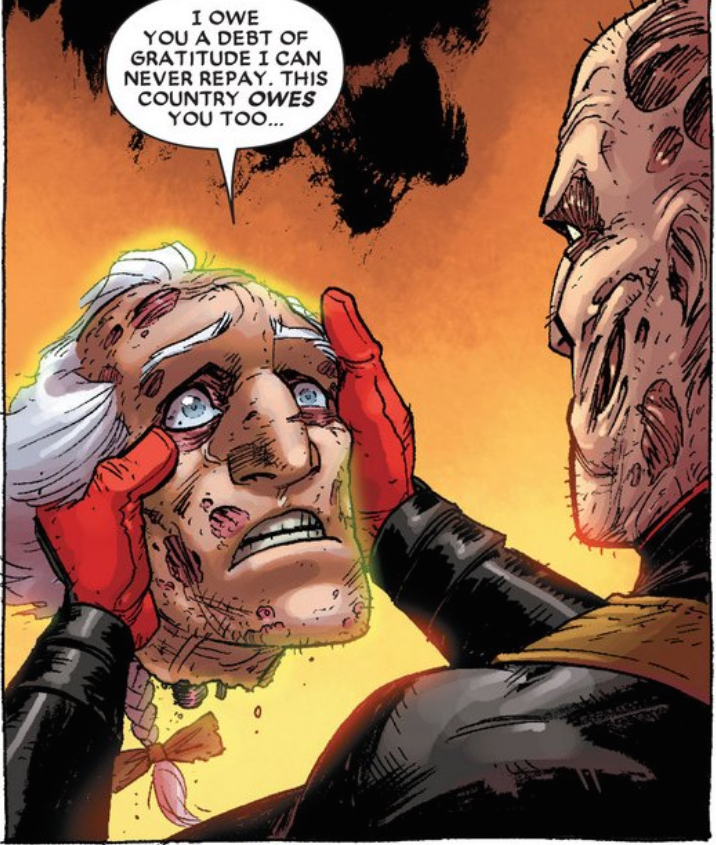
All of us here at Retcon Punch just want to say a quick Happy Presidents Day! Enjoy the day off, but remember to take a moment to reflect on what our Presidents have done for this country.

National Debt

You said it, resurrected head of George Washington! We’ll be back with our regular coverage tomorrow!