East of West 17

east of west 17

Today, Drew and Taylor are discussing East of West 17, originally released February 4th, 2015.

A long time ago in a galaxy far, far away…

Star Wars

Drew: Myths are almost all told from a third person omniscient perspective in the past tense; not only do we get a glimpse into the separate actions of both the Tortoise and the Hare, we understand that this race already happened. That second part is natural to storytelling in general — everything from personal anecdotes to the high-flyingest science fiction is told as if the events already happened. Curiously, both tense and narrative mode tend to disappear when working in a visual medium — the illusion that these actions are actually playing out in front of us is strong enough to override any confusion about who is telling this story, and when. To give visual storytelling a mythic quality requires making the past tense nature and omniscient narrator explicit, perhaps with a framing device a la The Princess Bride, or perhaps just with that innocuous introduction I included above. East of West 17 finds writer Jonathan Hickman slipping his narrator in, lending the proceedings the mythic qualities they rightly deserve. Continue reading
Hawkeye 21

Alternating Currents: Hawkeye 21, Drew and Spencer

Today, Drew and Spencer are discussing Hawkeye 21, originally released February 4th, 2015.

I shall not today attempt further to define the kinds of material I understand to be embraced within that shorthand description; and perhaps I could never succeed in intelligibly doing so. But I know it when I see it…

Justice Potter Stewart

Drew: I’ve never been a fan of classifications in art. I could go on at length about how sub-subgenres eventually become too specific to have any utility, while broader classifications face the opposite problem of being to general, but my real issue is that our definitions fall apart under scrutiny. We tend to accept the kind of “I know it when I see it” definition of basically every category we have, from gender to genre, but most working definitions have to allow for so many exceptions that they lose all meaning. Take “superhero” for example. We all have a lose idea of who a superhero is, what they do, how they act, but to try and pin down the definition reveals that none of those things are fixed. Are they heroic (courageous, noble, selfless)? Many are, sure, but there are plenty of antiheroes muddying up any moral definition. What about superpowers? Again, lots do, but with so many non-powered superheroes, it’s hardly a criteria. The closest I can come up with is based on our relationship to superheroes — namely, that we expect their actions to lead to their success. In that way, I’d like to posit Clint Barton — particularly as depicted in Matt Fraction and David Aja’s Hawkeye — as an antisuperhero. Continue reading

Zero 14

zero 14 Today, Drew and Taylor are discussing Zero 14, originally released January 28th, 2015. Art and Social Function

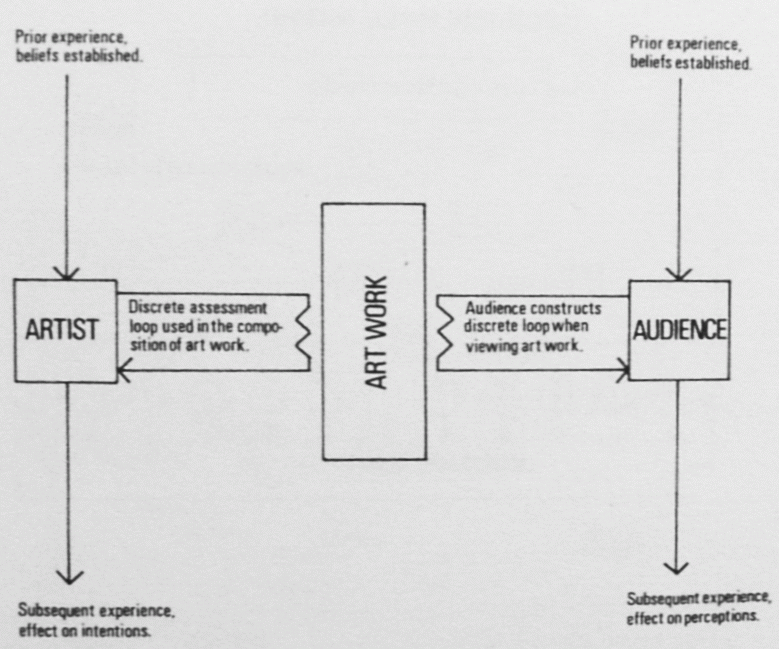
Two fundamental discrete cognate loops are shown, which are isolated from each other by the artwork. There is no form of interaction between the two which could generate mutual understanding as would be the case in a successful conversation. In the absence of such a procedure both the audience and the artists become locked in their own perceptual biases.

Stephen Willats, Art and Social Function

Drew: Where does meaning happen? I was brought up on the postmodern ideals outlined in the epigraph, but it seems that a great deal of modern society still clings to romantic notions of artistic intention. We celebrate and scorn artists based on their intentions, forgetting that the value of their art may not have anything to do with the artist. Indeed, we’re so obsessed with intention that we conflate it with meaning, minimizing the audience’s role — a role I might argue is the whole point of art in the first place. It’s because of this climate that I enjoy art that obscures its artist’s intentions. It’s easy to assume the moral is the “point” of one of Aesop’s fables, but it’s decidedly harder to draw such a clean line in something like Zero 14, where ambiguity and sheer density of ideas makes any meaning we can parse decidedly our own. Continue reading

Uncanny X-Men 30

uncanny xmen 30

Today, Drew and Michael are discussing Uncanny X-Men 30, originally released January 28th, 2015.

There was an old lady who swallowed a cow
I don’t know how she swallowed a cow
She swallowed the cow to catch the dog
She swallowed the dog to catch the cat
She swallowed the cat to catch the bird
She swallowed the bird to catch the spider
She swallowed the spider to catch the fly
I don’t know why she swallowed a fly — Perhaps she’ll die!

Traditional

Drew: Way back in All-New X-Men 1, Hank McCoy was up against a problem so insurmountable, his only solution was to drag the original X-Men into the present to help solve it. Uncanny X-Men 30 finds Eva Bell against an even more insurmountable problem, one the original X-Men already failed to solve. What’s she left to do but to go back in time and call in the X-Men’s boss? It’s escalation in its purest (and most obvious) form, but does bringing Charles Xavier back from the dead suffer from the repetition? Continue reading

Batman 38

Alternating Currents: Batman 38, Drew and Patrick

Today, Drew and Patrick are discussing Batman 38 originally released on January 28th, 2015.

Drew: Fiction has a complex relationship with expectations. We want fiction to meet some expectations — that it should feature the conflicts and conceits pitched on the back cover, that it meets whatever network of expectations that might make it “believable” — but we also want it to defy others. The story of a farm girl suffering a concussion during a tornado may be believable, but it doesn’t capture our imaginations in the same way as the adventures she has when she thinks she’s whisked off to the magical land over the rainbow. Exactly how a story balances meeting and subverting our expectations varies from genre to genre, writer to writer, even moment to moment, but most stories seem to get the most mileage out of meeting our expectations just long enough to really surprise us when the unexpected hits. After three epic arcs of defying expectations, Scott Snyder and Greg Capullo’s Batman has an even more complex relationship with the expected, creating a situation where the surprises may very well be the expected norm to be subverted. Continue reading

Fables 148

fables 148
Today, Drew and Patrick are discussing Fables 148, originally released January 21st, 2015.

Once upon a time…

Traditional

Drew: Where would you say your story begins? Your first memory? Your birth? Your conception? Your parents’ first date? Their births? It’s easy enough to trace that back ad infinitum, as the circumstances that allowed you to become the person you are were set in motion at the very dawn of time. The same could be said of when your story ends. Is it your death? The death of the last person who knew you? Perhaps your mere existence influences events until the very end of time. Obviously, the scope of an individual story tends to be a bit narrower — infinite context is rarely necessary or informative — but what about the scope of all stories? The folklore origins of Fables have always given the characters a certain vintage of origin, and the modern-day setting gives them a certain end-date, but issue 148 finds important context stretching further in both directions, effectively widening the scope of the series to the narrative arc of the entire universe. Continue reading

The Wicked + The Divine 7

Alternating Currents: The Wicked and The Divine 7, Drew and Spencer

Today, Drew and Spencer are discussing The Wicked + The Divine 7, originally released January 21st, 2015.

Drew: Religion is such a weird thing in comics. Both of the Big Two feature actual gods in their publishing line, which opens up a whole host of ontological questions — Did these gods play a role in the creation of the universe? How did they come to exist? — but these characters largely aren’t designed to answer religious questions. Just like Superman isn’t really about the existential questions raised by alien societies, the likes of Thor and Wonder Woman aren’t really about mythology — goddom is just another avenue to explain why your characters would have superpowers. It was easy for me to confuse The Wicked + The Divine with this type of story — neither is ultimately interested in the religious implications of having gods up and walking around — but as the series’ themes continue to solidify, it’s become ever more apparent that the powers don’t matter, either. “God” is just an exaggerated stand-in for “teen idol,” and given the way our society treats celebrities, it’s not that much of an exaggeration. Continue reading

Avengers 40

Alternating Currents: Avengers 40, Drew and Mark

Today, Drew and Mark are discussing Avengers 40, originally released January 14th, 2015. 

The more I love humanity in general, the less I love man in particular

Fyodor Dostoyevsky, The Brothers Karamazov

Drew: I think it would be fair to say that Dostoevsky’s polyphonic style — one built upon the perspectives of an array of characters — is antithetical to the notion of the hero’s journey. Indeed, Dostoyevsky’s philosophies (as articulated in the quote above) suggest that there’s an active tension between caring about an individual and caring about humanity at large. I’ve always been partial to the depth of understanding achieved by sticking with one protagonist — especially when it comes to comics — which has made me wary of the kind of expansive, Dostoyevskian scope of Jonathan Hickman’s Avengers. In my mind, a tight focus on a single character more accurately reflects how we experience the world, but with Avengers 40, Hickman makes a compelling case for how his dense interconnectedness reflects how the world actually is. Continue reading

Captain Marvel 11

captain marvel 11

Today, Drew and Suzanne are discussing Captain Marvel 11, originally released January 14th, 2015.

Drew: It’s no secret that I don’t have a lot of patience for tropes. Predictable situations, reactions, or patterns are crutches for serialized storytellers, which is only made more apparent by those writers who manage to avoid them. Still, I do understand that certain tropes can be comforting — and perhaps even important to the identity of the work of art in question. I’m willing to forgive The Twilight Zone having the most obvious twist endings, because that’s kind of the point. That willingness to forgive certain tropes varies from person to person, as can be seen in the varied reactions to Christmas movies, albums, and episodes. Are they cheap cash-grabs? Charming acknowledgements of the season? Unfortunate acquiescences to the Christo-normativity of America? Christmas stories aren’t my favorite (I swear, if I see another reimagining of A Christmas Carol, I’m going to lose it), but I’ve seen enough pulled off well that I’m willing to at least have an open mind. Unless, of course, I’m consuming that story three weeks after Christmas, in which case, my patience for Christmas tropes dwindles right back down to zero. Continue reading

Star Wars 1

Alternating Currents: Star Wars 1, Drew and Taylor

Today, Drew and Taylor are discussing Star Wars 1, originally released January 14th, 2015.

Drew: I was eight years old when Michael Crichton’s The Lost World was published. I hadn’t read Jurassic Park (reminder: I was eight), but I LOVED the movie. Nothing, not even my reading level, could stop me from consuming this new tale of genetically resurrected dinos, so I convinced my parents to get me the book on tape. When the film adaptation came out in 1997, it was my first experience seeing a movie based on a text I was already familiar with. There were substantial changes to the plot, but I didn’t care — the draw for me was dinosaurs, and the movie definitely delivered. I was similarly undaunted by the streamlining of the plot in Peter Jackson’s Lord of the Rings adaptations — the draw here was a heroes journey set in a lushly detailed fantasy world.

It wasn’t until Zack Snyder’s Watchmen that I was first apprehensive about a film adaptation — the draw for me was no longer the plot or specific characters, but the medium of the story itself. A film couldn’t hope to capture the formal elements specific to comics that makes Watchmen such an achievement. I find myself confronted with these questions as I think about Marvel’s new Star Wars series (my first foray into any non-film explorations of the universe) — what is the draw for Star Wars? Is it the space operatics? The characters? The actors that play them? The thrilling John Williams score? It turns out, my answer may be “all of the above,” but that doesn’t stop this issue from being a largely successful translation of the Star Wars universe onto the page. Continue reading