Echos of Grief Reverberate in Isola 3

By Mark Mitchell

This article contains SPOILERS. If you haven’t read the issue yet, proceed at your own risk!

We don’t know exactly what transpired between Rook and Queen Olwyn that led them to their current paths, but Isola 3 continues to deepen their connection even as the two are further separated by physical distance. Continue reading

A Head-Scratching Flashback in Captain America 703

by Spencer Irwin

This article contains SPOILERS. If you haven’t read the issue yet, proceed at your own risk!

It’s a generally understood rule of storytelling that any detail included in a story should be there for a reason — extraneous plots, characters, or ideas can be distracting at best, or derail the entire story at worst. This rule goes double for flashbacks, which are so often useful, even essential storytelling tools that, nonetheless, stick out like a sore thumb when used without purpose. This is unfortunately the case in Captain America 703, an otherwise enjoyable issue that’s dragged down by an almost inexplicable flashback. Continue reading

The Power of a Clear Trajectory in Descender 30

by Spencer Irwin

This article contains SPOILERS. If you haven’t read the issue yet, proceed at your own risk!

Descender has a sense of trajectory unlike any other series I’ve ever read. From the very first issue, Jeff Lemire and Dustin Nguyen have made their young protagonist, Tim-21, the focal point of the entire series — he’s not just the star, but he’s like the horizon point in a drawing, that one spot in the galaxy that all other figures are drawn to. Even as more and more characters have been introduced into Descender‘s world, all their various agendas have continued to lead straight to Tim-21. In Descender 30, Lemire and Nguyen continue to bring more and more factions drawing inevitably closer to Tim-21, all while upping the stakes — if Tim is captured, it’s not just his life that’s in danger, but the safety of the entire universe! Continue reading

Marvel Two-In-One 6: Discussion

by Taylor Anderson and Drew Baumgartner

This article contains SPOILERS. If you haven’t read the issue yet, proceed at your own risk!

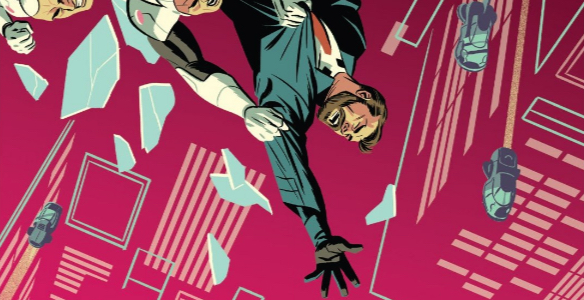
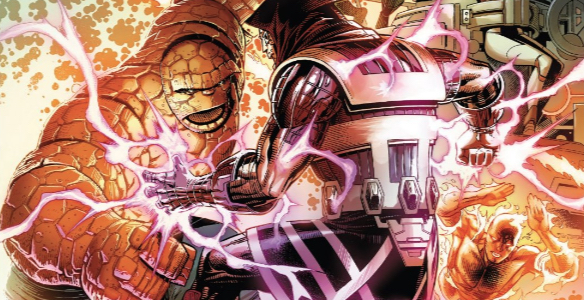
Taylor: Sometimes I’ll come home after work and my wife will ask me how my day was. Usually, I have something interesting to tell her, but occasionally there simply isn’t anything all that remarkable to say. In these cases, my response to her query is that is was “just a day.” See, the thing is, if you do anything enough times it’s bound to become rote every now and then. This same idea certainly holds true with monthly comics, with most series producing “just an issue” that isn’t all that remarkable. Such is the case with Marvel Two-In-One 6, which notable only for how generic it feels.

Continue reading

Waging Peace in X-Men Red Annual 1

by Patrick Ehlers

This article contains SPOILERS. If you haven’t read the issue yet, proceed at your own risk!

“I was the Phoenix. I burned so brightly. Then I was dead. And everything was dark.”

Jean Grey, X-Men Red (2018) Annual #1

Writer Tom Taylor starts this issue with the narration above, quickly summarizing the tragic arc of Jean Grey. It was a violent life, and the bullet points of her story are mostly bummers. Over Scott Summer’s grave, Jean promises that this time is going to be different, and this annual is all about what that might look like. Taylor and artist Pascal Alixe offer an issue full of love, understanding, and difficult conversations. Jean’s still here to win, but it’s not war she’s waging. It’s peace.

Continue reading

The Colors Tell the Story in Quantum and Woody 6

by Drew Baumgartner

Quantum and Woody 6

This article contains SPOILERS. If you haven’t read the issue yet, proceed at your own risk!

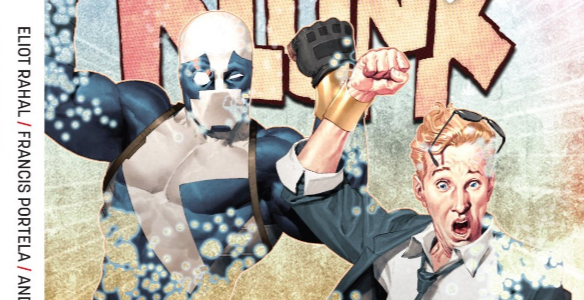
Our sense of color is intuitive, but I think that makes it harder for comics colorists to achieve true verisimilitude. Readers may not have a sophisticated understanding of color theory, but they still know when something looks wrong. And “wrong” can be anything from shadows and highlights to textures to atmospheric effects. We might only be able to articulate the most attention-getting aspects of comics coloring, but subtler choices have a profound impact on the believability of the art. Those choices can be simple, as they are in Quantum and Woody 6, but it’s the skill with which colorist Andrew Dalhouse pulls them off that ultimately makes them work. Continue reading

Man of Steel 1 Reclaims Superman

by Patrick Ehlers

This article contains SPOILERS. If you haven’t read the issue yet, proceed at your own risk!

“Let’s make America great again / by making racists ashamed again.
Let’s make compassion in fashion again; / let’s make America great again.”

“Make America Great Again,” Frank Turner

In isolation, the words “make America great again” shouldn’t elicit a strong negative biological/emotional response. But this fairly innocuous phrase has been twisted beyond recognition by white nationalism, isolationism, and just general shitheadery. On Frank Turner’s newest record, Be More Kind, he attempts to overwrite the listener’s associations with those four little words on track five, boldly titled “Make America Great Again.” The song is big, joyful and rebellious at the same time, like all of Turner’s best tunes. I like it a lot, but I still flinch when chorus comes around. Some words and some symbols are just too thoroughly corrupted to be reformed. Brian Michael Bendis and Ivan Reis’ Man of Steel 1 has a similar hurdle to overcome: attempting to return Superman to the platonic ideal that maybe only exists in the imaginations of Kal El’s biggest fans. The results are miraculous. Continue reading

Blackwood 1: Discussion

by Mark Mitchell and Ryan Mogge

This article contains SPOILERS. If you haven’t read the issue yet, proceed at your own risk!

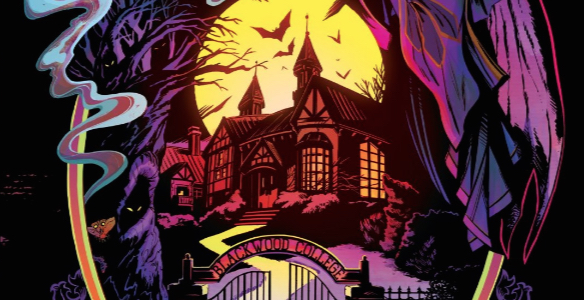
Mark: It’s pretty insane that we choose which college we’re going to attend based on almost zero context. Sure, you can take a campus tour, read about the experiences of alumni, and maybe even shadow a current student for a day or two, but in the end choosing a college — any college — is an immense leap of faith. This seems to be doubly true of attending Blackwood College, the eponymous school of the occult in Evan Dorkin and Veronica Fish’s Blackwood 1, as none of the students we meet in this premiere issue seem to have much understanding of what they’ve signed up for. Continue reading

Thrillingly Putting the Pieces in Place in Saga 52

by Drew Baumgartner

Saga 52

This article contains SPOILERS. If you haven’t read the issue yet, proceed at your own risk!

In this game, Fischer (playing Black) demonstrates noteworthy innovation and improvisation. Byrne (playing White), after a standard opening, makes a seemingly minor mistake on move 11, losing tempo by moving the same piece twice. Fischer pounces, with brilliant sacrificial play, culminating in an incredible queen sacrifice on move 17. Byrne captures the queen, but Fischer gets far too much material for it – a rook, two bishops, and a pawn. At the end, Fischer’s pieces coordinate to force checkmate, while Byrne’s queen sits, helpless, at the other end of the board.

Bobby Fischer’s Breakthrough: The Game of the Century

When someone says a chapter of a story is “putting the pieces in place,” it’s usually meant to point out some emotional shortcoming. Putting the pieces in place is seen as perfunctory, a perhaps necessary prelude to the actual drama to come, lacking in any real emotional investment (and maybe even drawing our attention to the invisible hand guiding circumstances into position). But I think that attitude is entirely shortsighted, privileging the fallout of events more than the setup, and ignoring that the “pieces” and “places” are the raw materials for drama, so how and why they’re there are essential story elements. It’s the kind of attitude that would make Bobby Fischer’s famous “Game of the Century” is only thrilling in its final moments, as he finally forced Byrne’s king into checkmate, but any chess fan can tell you that the ending was set up 21 moves earlier, which in turn may have been set up six moves earlier still, reminding us that the simple act of moving pieces on the board is what drives the drama in a game of chess. Obviously, Saga isn’t a game, and the characters aren’t chess pieces (royalty notwithstanding), but it’s just a thrilling to watch them scoot into attack position — even when we can’t see the attack coming. Continue reading

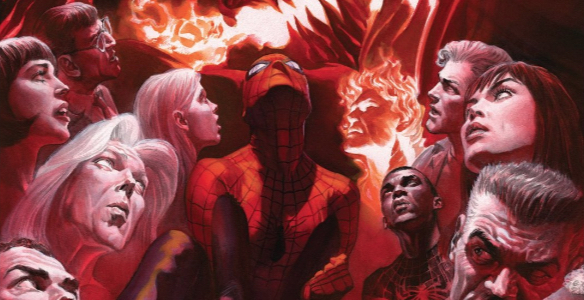
Finding Strength in Others in The Amazing Spider-Man 800

by Spencer Irwin

This article contains SPOILERS. If you haven’t read the issue yet, proceed at your own risk!

Spider-Man has one of the most iconic, expansive, and enduring supporting casts in all of superhero comics, and that’s a fact Dan Slott has used to his advantage throughout his long tenure on The Amazing Spider-Man. He especially leans on his supporting cast in issue 800, the penultimate issue of his run and the grand finale of “Go Down Swinging.” It’s an issue all about the power of the people in Peter Parker’s life, be it the power he gives them, or the power they give him. Continue reading