Catwoman 1: Discussion

by Spencer Irwin and Mark Mitchell

This article contains SPOILERS. If you haven’t read the issue yet, proceed at your own risk!

Spencer: I’ve only recently become familiar with Joëlle Jones, but it was immediately apparent from her work that she not only cares about fashion, but that she has a real talent for bringing it out on the page. It should be no surprise, then, that fashion — at least in a sense — seems to be one of the underlying themes of Jones’ Catwoman 1. I don’t necessarily mean fashion as in runways and models, although Jones’ take on Selina Kyle could certainly put Tyra Banks to shame — I mean fashion as in the idea of clothing, costumes, and disguises, what they mean to the public, and what they mean to the individuals wearing them. Continue reading

Batman 50: Discussion

by Drew Baumgartner and Michael DeLaney

Batman 50

This article contains SPOILERS. If you haven’t read the issue yet, proceed at your own risk!

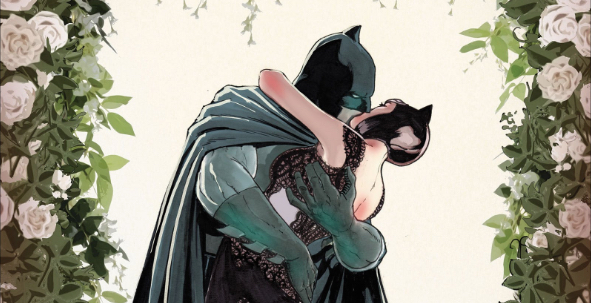
Drew: Bruce Wayne understands that his responsibilities as Batman demands sacrifice. He devotes his time, body, and earthly resources to his mission to fight crime, and generally takes that mission very seriously. All of which can look like he’s sacrificed his own happiness in order to be Batman. Or, more precisely, that his happiness is a necessary sacrifice for his existence. Batman’s drive, the argument goes, comes from his grief, anger, and sadness, so anything that blunts or dilutes those feelings weaken his mission. It’s a position DC Editorial staked out back in 2013, when Dan DiDio explained why Batwoman’s marriage could never happen, but it’s not necessarily a philosophy writer Tom King ascribes to. Indeed, King has argued that Batman’s happiness is a valuable source of drama, stating “There’s no conflict in having Batman be sad. There’s conflict in having Batman be happy.” That may mean King sees Batman’s happiness as only a temporary condition, but it’s obviously not out of the question. The point is, it’s a hotly debated topic, and one that King cleverly allows to play out in the pages of Batman 50. Continue reading

They Said What? in Doctor Strange 3

by Taylor Anderson

This article contains SPOILERS. If you haven’t read the issue yet, proceed at your own risk!

If you’ve ever had the fortune (or misfortune as it might be) of being an English major, you’ve likely entertained the idea of being a writer at some point in time — probably college. So you penned a couple stories that were mediocre at best and realized along the way that writing is actually quite difficult. Specifically, writing dialogue is a hard part of the process, if for no other reason than it is difficult to make it sound natural. This being so, I don’t blame Mark Waid for having hard time writing conversation in Doctor Strange 3, but his difficulty in writing it sure makes this issue hard to enjoy. Continue reading

Mythological Omnivorism in Cosmic Ghost Rider 1

by Patrick Ehlers

This article contains SPOILERS. If you haven’t read the issue yet, proceed at your own risk!

I aways struggle to identify with the Punisher. The straight line from Army vet to man suffering from personal loss and PTSD to gun wielding maniac only ever plays as tragedy for me. Like… where’s the fantasy? Where’s the escapism? Writer Donny Cates and artist Dylan Burnett address this dissonance by taking the two most sadistic parts of Frank Castle’s origin — military service and a mind set on vengeance — and mythically amplifying them both in uniquely Marvel ways. The result is, and I can’t believe I’m saying this about a Frank Castle story, tons of fun. Continue reading

A Fitting End in Kill or be Killed 20

By Drew Baumgartner

Kill or be Killed 17

This article contains SPOILERS. If you haven’t read the issue yet, proceed at your own risk!

Mr. Helpmann: He’s got away from us, Jack.
Jack Lint: ‘Fraid you’re right, Mr. Helpmann. He’s gone.

Brazil

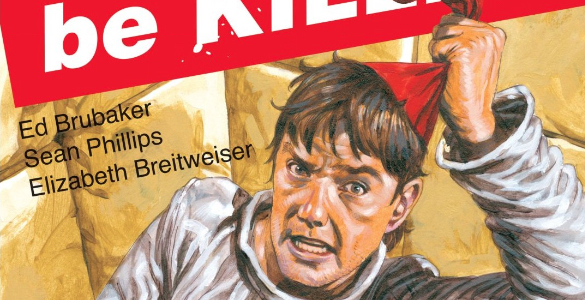
Drew: There are plenty of worthy contenders, but I tend to think of Terry Gilliam’s Brazil as having the most contentious final cut in film history. Indeed, as the film languished in post-production hell, both Gilliam and the chairman of Universal Pictures, Sid Sheinberg took out competing ads in Variety, imploring the other to release their preferred cut of the film. And much of that disagreement came down to the two lines quoted above; the ones that reveal the frenetic, phantasmagoric escape our hero makes is actually his dissociative fantasy — it turns out he never escaped his torture chamber. Since this is a Gilliam film, it’s easy to argue the whole movie is frenetic and phantasmagoric — and it definitely is to some degree — but the ending flies off the rails in a way that really only make sense as a fantasy. It’s an over-the-top “coincidences help the hero” ending that reads as a straight-up parody of Hollywood films, so it’s kind of hilarious that Sheinberg would insist on that ending not being a fantasy. Any savvy viewer would recognize that something is seriously wrong with Winston’s escape, so to insist that there’s nothing is an insult to our intelligence. That is, we know that it’s a fantasy, we just need the movie to be smart enough to agree with us. With their final issue of Kill or be Killed, Ed Brubaker and Sean Phillips lean into a similarly impossible-to-believe fantasy, along with a twist very much like the one Gilliam always intended for Brazil. Continue reading

Quantum and Woody 7 Traps Our Heroes In Perfection

by Patrick Ehlers

This article contains SPOILERS. If you haven’t read the issue yet, proceed at your own risk!

What do your fantasies look like? I’m not trying to ask a dirty question here. When your mind wanders and you start to imagine the ideal form of your life, what does it look like? What form does your imagination take? Are you able to view yourself in your perfect environment, like some sort of omniscient viewer? Are you giving an interview about everything you’ve accomplished? Or are you in your own head, looking out on your perfect life? How you express your fantasy to yourself is as revealing as what you fantasize about. Eliot Rahal and Francis Portela’s Quantum and Woody 7 finds the Henderson brothers trapped in idealized fantasy worlds that embrace tropes of genre and medium in equal measure. Continue reading

The More Peter Changes, the More He Stays the Same in Peter Parker: the Spectacular Spider-Man 306

by Spencer Irwin

This article contains SPOILERS. If you haven’t read the issue yet, proceed at your own risk!

Peter Parker’s been a lot of things in his 50+ years of existence — a bullied high school student, a harried college student and photographer, a loving husband, a clone, a CEO — but none of those roles have ever changed who Peter really is inside. This holds true in Peter Parker: The Spectacular Spider-Man 306, an issue that asserts that, no matter how much Peter changes, he’ll always be a hero. Continue reading

Sex Criminals 25: Discussion

By Michael DeLaney and Patrick Ehlers

This article contains SPOILERS. If you haven’t read the issue yet, proceed at your own risk!

Literally none of this makes any sense to me but I am fascinated

Dr. Glass

Michael: In the Western world — America in particular — we like to think that everything happens for a reason. In times of struggle we try to see it as a challenge or part of some greater purpose laid out for us by God, fate or the universe. And like anything, the only important meaning of something is what we ascribe to it. In Sex Criminals 25, protagonists Suzie and Jon both respond to their situations as if narrative meaning or consequence are an absolute. Continue reading

There’s No Escaping History in The Wicked + The Divine 37

by Spencer Irwin

This article contains SPOILERS. If you haven’t read the issue yet, proceed at your own risk!

History is an intrinsic facet of The Wicked + The Divine in multiple ways. Its story — and deities — have existed for the majority of recorded human history, and Kieron Gillen and Jamie McKelvie have gone to great lengths to accurately reflect that throughout the series. History is also a far more personal thing in WicDiv, though. There’s not a single character who can escape the pull of their own personal history, be it the baggage of Ananke/Minerva’s own six thousand year long existence, or the brief-yet-intense history behind the Morrigan and Baphomet/Marian and Cameron’s complex, tragic romance. Both tales reach inevitable — yet very different — climaxes in WicDiv 37. Continue reading

Heightening the Conflict in Harbinger Wars II 2

by Drew Baumgartner

Harbinger Wars 2 2

This article contains SPOILERS. If you haven’t read the issue yet, proceed at your own risk!

What is the collective noun for superheroes? An immodesty of superheroes, perhaps? A bluster, a cluster bomb, a swank? Somebody ought to settle the issue soon, if we’re going to be showered with films like “Avengers: Infinity War.”

Anthony Lane in The New Yorker

That quote comes from my least favorite culture review in recent memory. I’ve heard enough variations of “superheroes are dumb” over the years to keep my eyes rolling all the way to Anthony Lane’s door, but what’s particularly frustrating about his review is that it never bothers to support his dismissive attitude. It’s not a critique so much as a list of characters and events in the movie and the smug assumption that we all agree that that list is too long. To be clear, I think there is plenty to critique about that movie, not the least of which that it almost certainly would ring as paradoxically overstuffed and hollow without at least some familiarity with these characters — if we’re not already invested in Tony Stark’s worst fears or Thor’s grief or Doctor Strange’s sense of duty, they’ll read as pretty thin in the movie. Like most summer crossover events, Infinity War is mostly plot machinations, cashing in on the character work developed in its respective solo series. Such is definitely the case with Harbinger Wars II 2, which heightens the drama of the impending battle, but does relatively little to draw me into that drama. Continue reading