

From lines at conventions to the internet petitions every time an assignment changes, its clear comic fans put a lot of stock in who writes and draws their comics, often to the exclusion of the rest of the creative team. While colorists have slowly been gaining more recognition, they are still largely the unsung heroes of the comics world, adding depth and meaning to the storytelling in ways so subtle as to be almost invisible. As we started preparing our year-end lists, we realized that we, too, had been overlooking the contributions of these indispensable artists, and decided it was high time to offer the best the praise they so rightly deserve. These are our top 14 colorists of 2014.
Continue reading
Author Archives: Drew
She-Hulk 11
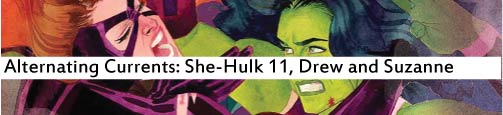 Today, Drew and Suzanne are discussing She-Hulk 11, originally released December 24th, 2014.

Dun-dun-duuuun!
Dramatic Sound Effect, Traditional
Drew: There’s nothing like a good plot twist. I may hem and haw over whether I prefer that a plot be surprising or relatable, but there’s nothing quite as exciting as having the rug yanked out from under us. Still, I find that twists work best when, to paraphrase fellow contributor Greg Smith, they’re both an interesting plot devices and an organic extension of the story. That is to say, while the ending of The Sixth Sense may feel like just a clever, Twilight-Zone-y twist, it actually provides a very logical end-point to Cole’s newfound mission in helping ghosts come to term with their deaths. It’s not yet clear if all of the twists in She-Hulk 11 (and there are many) are quite as character-driven, but writer Charles Soule cleverly packs them into this penultimate issue, leaving plenty of space for more meaningful conclusions next month. Continue reading
Best of 2014: Best Covers
 You know you shouldn’t judge a book by its cover, but that doesn’t mean you can’t judge the cover on its own merit. Some covers are so excellent that they pack all the drama, excitement and emotion of the whole issue into one succinct image. Sometimes they end up being their own surreal experience. And other times, we’re just exciting to see our favorite heroes kicking ass one more time. These are our top 14 covers of 2014. Continue reading
All-New X-Men Annual 1
 Today, Drew and Patrick are discussing All-New X-Men Annual 1, originally released December 24th, 2014.
Coincidences to get characters into trouble are great; coincidences to get them out of it are cheating.
Emma Coates, “Pixar’s 22 Rules of Storytelling”
Drew: This is a pretty well-worn axiom of fiction writing, and while I don’t have any qualms with the assertion that good coincidences are bad, I think it’s important to acknowledge that bad coincidences aren’t necessarily good. We’re all familiar with how deflating a Deus ex Machina resolution can be, but I firmly believe that an arbitrary, unlikely problem — a Diabolus ex Machina, if you will — can be just as bad. Actually, it might be worse; while we might understand a writer painting himself into a corner (thus requiring a miracle to get out of it), there’s no such justification for a coincidence up front. The arbitrary rules of sci-fi technology has always been a pet peeve of mine, but as the laws governing time-travel take center stage in All-New X-Men Annual 1, the conflict became a full-on Diabolus ex Machina, derailing what could have been a thrilling, emotional journey. Continue reading
Batman 37
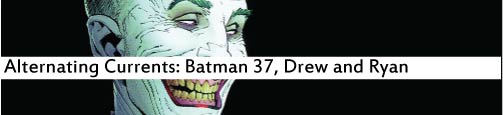 Today, Drew and Ryan are discussing Batman 36 originally released on December 17th, 2014.
Second verse, same as the first! A little bit louder and a little bit worse!
Traditional
Drew: Repetition is everywhere in art, from the themes of symphonies to the expectation that the hero will prevail, but do you ever wonder why we like repetition so much? Doesn’t it also make art tired and predictable? I suppose some material is more conducive to repetition than others — star-crossed lovers is a more versatile premise than, say, a hot tub time machine — but I would argue that everything can overstay its welcome. Comics are particularly prone to repetition (who will Superman save the day from this week?), but Scott Snyder and Greg Capullo have taken that repetition a step further, regularly weaving recreations of iconic Batman moments into their run (even as recently as last issue). Their love and respect for Batman’s mythology is beyond reproach, but that very emphasis they give every moment may have hit the point of diminishing returns in Batman 36, as Snyder struggles to make Joker even worse than he was the last time he showed up. Continue reading
Zero 13
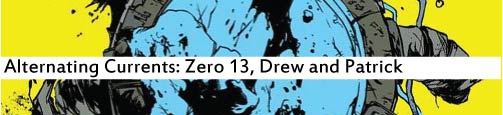 Today, Drew and Patrick are discussing Zero 13, originally released December 17th, 2014.
What has been will be again, what has been done will be done again; there is nothing new under the sun.
Ecclesiastes 1:9
Drew: It’s easy for the neophile to be frustrated with art. As much as our society claims to value innovation, our art tends to rely heavily on the comforts of the known. That’s not to say the majority of art is devoid of surprise, just that the forms that those surprises take are so prescribed as to be relatively predictable. Whether it’s the hero returning home or the melody returning to the home key, our most tried-and-true structures leave only the smaller details to truly distinguish themselves. Zero 13 contains a masterful example of this kind of small surprise, but this issue’s biggest surprise might lie in what it reveals about the larger form of the series. Continue reading
Afterlife with Archie 7
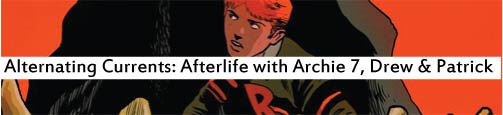 Today, Drew and Patrick are discussing Afterlife with Archie 7, originally released December 10th, 2014.
The critic encounters standard elements of comics work — word balloons, square panels, standard layouts — and immediately interprets them as meaningful to the content of the work. This is another example of the critic’s own ignorance coming out to play. Imagine if a critic wrote (of a prose novel) that “the straightness of the lines of text reflect the narrator’s matter-of-fact perception of the world, and the ordering of the letters from left-to-right functions as a subtle reference to his growing political conservatism as he comes of age over the course of the novel.”
Dylan Meconis, “How Not to Write Comics Criticism“
The medium is the message.
Michael McLuhan, Understanding Media: The Extensions of Man
Drew: These two statements might seem contradictory, but I firmly believe both of them. All elements of any work of art are meaningful, but not all are uniquely meaningful. Meconis makes this distinction later in his essay, acknowledging that even the elements we tend to take for granted can be full of meaning, but I tend to agree that they aren’t always worth noting in a discussion with a limited word count. The problem, of course, is in distinguishing which elements are uniquely meaningful to the work at hand, and which can be understood as “standard elements” — an easy task when you’re familiar with the medium (or genre) in question, but becomes a bit more treacherous when you aren’t. In those cases, we have to weigh the value of those fresh eyes (which might be more valuable for a discussion aimed at people equally unfamiliar) vs. doing more research (which will be better for an audience already well-versed in the medium/genre). I’ve opted for the former in this discussion of Afterlife with Archie 7, so my apologies to anyone who is no longer as excited about the novelty of Archie! With! Zombies! Continue reading
Batgirl 37
 Today,
 Suzanne Drew and Patrick are discussing Batgirl 37, originally released December 10th, 2014.
Drew: I don’t think it’s unfair to suggest that Barbara Gordon has one of the least memorable origin stories in the Bat-mythos. In fact, without the inciting incident of murdered/criminal parents, or simply figuring out Batman’s identity, it’s arguable that she doesn’t have an origin “story” — she just kind of became Batgirl in the same way someone becomes an adult. That means she doesn’t have the same motivations built into her character that Bruce, Dick, Jason, Tim, Cassandra, Steph, and Damian all have. That’s not to say she’s a lesser character — indeed, she’s been the center of several great stories — just that her “mission” isn’t as strongly defined or as personally motivated as those of her peers. With Batgirl 37, writers Brenden Fletcher and Cameron Stewart turn that lack of definition into a huge asset, making Babs an infinitely more believable 20-something. Continue reading
Weekly Round-Up: Comics Released 12/3/14
 Look, there are a lot of comics out there. Too many. We can never hope to have in-depth conversations about all of them. But, we sure can round up some of the more noteworthy titles we didn’t get around to from the week. Today, Spencer and Drew discuss Batman Eternal 35, Gotham Academy 3, Grayson 5, Angela: Asgard’s Assassin 1, The Autumnlands: Tooth and Claw 2, and The Private Eye 9.
 Spencer: So there’s been a lot of talk about who the “big bad” behind Batman Eternal is, but issue 35 makes me think that perhaps he’s been right under our noses since the very first issue. The one constant throughout this series, the one figure putting in an appearance in every arc, has been Jason Bard, and in this week’s installment we begin to dive into his intensely personal motives for targeting Batman. Indeed, “personal” is the name of the game this issue; Bard’s attacks on Batman continue to get more and more personal as he not only strips Bruce Wayne of his company and assets, but turns a trusted friend against him to boot. Fortunately, Bard’s about to get a taste of his own medicine; Vicki Vale is in Detroit, ready to dig up every last piece of dirt she can find on Bard. I don’t know whether Vicki was only faking her relationship with Bard to get close to him, or if she just had a change of heart after getting to know him better, but either way, it’s a delicious reversal. Continue reading
Swamp Thing 37
 Today, Drew and Spencer are discussing Swamp Thing 37, originally released December 3rd, 2014.
Men have become the tools of their tools.
Henry David Thoreau
Drew: I think it’s safe to say that technophobia has always been a thing. From fire to electricity, somebody was always more concerned over what we were losing than what we were gaining. Stories of people fearing electrical vapors or locomotives seem quaint to us now, but it wasn’t so long ago that buying things through this new internet thing seemed like an absurdly risky endeavor. In fact, I think consumers were so scared of online shopping that we were kind of oblivious to the impacts it could have in offline shopping. If anyone should have been scared of online shopping, it was brick-and-mortar establishments like Blockbuster and Borders (and, you know, countless small businesses) that couldn’t compete with the convenience and selection. The comics industry is still recovering from its most recent bout of technophobia, having only recently fully embraced same-day digital releases and content designed specifically for screens. Those growing pains are very much at the heart of Swamp Thing 37, which checks in on how the various avatars are reacting to the space technology is carving out for itself. Continue reading
 Retcon Punch