Action Comics 1001: Discussion

By Michael DeLaney and Spencer Irwin

Action Comics 1001

This article contains SPOILERS. If you haven’t read the issue yet, proceed at your own risk!

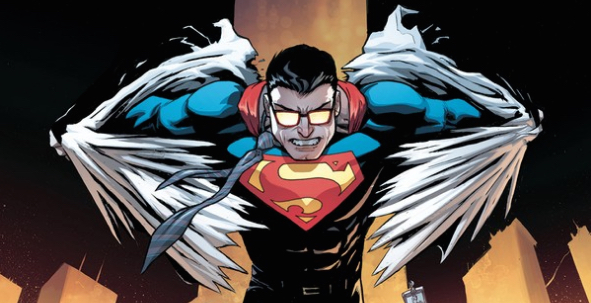
Michael: The distinction between Superman’s two long-running titles, Superman and Action Comics, has never really been made clear. Besides the dollar and cents of it all, the two books exist simultaneously to give different creators the opportunity to tell their own ongoing Superman stories. But what happens when it’s the same writer plotting both books? Continue reading

Doomsday Clock 6 Circles Marionette’s Past as it Circles the Drain

By Patrick Ehlers

This article contains SPOILERS. If you haven’t read the issue yet, proceed at your own risk!

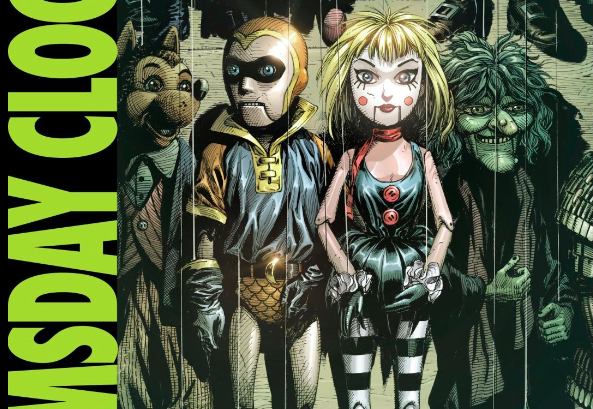
If I asked you to picture the single imagine that evokes Watchmen, what would you picture? Likely, you’re imagining the Comedian’s smiley face button, but I could also see an argument for Doctor Manhattan’s circular forehead logo. Both symbols are circles. I know that’s not exactly mind-blowing, but this is the level of visual rhetoric writer Geoff Johns and artist Gary Frank are playing with in Doomsday Clock 6.

The series continues to slump along in much the same way it did last time we talked about it. This time, Marionette and Mime are the focus of the story, which really doesn’t do Johns or Frank any favors. Stripped of all but the most tangential references to the Watchmen universe, the creators are left with the tone and tools of the piece to tell a story that spans two tonally discrete universes. If that sounds like an inadequate set of tools to complete an impossible task, that’s because it is. Continue reading

Superman 1: Discussion

by Spencer Irwin and Patrick Ehlers

This article contains SPOILERS. If you haven’t read the issue yet, proceed at your own risk!

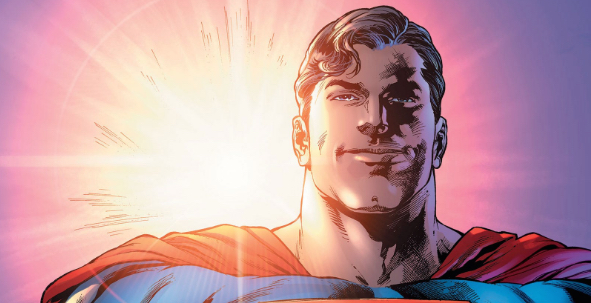
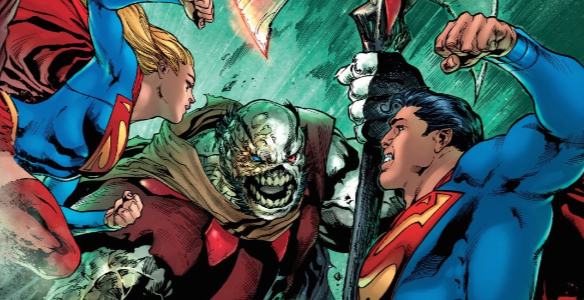
Spencer: One of the biggest criticisms I’ve seen thrown around about Superman as a character is that he’s “too powerful,” that nothing can challenge a man who can quite literally juggle planets. There’s a bit of truth to this, to be sure, but it’s a narrow criticism, one that only takes into consideration physical challenges; the most interesting Superman stories are the ones that challenge him morally, ethically, or in ways that make his physical abilities useless. Superman 1 is such a story, an issue that finds the character at his most physically competent, yet feeling more lost and helpless than ever before.  Continue reading

The Martian Migraines and Cosmic Confusion ofJustice League 3

By Michael DeLaney

This article contains SPOILERS. If you haven’t read the issue yet, proceed at your own risk!

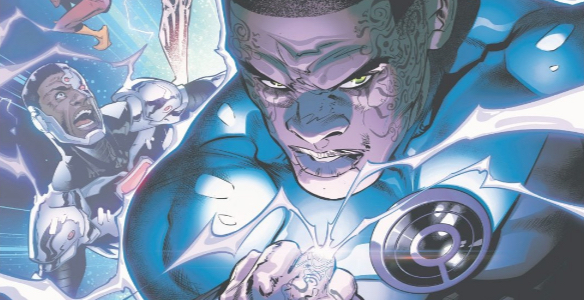
Great superhero epics always have a touch of mystery: an unseen enemy, the villain’s elaborate master plan or the occasional gigantic conspiracy. Does the simultaneous inclusion of multiple mysteries add to the excitement of such an adventure, or does it simply distract? These are the types of questions I face when reading a book like Justice League 3. Continue reading

Sensational Irony in The Immortal Hulk 2

by Patrick Ehlers

This article contains SPOILERS. If you haven’t read the issue yet, proceed at your own risk!

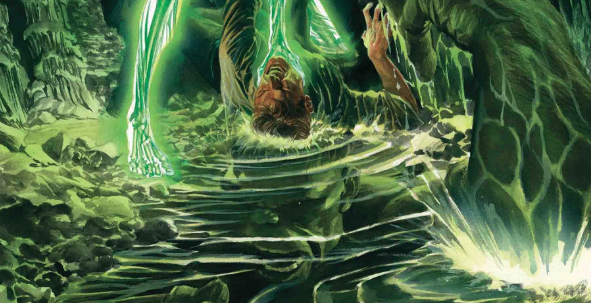
What scares you in media? I mean, we’ll all flinch at a well-timed jump scare: a sting of music, a flash of light, and suddenly we’re face to face with a monster. That’s a scare based on your senses, the creators manipulating your biological responses like buttons on a controller. Writer Al Ewing and artists Joe Bennett, Ruy José and Paul Mounts use sense-based scares as a smokescreen for the real horrors of The Immortal Hulk 2: irony.

This issue is so thematically compact and wonderful, it’s one of those rare superhero comics I’d recommend to anyone with a passing interest in The Hulk or horror comics. Even as Banner’s narration dips into some Civil War II plot nonsense, everything you need to understand the issue is contained within these 20 pages. Continue reading

Superman Fails to Find a Better Way in Man of Steel 6

by Drew Baumgartner

Man of Steel 6

This article contains SPOILERS. If you haven’t read the issue yet, proceed at your own risk!

Superman always finds a better way.

Superman purist, Traditional

I’m paraphrasing pretty heavily here, triangulating a sentiment from the dozens of arguments I read (and participated in) in the wake of Zack Snyder’s Man of Steel, but the idea that Superman can always come up with a solution that doesn’t involve murder is a ubiquitous one in Superman fandom. And I agree with that idea as it applies to that film — Superman certainly could have at least attempted something else (or the movie could have done a better job convincing us that he had exhausted his options) — but something about “always finding a better way” doesn’t quite feel like Superman to me. His moral compass true, and he’ll never fail to aim for a solution that satisfies his sense of what’s right and wrong, but the thought that he always comes up with a solution would rob those morals of any real consequence. While some Superman stories might resemble Sherlock Holmes in that “seeing how he solves it is the fun” kind of way, one of the most interesting things about Superman having such a strong morality is that it might be tested or bear some emotional cost. That’s a point Brian Michael Bendis and Jason Fabok leverage twice in Man of Steel 6, as Superman fails to “find a better way” in both his superheroing and family lives. Continue reading

How to Maintain a Balanced View of Technology in Nightwing 46

by Spencer Irwin

This article contains SPOILERS. If you haven’t read the issue yet, proceed at your own risk!

slim-banner

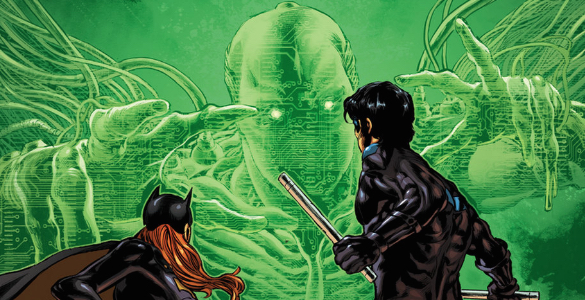
I’ve spent a lot of time recently making fun of “Alexa” and other similar voice activated assistants — the idea of willingly installing what ultimately amounts to a wire-tapping device in my own home seems patently absurd to me. Yet, I can’t deny the fact that I carry a smartphone with me at all times, a device that not only has similar surveillance abilities, but the power to track my every movement as well. I guess the question I should really be asking, then, isn’t “why would someone willingly buy a device like this?,” but “what would it take to make someone willingly buy a device like this?” Sometimes it’s convenience, sometime it’s the unparalleled access to information, and sometimes it’s simple denial. All these seem to be in play in Benjamin Percy, Christopher Mooneyham, and Lalit Kumar Sharma’s Nightwing 46, as Blüdhaven embraces technology that’s clearly attempting to data-mine the entire city. Continue reading

Catwoman 1: Discussion

by Spencer Irwin and Mark Mitchell

This article contains SPOILERS. If you haven’t read the issue yet, proceed at your own risk!

Spencer: I’ve only recently become familiar with Joëlle Jones, but it was immediately apparent from her work that she not only cares about fashion, but that she has a real talent for bringing it out on the page. It should be no surprise, then, that fashion — at least in a sense — seems to be one of the underlying themes of Jones’ Catwoman 1. I don’t necessarily mean fashion as in runways and models, although Jones’ take on Selina Kyle could certainly put Tyra Banks to shame — I mean fashion as in the idea of clothing, costumes, and disguises, what they mean to the public, and what they mean to the individuals wearing them. Continue reading

Batman 50: Discussion

by Drew Baumgartner and Michael DeLaney
Batman 50

This article contains SPOILERS. If you haven’t read the issue yet, proceed at your own risk!

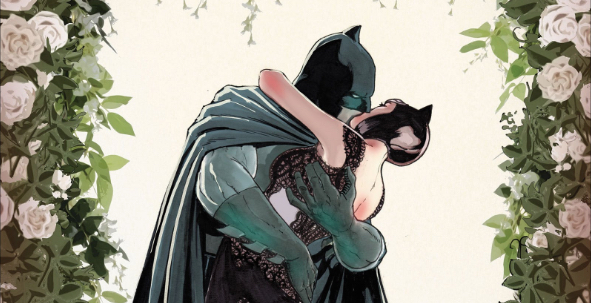
Drew: Bruce Wayne understands that his responsibilities as Batman demands sacrifice. He devotes his time, body, and earthly resources to his mission to fight crime, and generally takes that mission very seriously. All of which can look like he’s sacrificed his own happiness in order to be Batman. Or, more precisely, that his happiness is a necessary sacrifice for his existence. Batman’s drive, the argument goes, comes from his grief, anger, and sadness, so anything that blunts or dilutes those feelings weaken his mission. It’s a position DC Editorial staked out back in 2013, when Dan DiDio explained why Batwoman’s marriage could never happen, but it’s not necessarily a philosophy writer Tom King ascribes to. Indeed, King has argued that Batman’s happiness is a valuable source of drama, stating “There’s no conflict in having Batman be sad. There’s conflict in having Batman be happy.” That may mean King sees Batman’s happiness as only a temporary condition, but it’s obviously not out of the question. The point is, it’s a hotly debated topic, and one that King cleverly allows to play out in the pages of Batman 50. Continue reading

The Man of Steel 5 Lets Superman Define the Symbol

by Patrick Ehlers

This article contains SPOILERS. If you haven’t read the issue yet, proceed at your own risk!

Early in this issue, Superman catches a glimpse of a symbol on Rogol Zaar’s chest, and while he gets a good look at it, he can’t quite make out what it’s supposed to mean. The symbol is one that writer Brian Michael Bendis and his collaborators have been playing with from the very first pages of Man of Steel — a perfect circle with something interrupting that perfection. Bendis’ various collaborators have cast a number of different circles and spheres to play the role of this symbol: sometimes it’s a collapsing Krypton, or a quiet Earth, or the reflection of Rogol in Superman’s eye. My favorite circle actually appears in this issue, as Rogol’s eye peering into the opening of the bottled city of Kandor. Bendis has been teasing meaning in this shape for so long that when Superman finally decides he is interested in divining that meaning, the character and the reader are united in purpose. Continue reading