Captain America 1 Addresses the Change We Wish We Didn’t See

by Drew Baumgartner

Captain America 1

This article contains SPOILERS. If you haven’t read the issue yet, proceed at your own risk!

If we could change ourselves, the tendencies in the world would also change. As a man changes his own nature, so does the attitude of the world change towards him. […] We need not wait to see what others do.

Mahatma Gandhi

You might be more familiar with this quote as it is often paraphrased, “Be the change that you wish to see in the world.” It’s a (hilariously self-actualized) misquote that kinda sorta captures the sentiment of the original, paring a nuanced sentiment down to something that could fit on a bumper sticker. But we only need to think about the cheery optimism of that bumper sticker for a moment to see the pessimism inherent in it. We can be the solution to the world’s problems, sure, but only because we’re already the cause of them. We need to change because we are what the world is — any problems in it are caused by us (whether by malice, ignorance, or complacency).

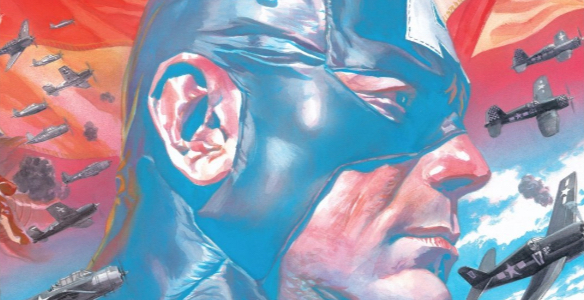
It’s a lesson many Americans learned (too late) after Donald Trump was elected. Not because we voted for him, but because we thought not voting for him was enough. We thought we were the solution to the problems we saw in the world, but didn’t appreciate how we were also the problem. We saw the battle over the future of this country as an “us vs. them,” failing to understand that there is only an “us,” that we can only be the solution when we accept that we are the problem. We thought fascism was a thing that happened in other countries, and that America would band together to reject it. We were wrong. Few people understand this (or have articulated it quite as clearly) as Ta-Nehisi Coates, which makes him the ideal writer to tackle Captain America, a series also coming to terms with its own in-universe convulsions of fascism. Continue reading

Cypher Drives the Action in Hunt for Wolverine: Weapon Lost 3

By Drew Baumgartner

Hunt for Wolverine Weapon Lost 3

This article contains SPOILERS. If you haven’t read the issue yet, proceed at your own risk!

One of my favorite insights in film criticism is that a shot can only have one subject. The subject can be (and often is) an individual, but the fascinating thing about a two-shot or group shot is that the individuals can’t be the subjects of those shots, so instead, the subject is their relationship. That is, when two characters are occupying a single shot, the subject of the shot isn’t either one of them, but their relationship to one another, whether it’s familial, antagonistic, friendly, or romantic. And I think we might be able to say something similar about ensemble stories. Or, at least, that the subject of an ensemble story can’t be several individuals. The subject can be anything from a character to a relationship to a theme, but there can be only one. So what is the subject if Hunt for Wolverine: Weapon Lost? Is it Daredevil, our narrator (and most recognizable character)? Is it Frank McGee and Misty Knight’s budding romance? Is it the group dynamics of this makeshift team? With issue three, Charles Soule and Matteo Buffagni seem to have settled on an unexpected option as their subject: Cypher. Continue reading

Batman 50: Discussion

by Drew Baumgartner and Michael DeLaney

Batman 50

This article contains SPOILERS. If you haven’t read the issue yet, proceed at your own risk!

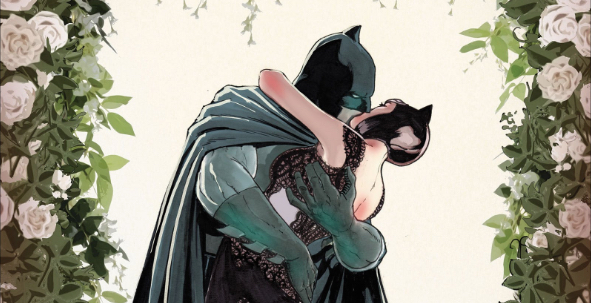
Drew: Bruce Wayne understands that his responsibilities as Batman demands sacrifice. He devotes his time, body, and earthly resources to his mission to fight crime, and generally takes that mission very seriously. All of which can look like he’s sacrificed his own happiness in order to be Batman. Or, more precisely, that his happiness is a necessary sacrifice for his existence. Batman’s drive, the argument goes, comes from his grief, anger, and sadness, so anything that blunts or dilutes those feelings weaken his mission. It’s a position DC Editorial staked out back in 2013, when Dan DiDio explained why Batwoman’s marriage could never happen, but it’s not necessarily a philosophy writer Tom King ascribes to. Indeed, King has argued that Batman’s happiness is a valuable source of drama, stating “There’s no conflict in having Batman be sad. There’s conflict in having Batman be happy.” That may mean King sees Batman’s happiness as only a temporary condition, but it’s obviously not out of the question. The point is, it’s a hotly debated topic, and one that King cleverly allows to play out in the pages of Batman 50. Continue reading

A Fitting End in Kill or be Killed 20

By Drew Baumgartner

Kill or be Killed 17

This article contains SPOILERS. If you haven’t read the issue yet, proceed at your own risk!

Mr. Helpmann: He’s got away from us, Jack.
Jack Lint: ‘Fraid you’re right, Mr. Helpmann. He’s gone.

Brazil

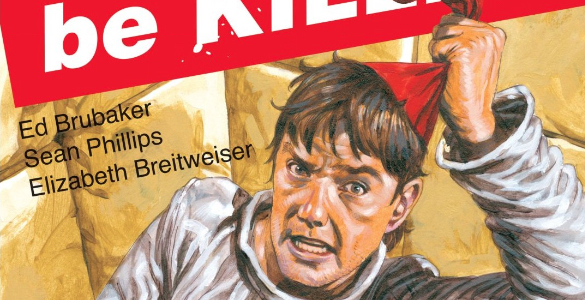
Drew: There are plenty of worthy contenders, but I tend to think of Terry Gilliam’s Brazil as having the most contentious final cut in film history. Indeed, as the film languished in post-production hell, both Gilliam and the chairman of Universal Pictures, Sid Sheinberg took out competing ads in Variety, imploring the other to release their preferred cut of the film. And much of that disagreement came down to the two lines quoted above; the ones that reveal the frenetic, phantasmagoric escape our hero makes is actually his dissociative fantasy — it turns out he never escaped his torture chamber. Since this is a Gilliam film, it’s easy to argue the whole movie is frenetic and phantasmagoric — and it definitely is to some degree — but the ending flies off the rails in a way that really only make sense as a fantasy. It’s an over-the-top “coincidences help the hero” ending that reads as a straight-up parody of Hollywood films, so it’s kind of hilarious that Sheinberg would insist on that ending not being a fantasy. Any savvy viewer would recognize that something is seriously wrong with Winston’s escape, so to insist that there’s nothing is an insult to our intelligence. That is, we know that it’s a fantasy, we just need the movie to be smart enough to agree with us. With their final issue of Kill or be Killed, Ed Brubaker and Sean Phillips lean into a similarly impossible-to-believe fantasy, along with a twist very much like the one Gilliam always intended for Brazil. Continue reading

Heightening the Conflict in Harbinger Wars II 2

by Drew Baumgartner

Harbinger Wars 2 2

This article contains SPOILERS. If you haven’t read the issue yet, proceed at your own risk!

What is the collective noun for superheroes? An immodesty of superheroes, perhaps? A bluster, a cluster bomb, a swank? Somebody ought to settle the issue soon, if we’re going to be showered with films like “Avengers: Infinity War.”

Anthony Lane in The New Yorker

That quote comes from my least favorite culture review in recent memory. I’ve heard enough variations of “superheroes are dumb” over the years to keep my eyes rolling all the way to Anthony Lane’s door, but what’s particularly frustrating about his review is that it never bothers to support his dismissive attitude. It’s not a critique so much as a list of characters and events in the movie and the smug assumption that we all agree that that list is too long. To be clear, I think there is plenty to critique about that movie, not the least of which that it almost certainly would ring as paradoxically overstuffed and hollow without at least some familiarity with these characters — if we’re not already invested in Tony Stark’s worst fears or Thor’s grief or Doctor Strange’s sense of duty, they’ll read as pretty thin in the movie. Like most summer crossover events, Infinity War is mostly plot machinations, cashing in on the character work developed in its respective solo series. Such is definitely the case with Harbinger Wars II 2, which heightens the drama of the impending battle, but does relatively little to draw me into that drama. Continue reading

Exposure Helps the Cause in Outcast 36

by Drew Baumgartner

Outcast 36

This article contains SPOILERS. If you haven’t read the issue yet, proceed at your own risk!

For nine years, Koresh had relentlessly drilled his followers to prepare for Armageddon, had preached its inevitability, had forecast its imminence. This was the ending that Koresh had prayed for and staked his reputation on — the final battle, the trial by fire. It didn’t matter if the fire came from automatic rifles or a match and a can of kerosene; this was what Koresh had promised. Anything less would have been a monumental betrayal of his claim to be David Koresh, Angel Warrior of the Armageddon. Did anyone really expect the prophet of Ranch Apocalypse to meekly surrender his sheep to the enemy and come out with his hands up?

Gary Cartwright, “The Enemy Within”

What do you know about the Waco siege? I admittedly don’t know a ton — it happened when I was five years old — but as with any event with conflicting stories, “what you know” may matter less than “who you believe.” In light of the beliefs of the Branch Davidians, the events of the eventual raid, and especially the presence of the stockpiled weapons the ATF was originally there to seize, it’s hard for me to imagine the Davidians as anything other than dangerous zealots. That is, the plausible deniability of their threat dissolved under scrutiny — the more light shed on the situation, the crazier they looked. Rowland Tusk has orchestrated a surprisingly similar situation for Kyle, preparing for a siege of his own religious “cult,” but with the truth on Kyle’s side, it sure seems like things are actually stacked in his favor. Continue reading

Multiple Multiple Men in Multiple Man 1

by Drew Baumgartner

Multiple Man 1

This article contains SPOILERS. If you haven’t read the issue yet, proceed at your own risk!

The X-Men represent a particularly confusing corner of the Marvel Universe. It would be hard enough to keep the ever-growing list of characters straight even without all of the time travel, shape-shifting, and body-doubling shenanigans. I suppose mileage varies depending on how familiar one is with all of those characters and timelines, but for me, the most readable X-Men stories tend to strip things down: a few characters, a specific problem, and clearly defined parameters that limit the solutions. Unfortunately, Multiple Man 1 doesn’t do a great job of laying out any of those components. Continue reading

Babs Can Afford to Trust in Batgirl 24

By Drew Baumgartner

Batgirl 24

This article contains SPOILERS. If you haven’t read the issue yet, proceed at your own risk!

Quick, what distinguishes Batgirl from Batman? The specifics may have changed over time, but one of the key components of her current incarnation is that she’s a bit more street level, tackling cases that impact her local community as opposed to ones that threaten the entire city, country, world, or fabric of reality as we know it. Her relationship to commissioner Gordon is also more fraught, as her closeness with him in civilian life complicates her interactions with him in her costumed life. And then there’s her compassion. Batman can be a bit flexible on this front — in some stories, he goes out of his way to help would-be criminals make smarter choices, in others, he goes out of his way to break as many of their bones as possible — but Batgirl almost invariably leads with empathy. It’s an approach that can occasionally blow up in her face, as it does in issue 24, but never so much that she can’t course-correct. Continue reading

James Bond The Body 6: Discussion

by Drew Baumgartner & Mark Mitchell

James Bond The Body 6

This article contains SPOILERS. If you haven’t read the issue yet, proceed at your own risk!

slim-banner

You are driving a bus with 12 passengers on it. At the first stop, half of the passengers get off and nine more get on. At the second stop, a third of the passengers get off and two more get on. At the third stop, one quarter of the passengers get off and seven more get on. What color are the bus driver’s eyes?

Traditional

Drew: Misdirection is a simple consequence of our limited attention. We can only focus on so many details at once, so if we’re misled about which of those details are important, we can easily miss what’s actually important. This old brain teaser illustrates the point perfectly, introducing the fact that we are driving the bus as an inconsequential detail before distracting us with a bunch of numerical information that seems like it is probably the point of the puzzle. Only, the solution to the puzzle requires that we divided our focus in the opposite way, remembering the one detail that seemed irrelevant to what we assumed was a math problem. James Bond: The Body 6 does something similar, laying out a detailed explanation of the case Bond spent the previous five issues skirting the edges of while the actual action plays out in the background. It’s a clever trick, disguising action as exposition, allowing Aleš Kot and Luca Casalanguida to play out their final reveal and villain showdown simultaneously, skipping the falling action right to the moment Bond can reflect on his role in everything. Continue reading

Genuine Jump Scares in Infidel 4

by Drew Baumgartner

Infidel 4

This article contains SPOILERS. If you haven’t read the issue yet, proceed at your own risk!

slim-banner

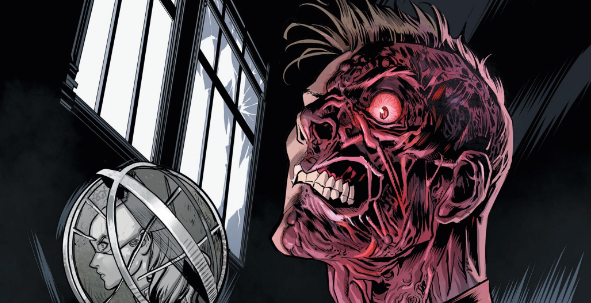
I’m so enamored of Infidel‘s social commentary, it’s easy to neglect just how skillful of a haunted house story it is. And I say that as someone who isn’t into horror generally or horror comics, specifically. I’m sure the social commentary elements help make the ghouls of this series feel so insidious, but this series manages to be scary far beyond its concepts. That is, the effectiveness of the horror relies on the skills of writer Pornsak Pichetshote and artist Aaron Campbell, and issue 4 perfectly demonstrates how they deliver scares in totally unexpected ways. Continue reading