Generations Sam Wilson Captain America & Steve Rogers Captain America 1: Discussion

by Patrick Ehlers and Ryan Mogge

This article contains SPOILERS. If you haven’t read the issue yet, proceed at your own risk!

slim-banner

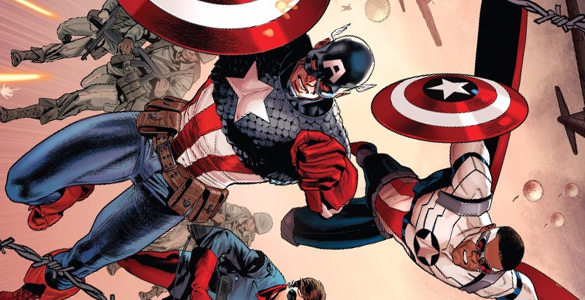
Patrick: One of the harsher truths of Secret Empire is that America was always run on an engine of hatred and fear. Racism, sexism, classism, fascism — neither Hydra Cap nor Donald Trump invented these things. They didn’t even popularize or legitimize them, they’re simply high profile embodiments thereof. It is increasingly easy to read the totality of American history as ugly and hateful, filled with crass opportunists, liars, and mass murderers. That can make the USA a hard hero to root for. With Generations Sam Wilson Captain America & Steve Rogers Captain America 1, writer Nick Spencer goes back in time, giving both Sam Wilson and his readers a lifetime to reconsider the value in fighting for what may, at times, appear to be a lost cause. Continue reading

Batman/The Shadow 6: Discussion

by Michael DeLaney and Mark Mitchell 

This article contains SPOILERS. If you haven’t read the issue yet, proceed at your own risk!

slim-banner

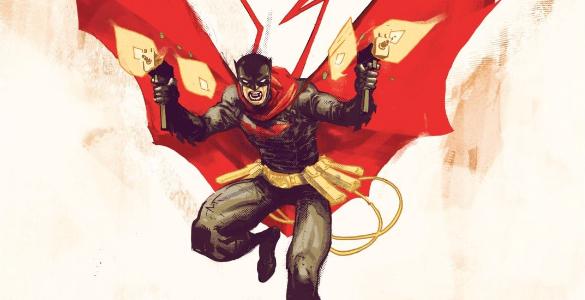
Michael: As Drew and I suggested in our discussion of this series’ first issue, Batman/The Shadow is absolutely a Batman-centric book featuring The Shadow and not the reverse. There’s nothing wrong with that, but it just proves how strong Batman’s hold is on the heart and mind of Scott Snyder. The finale — Batman/The Shadow 6 — underlines that statement as the fantastical elements of The Shadow’s world only strengthen Batman’s very human legend. Continue reading

Godshaper 6: Discussion

by Spencer Irwin and Drew Baumgartner

This article contains SPOILERS. If you haven’t read the issue yet, proceed at your own risk!

slim-banner

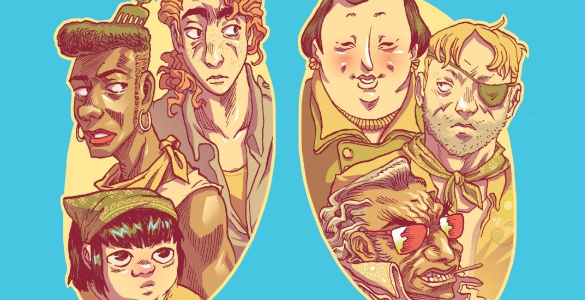
Spencer: It’s a marvelous thing to watch a series come into focus — to reach that eureka moment where you finally get what a creator is trying to say, where a series’ message finally clicks. Simon Spurrier and Jonas Goonface’s Godshaper 6 has been one of those moments for me, a finale that brings all the themes the series has been exploring together in a satisfying, yet completely unexpected fashion. Continue reading

Angelic 1: Discussion

by Spencer Irwin and Mark Mitchell

This article contains SPOILERS. If you haven’t read the issue yet, proceed at your own risk!

slim-banner

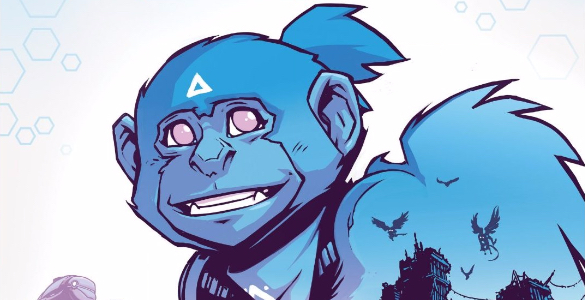
Spencer: Simon Spurrier may just be the best world builder working in comics today. We here at Retcon Punch are continually impressed by Spurrier’s ability to birth creative new world after creative new world, each with its own rules, vernacular, and aesthetic (thanks to the talented artists he’s enlisted), each feeling far vaster than the stories Spurrier decides to tell in them, each reflecting systematic problems, abuses, and issues we face here in the real world. Following on the heels of The Spire and Godshaper, Angelic finds Spurrier and Caspar Wijngaard using a world of sentient animals and oppressive lore to tell a story about the dangers of blind faith. Continue reading

Secret Weapons 4: Discussion

by Patrick Ehlers and Drew Baumgartner

This article contains SPOILERS. If you haven’t read the issue yet, proceed at your own risk!

slim-banner

“There. There it is: too much iron in your blood…”

Magneto, X2

Patrick: Magneto controls magnetic fields. It’s an objectively cool super power, impossibly useful in every situation (and particularly useful against any otherwise unkillable enemy). In X2, Magneto uses this power rip microscopic particles of iron out of his prison guard’s bloodstream. He manipulates the magnetic fields around the resultant bloody cloud until he’s in control of free-flying bullets and hovering platforms. It’s an absurd demonstration of Magneto’s powers. There’s a lot to criticize in the logic of that scene, but it’s hard to fault the giddy enthusiasm. Writer Eric Heisserer and artists Raúl Allén and Patricia Martín show a similar enthusiasm for their characters’ powers. The difference is that they start from a ridiculous premise and work their way to exciting applications.

That’d be reason enough to love the conclusion of Secret Weapons, but Heisserer, Allén and Martín hold the comic book medium in the same high esteem as the goofy powers their characters posses. Just as Avi, Nikki and Owen apply their simple skills in ingenious ways, so too does the creative team master the page with mindblowingly intuitive art. Continue reading

Runaways 1: Discussion

by Spencer Irwin and Taylor Anderson

This article contains SPOILERS. If you haven’t read the issue yet, proceed at your own risk!

Spencer: Runaways 1 has to be one of the most unusual first issues I’ve ever read, especially for a team book and especially for a book from the Big 2. While I’ve read plenty of good, sometimes even great, first issues, there’s certain objectives most first issues have to achieve — introducing the series’ cast, premise, and villain, for example — that can lead to them all feeling like they’re cut from the same template. Runaways 1, though, shatters that template completely; Rainbow Rowell, Kris Anka, and Matthew Wilson essentially skip to what would probably be issue 4 of any other series, immediately immersing readers deep in a tense, life-or-death scenario. It’s a marvelous decision. Continue reading

Action Comics 987: Discussion

by Mark Mitchell and Michael DeLaney  

Action Comics 987

This article contains SPOILERS. If you haven’t read the issue yet, proceed at your own risk!

slim-banner

Mark: Modern comic books are built on tropes. After nearly a century of storytelling in the medium, the particulars of what makes a Superman story different from a Batman story are so deeply engrained that creators have a binary choice when sitting down to craft a tale: embrace the tropes or react against them. And while longtime comic book readers tend to seek out and reward stories that are willing to subvert and contort their expectations, either choice can be successful if executed well. Continue reading

Secret Empire: Omega 1: Discussion

By Ryan Mogge and Drew Baumgartner

This article contains SPOILERS. If you haven’t read the issue yet, proceed at your own risk!

Ryan: Every event in your memory left some sort of mark. When it comes to trauma, those marks are more like deep grooves. No matter how much you heal, or how much better off you are, you are changed by what has happened to you. In the wake of a rebellion against a group of fascists bent on world domination with the face of the most trusted man alive, you certainly can’t expect to move forward without being changed. In Secret Empire: Omega 1, Nick Spencer and Andrea Sorrentino offer a mixture of back-to-normal plot points and artful rumination that operate quite differently but still offer the same themes of trauma and the scars left behind. Continue reading

The Wicked + The Divine 31: Discussion

by Drew Baumgartner and Spencer Irwin

Wicked + The Divine 31

This article contains SPOILERS. If you haven’t read the issue yet, proceed at your own risk!

In order to increase the likelihood that students will call for medical assistance in an alcohol-related emergency, some colleges and universities have instituted “Good Samaritan” or medical amnesty policies that eliminate or reduce judicial consequences for students involved in alcohol-related medical emergencies. Other schools may reject this type of strategy based on arguments such as the need to “avoid sending the wrong message” about the seriousness of underage drinking.

Doborah K. Lewis & Timothy C. Marchell,
Safety first: a medical amnesty approach
to alcohol poisoning at a U.S. university”

Drew: I first encountered the notion of a medical amnesty policy in college, though I can’t say I gave it much thought at the time. Indeed, it wasn’t until I was in a position to be worried about dangerously drunk/overdosing students not coming forward (I worked for several years at a summer camp for high-school students) that I started to appreciate how boneheaded the “avoid sending the wrong message” camp truly is. Mostly, it just forgets that the rules against drinking and alcohol use are there for the safety of the students in the first place, somehow valuing the sanctimonious tut-tutting of saying “you shouldn’t drink” over, you know, saving the life of a kid who broke the rules. It’s such an obviously flawed attitude, I was honestly taken aback when I saw reports that some sheriff in Florida was explicitly not offering amnesty to folks with warrants seeking shelter from Hurricane Irma. Or, more specifically, he was insisting on conducting unconstitutional ID checks in order to deter anyone with a warrant from seeking the refuge of a hurricane shelter, endangering their lives because he somehow values laws — the things society makes in order to protect people — more than actually protecting people.

Before I get too off topic, my point is that we’re often too preoccupied with the letter of the law to really parse its spirit. Certain things may be illegal because they’re dangerous, but if coming forward about illegal activity makes things objectively less dangerous, we should encourage that behavior. The article I quoted at the top of this piece offers objective data in support of that idea after studying a medical amnesty policy at Cornell, but I think it’s crucial to note that this type of thinking doesn’t just operate at the institutional level. Even in our daily lives we often react badly to honesty simply because we dislike the truths being revealed, but like the researchers at Cornell, we must recognize how that attitude only makes the situation worse. I found myself thinking about this phenomenon a great deal as I read The Wicked + The Divine 31, as issues of amnesty (and lack thereof) cropped up throughout the issue. Continue reading

Batman 30: Discussion

by Michael DeLaney and Drew Baumgartner 

This article contains SPOILERS. If you haven’t read the issue yet, proceed at your own risk!

Michael: I’ll admit, I haven’t really understood Tom King’s fascination with Kite Man during his tenure on Batman. King placed Kite Man in the middle of “The War of Jokes and Riddles” in Batman 27 and his tragic origin — Riddler poisoning and killing his son — still left me unmoved. Batman 30 marks the second part of “The Ballad of Kite Man” as well as my cold heart thawing to Kite Man’s tragic existence. Continue reading