Mata Hari 1: Discussion

by Mark Mitchell and Patrick Ehlers
This article contains SPOILERS. If you haven’t read the issue yet, proceed at your own risk!

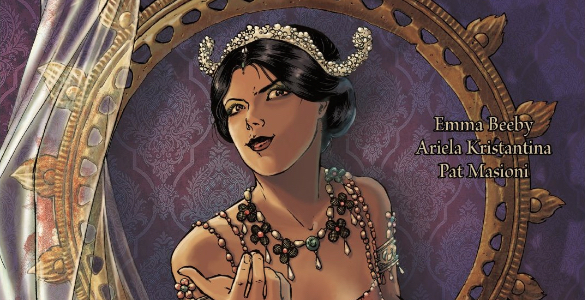
Mark: One of the corollaries to the Harvey Weinstein revelations and the #METOO and #TIMESUP movements is the healthy reexamination of other women in history who were victims, in one way or another, of systemic misogyny. Though they were produced before the movements began, last year’s Oscar nominated film I, Tonya makes the case for re-examining the way the media portrayed Tonya Harding — regardless of her guilt — and FX’s 2016 American Crime Story: The People vs OJ Simpson television series was a notably empathetic portrayal of lead prosecutor Marcia Clark. The point of these and other reexaminations isn’t to canonize these women, but to consider that the truth of their stories is more complicated than the convenient daytime talk show-like narratives that surround them.

Writer Emma Beeby calls out Harvey Weinstein by name in her author’s note at the end of Mata Hari 1, noting specifically that “now is the perfect moment to tell the story of what happens when women are without power.” Continue reading
Kingpin Drowns Out Everything Else in Daredevil 599

by Spencer Irwin

This article contains SPOILERS. If you haven’t read the issue yet, proceed at your own risk!

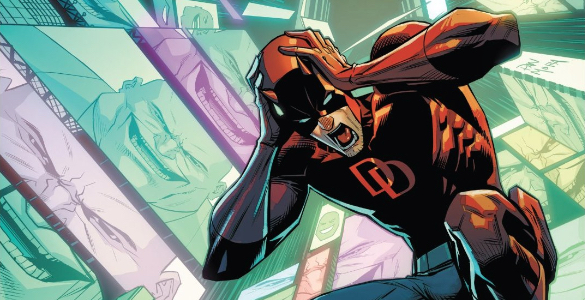
Ever since Donald Trump was elected president, the media has been a constant bombardment of scandals, missteps, and outrage. Every new sound bite is accused of being a “distraction” from something more important, but the truth is that almost every one of these stories is important (and horrifying) in their own way. Still, so many stories flying around at once can be absolutely overwhelming — nobody can get their bearings straight or agree on which scandals to tackle first. There’s just no way to focus in a world absolutely overwhelmed by Trumpian horrors, which is exactly what Matt Murdock is discovering in Daredevil 599, where newly-elected Mayor Fisk is just as divisive, dangerous, and all-encompassing a figure. Continue reading

Old Habits Die Hard in Amazing Spider-Man 796

by Drew Baumgartner

Amazing Spider-Man 796

This article contains SPOILERS. If you haven’t read the issue yet, proceed at your own risk!

There’s a concept in psychology of the “repetition compulsion,” which essentially lays out a kind of self-fulfilling prophecy for our neuroses. A straightforward (and non-pathological) example would be an introvert avoiding big crowds, which in turn prevents them from developing comfort around (or at least strategies to cope with) big crowds, which in turn encourages them to avoid big crowds, but this phenomenon can be seen operating at everything from our smallest habits to our biggest problems. Lest this sound too fatalistic, those cycles of repetition can be broken, but my actual point in bringing them up is just to emphasize how cyclical our lives can be — even when embarking on a new adventure, our old habits may force them to resemble our old adventures. Such has long been the case of superheroes, whose new adventures are in part only marketable because people liked the old adventures, so leaning into those repetition compulsions (even the destructive ones) is a logical choice.

Writer Dan Slott has always managed to keep a remarkable balance between the old and the new, repeating enough to keep his characters recognizable, but changing enough to keep the stories exciting, largely by changing the big patterns (Pete’s job, relationship status, identity, etc) but holding onto the small ones (Pete’s talkativeness, bad luck, sense of responsibility, etc). But with issue 796, Slott and co-writer Christos Gage begin folding some of those larger repetitions back into the mix, suggesting that Slott might just be putting the toys back in place as he hands over the reigns of the series he’s been writing for over a decade. Continue reading

Black Panther Annual 1: Discussion

by Drew Baumgartner and Ryan Desaulniers

Black Panther Annual 1

This article contains SPOILERS. If you haven’t read the issue yet, proceed at your own risk!

Drew: Over the past two weeks, countless articles have been written about the world-building in the Black Panther film. It’s obviously something the movie does remarkably well, combining a kind of anthropological survey of African culture with a sci-fi utopia for an Afrofuturist aesthetic that is unique in the world of blockbuster movies. Moreover, that world-building was essential in ingratiating a new audience to the character and his home country, implying a rich culture that stretched far beyond what we saw on the screen. Of course, superhero comics — especially long-running ones — are often more interested in what has already been built than they are in what is new, trading on our nostalgia for familiar events and characters in a way that a single film obviously can’t. There’s certainly a case to be made for honoring the storied history of any character in that way, though the approach may be at odds with appealing to newcomers (who may have been brought in by, say, a widely popular movie), all of which puts Black Panther Annual 1 in a difficult position. Is it aimed at newcomers looking for an approachable entry into comics after seeing the movie, or is it aimed at long-time readers who are already duly familiar with the character’s history? Continue reading

Giving Meaning to the Inevitable in Mighty Thor 704

by Drew Baumgartner

The Mighty Thor 704

This article contains SPOILERS. If you haven’t read the issue yet, proceed at your own risk!

Heroes are predictable, at least in terms of the noble qualities that define heroism. That is, while a hero’s cunning plan or stroke of genius may surprise us, that they would try to save the day — even and especially at great risk to themselves — is kind of a foregone conclusion. And no hero represents that quality of self-sacrifice better than Jane Foster, whose daily choice to wield Mjolnir to protect others has slowly allowed her cancer to advance. So that she would take up the hammer once again, even with the knowledge that doing so would surely kill her, isn’t exactly a surprise Jason Aaron and Russell Dauterman could have hoped to withhold. So instead, they spend this issue detailing exactly what that decision means to her beyond self-sacrifice, getting at just what it is that makes Jane so selfless in the first place. Continue reading

Learning New “Normals” in Super Sons 13

by Spencer Irwin

This article contains SPOILERS. If you haven’t read the issue yet, proceed at your own risk!

Growing up, we tend to think of our families as “normal.” Even if we think our family and their routines are weird or embarrassing, a lack of reference and experience often leave us assuming that this is just what every family is like — it isn’t until we get older and start spending time with friends and meeting new people that we realize how varied the human experience actually is. As always, Super Sons continues to use its two leads’ wildly different life experiences as learning aids for both, expanding their understanding of what “normal” is. Continue reading

The End of Deadpool vs. Old Man Logan 5 Isn’t About Her

By Patrick Ehlers

Deadpool vs Old Man Logan 5

This article contains SPOILERS. If you haven’t read the issue yet, proceed at your own risk!

The damsel in distress is creaky, well-worn trope. It’s an obvious and immediate call to action, and an easy way to assert both the heroism and the masculinity of our heroes. But, like, it doesn’t really really explain the motivation of our adventurers, does it? Deadpool vs. Old Man Logan presents the recurring issues of two immortal warriors as a kind of “we need to rescue / we need to deal with Maddie” quest. But whatever her deal is, and whatever she really needs, is totally secondary to how Wade and Logan deal with the problems that keep cropping up in their lives. It’s a depressing reminder of how stuck both of these guys are. Continue reading

Batman 41: Discussion

by Michael DeLaney and Ryan Mogge

This article contains SPOILERS. If you haven’t read the issue yet, proceed at your own risk!

Michael: The traditional superhero narrative can boil down to “hero is on top, villain arrives and takes over, hero defeats villain and the status-quo is restored.” There will be a period — however long or brief — where the villain has won and all hope is lost. Instead of showing a gradual build to that moment of defeat, Batman 41 starts us off there. Instead of opening with the first act optimism of A New Hope, Batman 41 goes right for the bleak Empire Strikes Back act break. Continue reading

Embrace the Immensity of Infinity Countdown Prime 1

By Michael DeLaney

This article contains SPOILERS. If you haven’t read the issue yet, proceed at your own risk!

With all of the backstory it lays out, Infinity Countdown Prime 1 should probably be renamed “Infinity Countdown Primer.” The book is equal parts past and prologue. Gerry Duggan and Mike Deodato Jr. set the stage for Infinity Countdown, cushioned between a Marvel editorial recap of what the Infinity Stones do and what their history is. And while it does throw a lot of information at the reader at once, it feels like one of the more successful starting points for a major comic event in recent memory — especially if you aren’t heavily versed in all things Infinity. Continue reading

Doctor Strange: Damnation 1: Discussion

by Spencer Irwin and Taylor Anderson

This article contains SPOILERS. If you haven’t read the issue yet, proceed at your own risk!

Spencer: Since our audience has excellent taste, I’m going to assume that you’re all watching NBC’s The Good Place, right? Essentially a show about lost souls trying to earn their way into Heaven by becoming better people, one of the more interesting concepts percolating beneath the show’s surface is the idea that the rules dictating what afterlife you’re sent to are inherently flawed and unfair. It’s almost impossible to earn your way into the Good Place — only the most selfless and charitable of souls make it — leaving plenty of folks who led wholly mediocre lives (or whose greatest crimes were being born in Florida) facing an eternity of torture and punishment. I couldn’t help but think of this while reading Nick Spencer, Donny Cates, and Rod Reis’ Doctor Strange: Damnation 1, which finds the city of Las Vegas, the Avengers, and perhaps the entire world being judged by equally biased, unfair rules. Continue reading