Action Comics 1001: Discussion

By Michael DeLaney and Spencer Irwin

Action Comics 1001

This article contains SPOILERS. If you haven’t read the issue yet, proceed at your own risk!

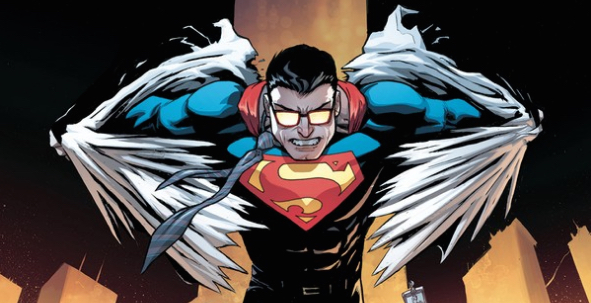
Michael: The distinction between Superman’s two long-running titles, Superman and Action Comics, has never really been made clear. Besides the dollar and cents of it all, the two books exist simultaneously to give different creators the opportunity to tell their own ongoing Superman stories. But what happens when it’s the same writer plotting both books? Continue reading

Infidel 5: Discussion

by Patrick Ehlers and Drew Baumgartner

Infidel 5

This article contains SPOILERS. If you haven’t read the issue yet, proceed at your own risk!

The function, the very serious function of racism is distraction. It keeps you from doing your work. It keeps you explaining, over and over again, your reason for being. […] None of this is necessary. There will always be one more thing.

Toni Morrison

Patrick: There is a lot to be stressed out about in 2018. One of the more insidious is also one of the more pointless: racism. It’s a series of prejudices and assumptions based on lies passed down by generations of systems put in place to keep the powerful in power. It is literally senseless. But it is also tenacious as fuck. Whatever else is going on, the looming specter of prejudice is going to warp everything else, muting solutions to all other societal problems. Pornshak Pichetshote and Aaron Campbell’s Infidel 5 takes this uncomfortable truth and and shows just how persistent racism can be, even in the face of literal demons. Continue reading

Thor 3: Discussion

by Spencer Irwin and Drew Baumgartner

Thor 3

This article contains SPOILERS. If you haven’t read the issue yet, proceed at your own risk!

Spencer: Last weekend my grandmother was sent to the hospital. Thankfully she’s recovering nicely, but the actual task of getting her treated was complicated by the sheer amount of her children and grandchildren gathered in one place, bickering over treatments, supposedly-rude doctors, and the usual family gossip. For better or for worse, I think this kind of behavior is typical when almost any family gets together; there’s no task so important that some family drama can’t derail it. That’s certainly the case for the Odinson clan in Thor 3, who nearly bicker each other into oblivion even as the Queen of Cinders is on the verge of conquering Hel.  Continue reading

Amazing Spider-Man 1: Discussion

By Drew Baumgartner and Patrick Ehlers

Amazing Spider-Man 1

This article contains SPOILERS. If you haven’t read the issue yet, proceed at your own risk!

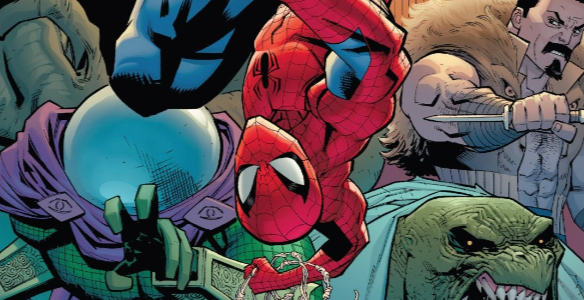
Drew: If you only had one word to describe Spider-Man, what would it be? Strength? Responsibility? Verbosity? These are all great answers, each with plenty of classic Spidey stories that emphasize those characteristics, but they aren’t quite perfect. Plenty of heroes are as strong and/or responsible, and a few even talk as much as Spider-Man, but there’s something else that makes him unique. With Amazing Spider-Man 1, Nick Spencer and Ryan Ottley offer up their own answer — one I had never considered, but feels obvious on reflection: Karma. Beyond his powers and the responsibilities that come with them, Spider-Man is a person plagued by the consequences of his past mistakes. Continue reading

Superman 1: Discussion

by Spencer Irwin and Patrick Ehlers

This article contains SPOILERS. If you haven’t read the issue yet, proceed at your own risk!

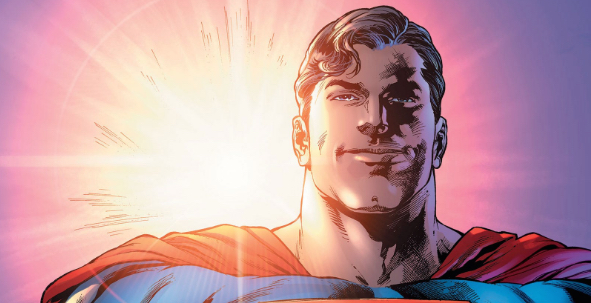
Spencer: One of the biggest criticisms I’ve seen thrown around about Superman as a character is that he’s “too powerful,” that nothing can challenge a man who can quite literally juggle planets. There’s a bit of truth to this, to be sure, but it’s a narrow criticism, one that only takes into consideration physical challenges; the most interesting Superman stories are the ones that challenge him morally, ethically, or in ways that make his physical abilities useless. Superman 1 is such a story, an issue that finds the character at his most physically competent, yet feeling more lost and helpless than ever before.  Continue reading

Death Of The Inhumans 1: Discussion

By Ryan Mogge and Patrick Ehlers

This article contains SPOILERS. If you haven’t read the issue yet, proceed at your own risk!

Ryan: Narration can be a crutch, a device used to add exposition where story cannot carry itself, the epitome of “show don’t tell.” However, when it’s done well, it can be fantastic. In Death of the Inhumans 1, the narration’s tone and point of view work in concert with the story as it unfolds. At times, it feels as though the visual and the narration are two paths that run alongside one another and intersect intermittently. They inform each other and create a balance that elevates both elements to something more nuanced and affecting. Continue reading

Star Wars 50: Discussion

By Patrick Ehlers and Taylor Anderson

This article contains SPOILERS. If you haven’t read the issue yet, proceed at your own risk!

Patrick: With the conclusion of the “Mutiny on Mon Cala” story arc, things are looking up for our heroes. And why wouldn’t they? One of the features of Marvel’s interquel Star Wars series is that we know an awful lot about both the past and future of these characters. There’s a dramatic irony baked into the entire concept of this series. Any time Luke, Han, and Leia are in mortal danger, we can override our fears for their safety by simply remembering that they all live to fight another day. But that’s only half of it, right? We also know that the Rebels are on the run by The Empire Strikes Back. Writer Kieron Gillen and artists Salvador Larroca and Giuseppe Camuncoli use the oversized issue 50 to pivot from inevitable safety to inevitable danger. Continue reading

Catwoman 1: Discussion

by Spencer Irwin and Mark Mitchell

This article contains SPOILERS. If you haven’t read the issue yet, proceed at your own risk!

Spencer: I’ve only recently become familiar with Joëlle Jones, but it was immediately apparent from her work that she not only cares about fashion, but that she has a real talent for bringing it out on the page. It should be no surprise, then, that fashion — at least in a sense — seems to be one of the underlying themes of Jones’ Catwoman 1. I don’t necessarily mean fashion as in runways and models, although Jones’ take on Selina Kyle could certainly put Tyra Banks to shame — I mean fashion as in the idea of clothing, costumes, and disguises, what they mean to the public, and what they mean to the individuals wearing them. Continue reading

Batman 50: Discussion

by Drew Baumgartner and Michael DeLaney
Batman 50

This article contains SPOILERS. If you haven’t read the issue yet, proceed at your own risk!

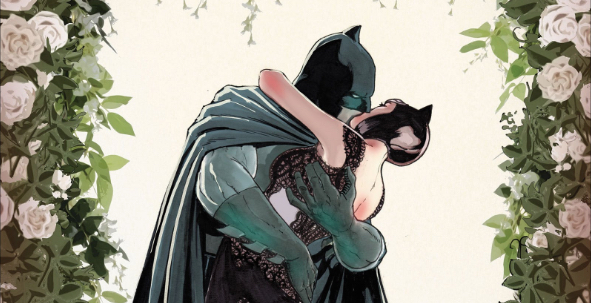
Drew: Bruce Wayne understands that his responsibilities as Batman demands sacrifice. He devotes his time, body, and earthly resources to his mission to fight crime, and generally takes that mission very seriously. All of which can look like he’s sacrificed his own happiness in order to be Batman. Or, more precisely, that his happiness is a necessary sacrifice for his existence. Batman’s drive, the argument goes, comes from his grief, anger, and sadness, so anything that blunts or dilutes those feelings weaken his mission. It’s a position DC Editorial staked out back in 2013, when Dan DiDio explained why Batwoman’s marriage could never happen, but it’s not necessarily a philosophy writer Tom King ascribes to. Indeed, King has argued that Batman’s happiness is a valuable source of drama, stating “There’s no conflict in having Batman be sad. There’s conflict in having Batman be happy.” That may mean King sees Batman’s happiness as only a temporary condition, but it’s obviously not out of the question. The point is, it’s a hotly debated topic, and one that King cleverly allows to play out in the pages of Batman 50. Continue reading

Saga 53: Discussion

by Spencer Irwin and Taylor Anderson

This article containers SPOILERS. If you have not read the issue yet, proceed at your own risk!

Spencer: In recent months our Saga coverage has focused quite a bit on how Fiona Staples and Brian K. Vaughan have been taking their time, luxuriating in a slower pace and revealing more and more about their characters as they move pieces into place, setting up for a no doubt explosive finale. That said, no matter how much build up they have, grand confrontations don’t work the same way in Saga as they do in many other similar pieces of media; there’s no monologue-and-metaphor-filled matches of will, no intricately choreographed fight scenes, no thirty episode long battles as Namek slowly burns in the background. Instead, Saga’s finales reflect real life violence. They’re quick, brutal, often random, and care very little about the events that have led up to them or who’s right or wrong.  Continue reading