Isola 1: Discussion

By Spencer Irwin and Michael DeLaney
This article contains SPOILERS. If you haven’t read the issue yet, proceed at your own risk!

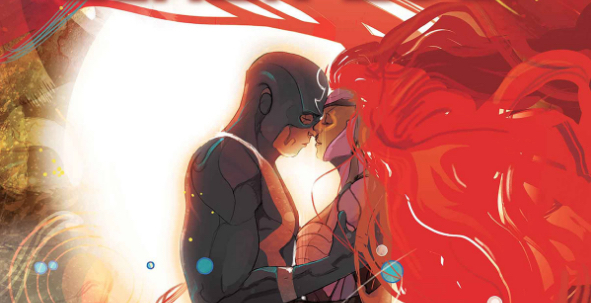
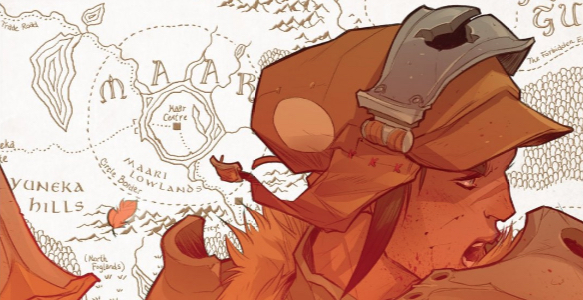
Spencer: The older I get, the more I realize how vital communication is to just about every single facet of life. So many problems and conflicts, be they in business or our personal lives, are caused by simple miscommunications, and the inability to communicate with someone makes it almost impossible to do anything with them or have any sort of meaningful relationship. Communication is a central theme of Isola, the new Image series from former Gotham Academy collaborators Brenden Fletcher, Karl Kerschl, and Msassyk. Not only does Isola 1 explore the difficulties that arise when two parties are unable to communicate, but the methods the creative team use to communicate information with the readers are second-to-none. This is one smartly-told comic book. Continue reading
Daredevil 600: Discussion

by Patrick Ehlers and Ryan Desaulniers

This article containers SPOILERS. If you have not read the issue yet, proceed at your own risk!

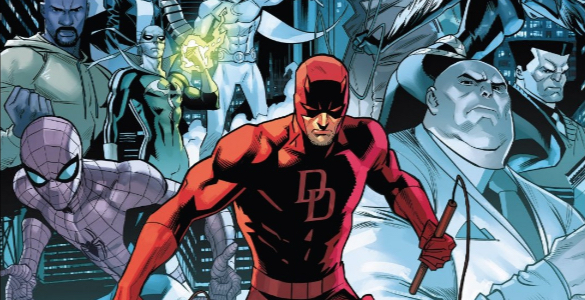
Patrick: Where does power come from? I’ve been seriously grappling with this one since Trump was elected to the White House, but this question obviously extends waaaay beyond that fucking monster. Does power ultimately come from money? From social connections? From one’s willingness to sacrifice their friendships? From violence? From non-violence? As the battle between Wilson Fisk and Daredevil reaches a fever pitch, questions of where either of them gets their power are posed right alongside the question of where Daredevil 600 gets its power. This is a six-hundredth issue, after all — so what makes this one special? Continue reading

Reconciling with the Past in Black Bolt 12

By Drew Baumgartner

Black Bolt 12

This article contains SPOILERS. If you haven’t read the issue yet, proceed at your own risk!

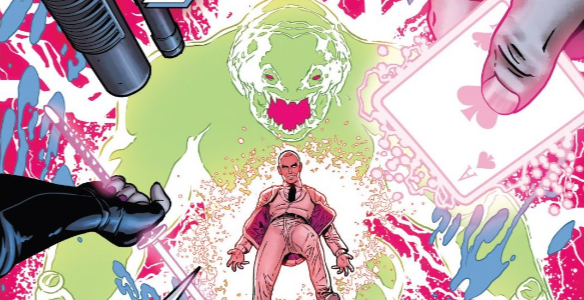
The superhero genre is littered with emotionally scarred men. Whether it’s a murdered loved one or a superpower-generating freak accident, trauma of one kind or another is a ubiquitous motivator for superheroes. Indeed, for most characters, that tragic backstory is so central to who they are and why they fight that it’s all but impossible to truly confront it — remove the psychological pain, and you “solve” the character’s motivating problem, effectively ending their story. So most of these characters are doomed to never resolve their issues. But what if why they fight has little to do with their trauma? What if that emotional baggage isn’t their motivating force? What if a superhero could confront their problems without destroying the conflicts that make them a hero in the first place? These are questions posed by discerning fans for decades, but rarely have those questions been answered as effectively as they are in Saladin Ahmed and Christian Ward’s Black Bolt 12. Continue reading

Analog 1: Discussion

By Patrick Ehlers and Drew Baumgartner

This article contains SPOILERS. If you haven’t read the issue yet, proceed at your own risk!

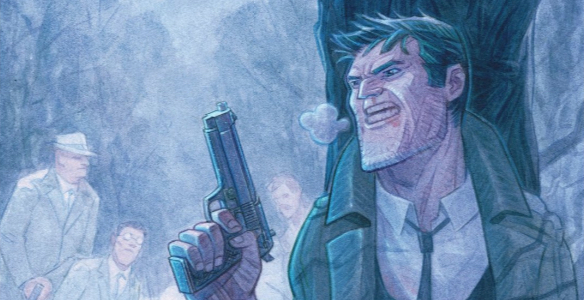
Patrick: I listen to a lot of Slate’s Trumpcast. Y’know, because the president has me in a nearly constant state of low-key panic, and I feel utterly powerless to stop our democracy from crumbling, so like, might as well listen to a podcast about it. One of the things that comes up on the show pretty often is the idea that we need to let go of the idea that there is one smoking gun that will implicate the administration and the president himself in collusion with the Russian government. There is no evidence so ironclad that it would force impeachment. Further, impeachment and removal from office would not address the systemic problems with corruption, bigotry, and foreign interference. There’s no “one solution” because there is no “one problem.” Gerry Duggan and David O’Sullivan’s Analog 1 takes a very specific speculative high-concept pitch, and gradually reminds the reader of everything else that is intriguing and terrifying about their world — there is no “one problem.” Continue reading

Are New Mediums Influencing the Artwork in Astonishing X-Men 10?

by Taylor Anderson

This article contains SPOILERS. If you haven’t read the issue yet, proceed at your own risk!

Much has been made about how the internet and e-books are killing the printed word. Even though that’s a bit hyperbolic, it is true that more and more people are reading books on an electronic device. This same trend holds true in the world of comic books, where sites such as Comixology have cut into the traditional printed market. I myself prefer to read comic books on my iPad these days, and as I do so, I sometimes wonder how this change in medium might be affecting the way comics are made and published. With that in mind, I couldn’t help but consider Astonishing X-Men 10 an interesting case study in the way electronic formats might be alternating the way comic book artists produce their craft. Continue reading

Peter’s Problems Outpace His Growth in Amazing Spider-Man 798

by Drew Baumgartner

Amazing Spider-Man 798

This article contains SPOILERS. If you haven’t read the issue yet, proceed at your own risk!

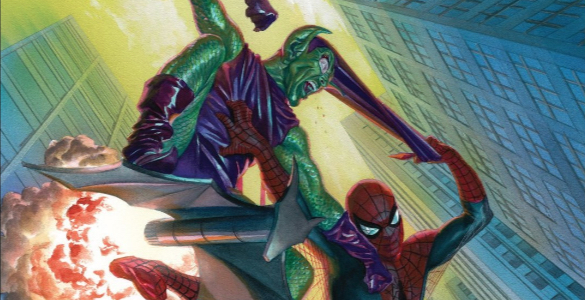
I had a college professor who liked to talk about “the ascending spiral groove thang” — the notion that we tend to cycle through the same problems, but always with our previous experience informing each new iteration, turning that cycle into a kind of spiral staircase. It’s an elegant idea that helps turn the hopelessness of facing down the same issues again and again feel like an opportunity for improvement. It’s an idea that Peter Parker embodies almost perfectly, vowing to improve (if never quite perfect) the decisions that led to the deaths of his loved ones. But what if those problems have an ascending spiral groove thang of their own? What if Peter’s problems are getting smarter and more mature along with him? That’s exactly what he’s up against in Amazing Spider-Man 798, as Norman Osborn returns with the Carnage symbiote. Continue reading

The Deadpoolian Doctor of Star Wars: Doctor Aphra 18

by Michael DeLaney

This article contains SPOILERS. If you haven’t read the issue yet, proceed at your own risk!

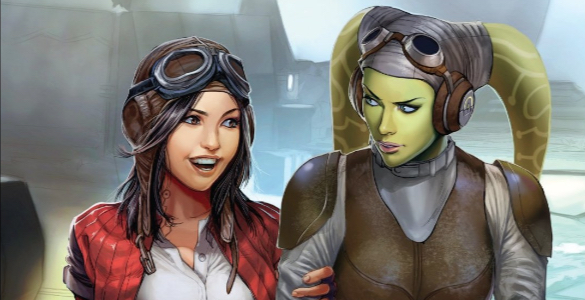
The relevance of the antihero has risen and fallen numerous times over the past couple of decades. With the mainstream introduction of Deadpool, we have a new mold that mashes antihero with that of lovable scoundrel. Since her arrival, Doctor Aphra has been more of the lovable scoundrel type, but with Star Wars Doctor Aphra 18, Kieron Gillen, Simon Spurrier, and Emilio Laiso lead her into Deadpool territory. Continue reading

Using Our Voices to Help, Not Hurt in Black Panther 171

By Spencer Irwin

This article contains SPOILERS. If you haven’t read the issue yet, proceed at your own risk!

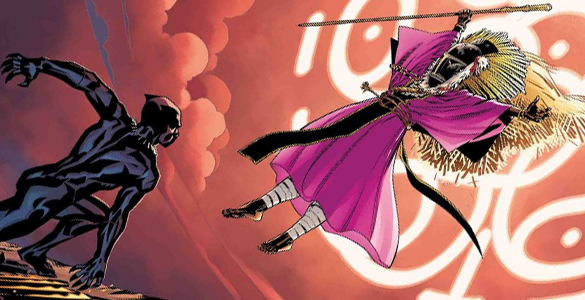
Our voices make us powerful. They allow us to make bonds and forge connections with one another, they allow us to speak out against oppression and injustice, they allow us to express our innermost desires and emotions, to be heard. Unfortunately, some voices are louder than others. Voices of men, voices of white people, they have a platform that women or people of color are so often denied access to, a platform that amplifies their voice, not only giving their words too much power, but drowning out the voices of others. This is first and foremost a problem for those whose voices are being drowned out, of course, but it’s also a problem for those doing the speaking; they’re so busy talking that they’re not listening, and that means they’re missing out on a lot of vital information. Continue reading

A Glass Half-Full of Pessimism in Days of Hate 3

by Drew Baumgartner

Days of Hate 3

This article contains SPOILERS. If you haven’t read the issue yet, proceed at your own risk!

Drew: The heuristic we use for optimism and pessimism — whether a glass is seen as half full or half empty — focuses on the language we use to frame a description. But that’s not necessarily the difference between an optimist and a pessimist. If we could construct some kind of neutral description of an amount of water in a glass, you could still have disagreement about whether that is good or bad, whether it will improve or get worse, and what exactly caused this state in the first place. Moreover, in this day and age, you might have people disagreeing about the facts of how much water is in the glass at all. These are the distinctions Aleš Kot and Danijel Žeželj make between Amanda and Xing’s accounts of their relationship in Days of Hate 3. Continue reading

The Gordons Investigate Together in Batgirl 21

By Drew Baumgartner

Batgirl 21

This article contains SPOILERS. If you haven’t read the issue yet, proceed at your own risk!

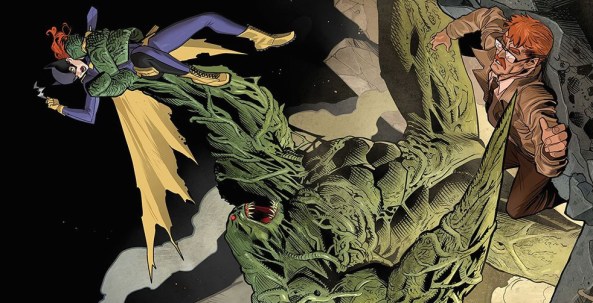
One of my favorite anecdotes (not mine), involves some confusion at an Arby’s drive-thru — a woman orders orange juice and drives away with a cup full of au jus. Of course, the entire premise of that story requires us to accept that anyone would order orange juice at an Arby’s, but I like the punchline enough to justify that minor suspension of disbelief. And that really is how I think about suspension of disbelief: if it’s justified — even retroactively — I’ll happily go along for the ride; if not, then the very odd detail of the orange juice at the Arby’s drive-thru probably shouldn’t be there. Such is the case with Batgirl 21, which finds both Babs and Jim independently investigating the same supernatural phenomenon, but never quite justifies their choices. Continue reading