Mind Wipes and Missteps in Infinity Countdown: Daredevil 1

by Michael DeLaney

This article contains SPOILERS. If you haven’t read the issue yet, proceed at your own risk!

slim-banner

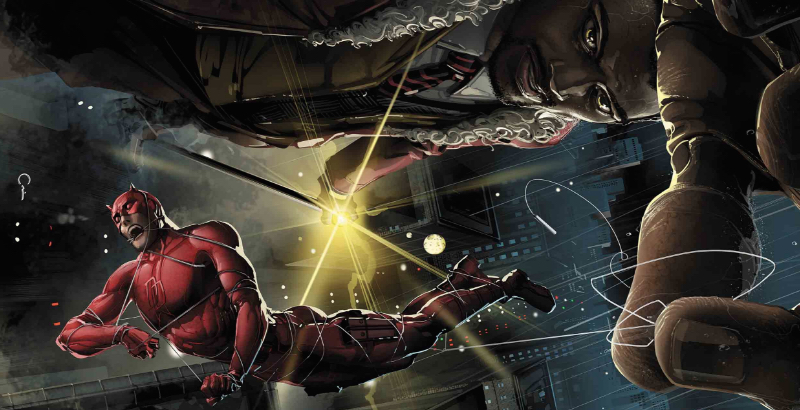
Infinity Countdown is well under way which means…time for some tie-ins! Written by the Infinity Countdown helmer Gerry Duggan, Infinity Countdown: Daredevil 1 focuses on the current owner of the Mind Gem: Daredevil “villain” Turk Barrett. Many readers scratched their heads when it was revealed that low-level criminal Turk was in possession of an Infinity Stone. While Duggan highlights why Daredevil is a good pairing for the Mind Gem, the issue lacks consequence. Continue reading

Breaking the Cycle in The Wicked + The Divine 36

by Spencer Irwin

This article contains SPOILERS. If you haven’t read the issue yet, proceed at your own risk!

It’s happening now. It’s happening again.

The Wicked + The Divine

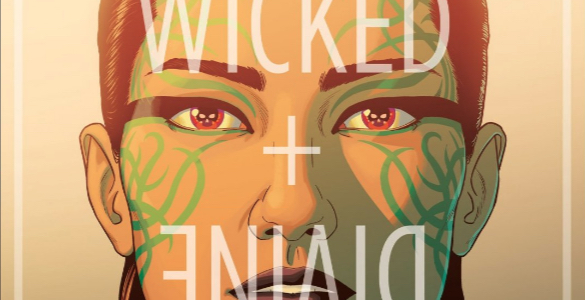
Endless cycles are a motif that runs deep throughout The Wicked + The Divine, from the unending dysfunction and madness of the Pantheon, to the circle that makes up their logo and meeting table, to the very nature of their perpetual rise and fall, a neverending cycle of death and rebirth. In fact — if anything she’s said can ever be believed — one of Ananke’s greatest fears seemed to be the idea that this cycle could somehow be broken.

These are both ideas that Kieron Gillen, Jamie McKelvie, Matthew Wilson, and Clayton Cowles dig into in The Wicked + The Divine 36, an issue that spends a shocking amount of space detailing yet another endless cycle, and the rest of the issue breaking an entirely different one. Continue reading

The Shield as Excalibur in Captain America 702

by Drew Baumgartner

Captain America 702

This article contains SPOILERS. If you haven’t read the issue yet, proceed at your own risk!

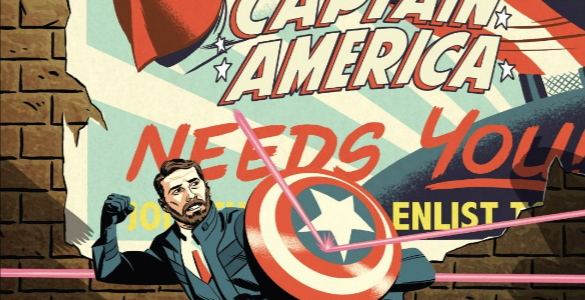
Drew: Comics historians are obsessed with Wonder Woman’s Lasso of Truth. There’s fun parallels to draw between the lasso and Wonder Woman creator William Moulton Marston’s invention of the lie detector, but another essential point is that a lasso isn’t a phallus in the same way that a sword or gun is. That is, it’s a feminine weapon, designed to entwine Wonder Woman’s enemies, rather than pierce their flesh. I think that reading certainly has utility, but I think practically, the effect of that choice is that Wonder Woman is less concerned with injuring and maiming her enemies as she is neutralizing them — her weapon of choice embodies her compassion. I think Captain America’s shield represents a similar compassion, positioning as a defender, rather than an aggressor. That fact becomes particularly salient as Mark Waid and Leonardo Romero explicitly draw parallels between the shield and Excalibur, effectively highlighting the difference between a shield and a sword. Continue reading

Moonshine 10: Discussion

by Drew Baumgartner and Patrick Ehlers

Moonshine 10

This article contains SPOILERS. If you haven’t read the issue yet, proceed at your own risk!

Remove everything that has no relevance to the story. If you say in the first chapter that there is a rifle hanging on the wall, in the second or third chapter it absolutely must go off. If it’s not going to be fired, it shouldn’t be hanging there.

Anton Chekhov

Drew: Chekhov’s gun has parallels in virtually every artform (at least in aesthetics that value clarity); whether it’s a brushstroke in illustration, a word in prose, or a note in music, if it doesn’t have an explicit purpose, it shouldn’t be there. But, of course, our knowledge of this principle lends a sense of foreshadowing to every object, character, or concept that is introduced in a narrative (again, if we can assume the narrative is playing by Chekhov’s rules). But because narratives are driven by drama (that is, difficulties for the protagonist), Chekhov’s gun mostly applies to things that can somehow harm or disrupt the characters’ lives — there’s a reason it’s not called “Chekhov’s birthday present.” Which creates very different expectations for things going right and wrong — things going wrong are far more likely to be introduced ahead of time (per Chekhov’s rules), while the drama of things going right is left best to the last possible moment. In that way, narratives reflect our own experience of reality, where we’ve given the name “Murphy’s law” to the notion that things will go wrong if they can, but no similar expectation for things going right. That is, we expect things to go wrong, so things going right is always a pleasant surprise. Or, as Lou Pirlo puts it in Moonshine 10, “God works in mysterious ways,” but “Old Lucifer…he was direct.” Continue reading

The Inconsistent Emotions of Batman 47

by Michael DeLaney

This article contains SPOILERS. If you haven’t read the issue yet, proceed at your own risk!

slim-banner

Tom King recently announced that he has a “HUGE” Booster Gold story coming for DC sometime in the near future, which makes his latest Batman arc “The Gift” a dry run of sorts on the braggadocious time-traveler. Batman 47 closes out the arc with Booster undoing his foolish time alterations, leaving him a little shell-shocked. As entertaining as “The Gift” has been in its Flashpoint-y twists, it leaves a very mixed depiction of Booster Gold. Continue reading

A Roadmap for Jane’s Future in The Mighty Thor: At The Gates of Valhalla 1

by Spencer Irwin

This article contains SPOILERS. If you haven’t read the issue yet, proceed at your own risk!

The Mighty Thor: At The Gates of Valhalla isn’t what most readers probably thought it would be. Despite the timing of its release, it’s explicitly not an issue meant to transition from The Mighty Thor to the upcoming Thor — outside the cover, Thor Odinson doesn’t even put in an appearance — and despite the title, it spends no time in (or near) Valhalla, Jane’s Thor likewise doesn’t appear, and Jane herself has relatively little screen time. Instead, this special serves as a road map for the future of the Thor mythos, and especially for Jane’s place within it.  Continue reading

Delayed Gratification in Avengers 2

by Mark Mitchell

This article contains SPOILERS. If you haven’t read the issue yet, proceed at your own risk!

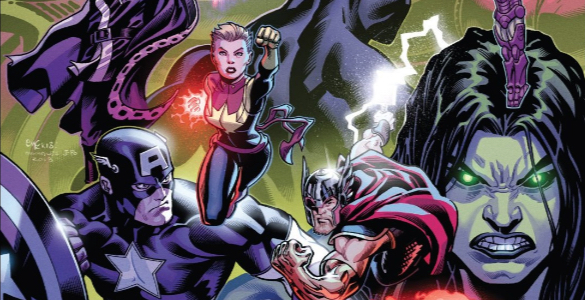
Avengers 2 finds writer Jason Aaron and artist Ed McGuinness still trying to explain just what their Avengers book is going to be. Like the premiere issue, Avengers 2 is incredibly chatty, stuffed to the gills with narration, banter, quips, and inner-monologue that try to help explain the presence (and absence) of various Avengers. There’s a delayed gratification aspect at play, and seeing the entire team finally all together (whenever that happens) will no doubt be cathartic, but spending so much ink explaining why this team-up book doesn’t yet have a team is a sometimes frustrating choice. Continue reading

The Worst Horrors in Infidel 3 are Real

by Drew Baumgartner

Infidel 3

This article contains SPOILERS. If you haven’t read the issue yet, proceed at your own risk!

slim-banner

Last month, Patrick remarked on how both real and scary Infidel is — that is, the horrors of this book come from societies worst (but all too real) problems. And they really do seem to come from those problems. For some reason, when I read the solicit for this series, I imagined that the specters in this series somehow caused the islamophobia that runs rampant throughout Aisha’s building; that it was somehow responsible for making people hateful. As we spend more time with them, however, (and as more residents seem to encounter them), it seems like they aren’t so much the cause of the bigotry, but the result of it. That is, they are the manifestation of the fear minorities feel when encountering bigotry. Continue reading

All-New Wolverine 35: Discussion

by Spencer Irwin and Taylor Anderson

This article contains SPOILERS. If you haven’t read the issue yet, proceed at your own risk!

Spencer: I think I may have missed the mark a bit when discussing last month’s installment of All-New Wolverine. I claimed that “Old Woman Laura” was a story about redeeming Bellona and defeating Doctor Doom, the last tyrant left in a world that’s otherwise an utopia, but Tom Taylor and Ramon Rosanas have proven me wrong in All-New Wolverine 35, the series’ finale. Those are a part of this adventure, to be sure, but only a small part. What this story is about — what it’s always been about — is giving Laura Kinney the happy ending she deserves.  Continue reading

The Difference Between Mayoral Action and Superhero Action in Daredevil 602

By Patrick Ehlers

This article contains SPOILERS. If you haven’t read the issue yet, proceed at your own risk!

“New York City’s uniformed protectors are under attack by the Hand.” It’s a straightforward premise, one with both obvious drama and an obvious solution: superheroes fight the ninjas. But as of Daredevil 601, Matt Murdock is more than just a superhero; he’s also the mayor of New York. Suddenly those simple solutions don’t seem quite as simple. Charles Soule, Mike Henderson, Matt Villa and Clayton Cowles’ Daredevil 602 illustrate the difference between the streamlined drama of the superhero and the complicated drama of the mayor. Continue reading