Nightwing: The New Order 1: Discussion

by Mark Mitchell and Ryan Desaulniers 
This article contains SPOILERS. If you haven’t read the issue yet, proceed at your own risk!

slim-banner

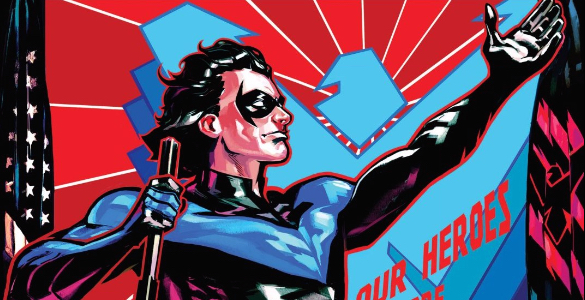
Mark: Dick Grayson is know for his perfection; the best ass in comics, the most suave personality, the most kickass combatant — generally the coolest guy in the universe. It’s an impressive feat, then, that writer Kyle Higgins and artist Trevor McCarthy (with colors by Dean White) are able to so thoroughly undermine Nightwing’s image of perfection in Nightwing: The New Order 1 without making us completely turn on the character. Continue reading
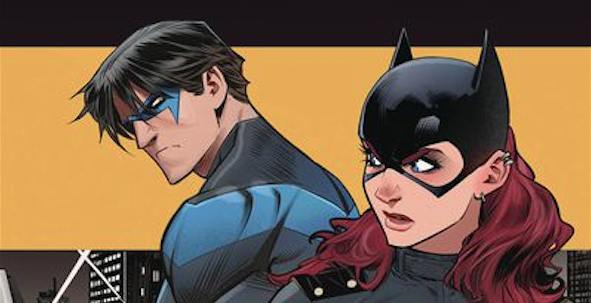
Unknown history sits at the heart of Batgirl 14

by Drew Baumgartner

Batgirl 14

This article contains SPOILERS. If you haven’t read the issue yet, read on at your own risk!

I’ve never been a huge fan of dramatic irony — I can appreciate how giving us more information than the characters have can produce tension (or humor), but that information kind of gets in the way of relating to the characters. Still, I have a heck of a lot more patience for dramatic irony than I do its exact opposite, where characters are privy to information that is deliberately withheld from the audience. Not only does the tension it create feel cheaper (amounting to little more than a narrative chant of “I know something you don’t know”), it makes the characters even harder to relate to, as we’re necessarily left in the dark about what they might be thinking or feeling. All of which kept me from truly enjoying Batgirl 14. Continue reading

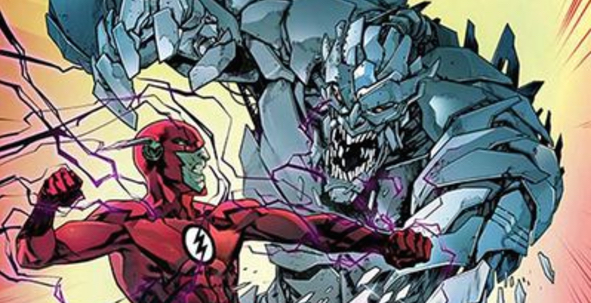
The Flash 29 Is An Issue Divided

by Spencer Irwin

This article will contain SPOILERS. If you haven’t read the issue yet, proceed at your own risk!

The bi-weekly shipping schedule DC’s implemented for some of its top books has been a benefit to the speed of the narrative, but it’s been more problematic when it comes to the artwork. While some titles have found elegant solutions to this problem, others have worked their way through fill-in artists almost haphazardly. The Flash, unfortunately, is one of the latter, and issue 29 is especially egregious in that regard. Continue reading

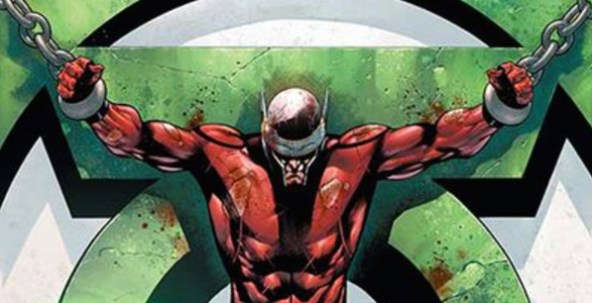
Driving Toward the Single Arresting Moment in Hal Jordan and the Green Lantern Corps 27

by Patrick Ehlers

This article contains SPOILERS. If you haven’t read the issue yet, proceed at your own risk!

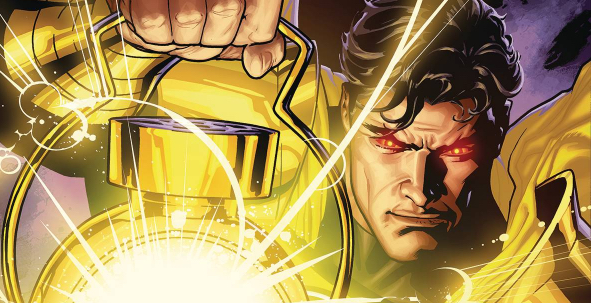
Y’know that scene in Raging Bull  where Jake LoMatta (DeNiro) is in the ring and takes that slow-motion jab right to the nose? Sure you do — even if you haven’t seen the movie, it’s one of those moments that’s been parodied and emulated hundreds of times in the four decades since the film’s release. The punch slowly ripples across Jake’s face, breaking his nose and forcing a geyser of blood to erupt from his head. Its a explosive moment of physical horror which comes after nearly two whole hours of slowly unspooling emotional horror — effectively, it is thematic material of self-destruction made literal and permanent. There’s something about the violence of that choice that shakes the audience awake, casting everything that happened before it, however gradually, in to sharp, sudden relief. In Hal Jordan and the Green Lantern Corps 27, writer Robert Venditti and artist Rafa Sandoval drive towards a similarly gross moment, and while they steer into the silliness of it, the inherent gore in cutting out Orion’s heart serves the shake the reader awake. Continue reading

Overcoming the Refusal of the Call in Green Lanterns 29

by Drew Baumgartner

Green Lanterns 29

This article contains SPOILERS. If you haven’t read the issue yet, proceed at your own risk!

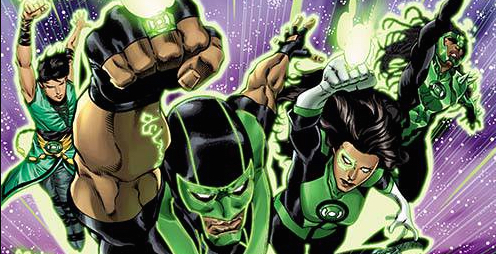
Superheroes are locked in a permanent state of adventure, so their stories never really end. For that reason, it might seem absurd to apply narrative structures like Joseph Campbell’s “Hero’s Journey” to superhero narratives, as there is little hope of “return,” and notions of “known” and “unknown” start to break down once the hero has been around for a while. But I’ll be damned if the first few beats of any Superhero origin doesn’t more or less follow the first few beats of the Hero’s Journey — especially if the “hero” undergoing the journey happens to be a supporting character. Such is the case in Sam Humphries and Eduardo Pansica’s Green Lanterns 29, which finds all of the original Green Lanterns (OGLs) refusing the call to adventure before ultimately deciding that they have no choice. Continue reading

Green Arrow Stands Apart from Batman in Green Arrow 29

by Michael DeLaney

This article contains SPOILERS! If you haven’t read the issue, proceed at your own risk.

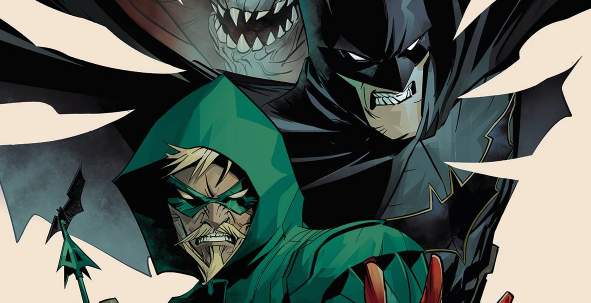
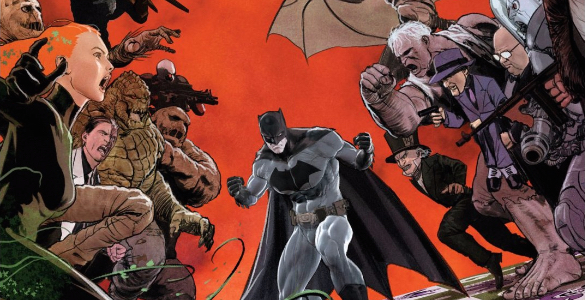
I like to think of Benjamin Percy’s “Hard-Travelling Hero” arc of Green Arrow as “The Oliver Queen Apology Tour” — as Green Arrow travels across the country and ends up proving his worth to the heavy hitters of the Justice League. This time around Green Arrow is teamed up with fellow billionaire playboy/non-powered vigilante Batman. Continue reading

Dark Nights: Metal 1: Discussion

by Patrick Ehlers and Mark Mitchell 

This article contains SPOILERS. If you haven’t read the issue yet, proceed at your own risk!

slim-banner

Patrick: Throughout Scott Snyder and Greg Capullo’s run on Batman, the creative team valued invention over archeology. The character of Batman has been around for so long that deconstruction of the character is practically in his DNA, and while Snyder and Capullo found ways to riff on Batman’s history, their stories were always new. New threats, new allies, new secret identity. With Metal, the latest DC event, Snyder and Capullo turn inward, to explore, refine, and recontextualize the mythology and iconography that is already part of their multiverse. There’s a premium on re-arranging existing pieces into an entirely new whole. Continue reading

Full Page Problems in Wonder Woman 28

by Taylor Anderson

This article contains SPOILERS. If you haven’t read the issue yet, proceed at your own risk!

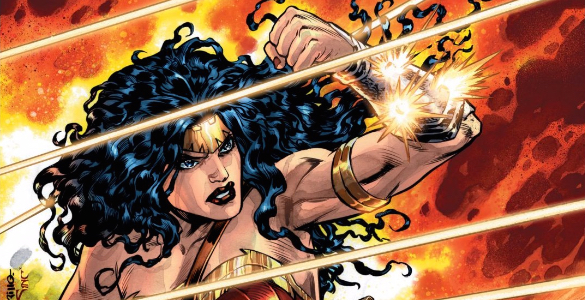
When I think about it, the very idea of a full page spread seems pretty audacious. Given that a creative team has only twenty pages to tell their story, the act of devoting two full pages to single panel means that image better be damn impressive. More than that, it needs to convey emotion, theme, and character to really give the image the emotional impact its two pages demand. But what happens if a full page spread doesn’t do these things – what does that look like?

Continue reading

Facing Horror with Virtue in Superman 29

by Mark Mitchell

This article contains SPOILERS. If you haven’t read the issue yet, read on at your own risk!

Rarely does Superman venture into horror territory, and rarer still does it do so as successfully as in Keith Champagne and Doug Mahnke’s Superman 29. The duo take a story featuring child abduction, possession, and a generally dour and oppressive atmosphere — things I generally would find anathema to a good Superman story — and make them work by never compromising Superman as a character. In fact, while Superman is brave and dependable as always, Champagne and Mahnke dial up his virtue to exaggerated heights, the better to combat the strange darkness of the material. Continue reading

Choosing a Side in Batman 29

by Spencer Irwin

This article contains SPOILERS. If you haven’t read the issue yet, proceed at your own risk!

Marvel’s various takes on their Civil War franchise have all urged readers to “choose a side.” That’s not an approach Tom King and Mikel Janin can really take with “The War of Jokes and Riddles” though, because who wants to support either side of a war waged by sadistic supervillains? Yet, that’s exactly where Batman finds himself in Batman 29 — forced to pick between supporting either the Joker or the Riddler if he wants to end this war once and for all. Continue reading