Amazing Spider-Man 797 Does What Only a Comic Book Can

by Spencer Irwin

This article contains SPOILERS. If you haven’t read the issue yet, proceed at your own risk!

I was initially drawn to comic books simply because I loved superheroes, and wanted to find more stories about them. Story is still probably my favorite part of comics (or anything, really), but over the years I’ve learned to appreciate the specific strengths of comic books as an art-form, the things they can do that no other medium can. Dan Slott and Stuart Immonen certainly understand those strengths, as their Amazing Spider-Man 797 revolves around a sequence that just wouldn’t work on TV or in the movie theater. Continue reading
Gideon Falls 1: Discussion

by Ryan Desaulniers and Mark Mitchell

This article contains SPOILERS. If you haven’t read the issue yet, proceed at your own risk!

…nothing is so alien to the human mind as the idea of randomness.

John Cohen

Ryan D: Pattern recognition plays an integral role in the human cognitive process, with comic books being a particular medium which simply wouldn’t work without that ability to see and recognize patterns in visual symbols, icons, and shapes, as our brains wrestle a slew of static visual images into a narrative. The images are coherent because they are created together purposefully to be consumed in relation to each other. However, the human brain can still find patterns where there is no direct correlation. In 1958, the term “apophenia” came into being to describe that ability to take unrelated things and tie them together with connections which might not exist. We can observe this phenomenon every day in the form of confirmation bias, or, in more extreme cases, the claims of paranoid schizophrenics who may find the most benign details to be irrefutable proof of a grandiose conspiracy. So what happens if two seemingly unrelated people in different parts of the world — one embroiled in this hunt for clues in an outlandish pattern, the other just trying to adjust to a new life — both find the horrifying answer to what seems to be delusion? Herein lies the crux of Gideon Falls 1 by Jeff Lemire and Andrea Sorrentino, backed by a decorated team on colors and lettering of Dave Stewart and Steve “SWANDS” Wands. Continue reading

Doctor Strange: Damnation 2 is Basically a Heist Movie

by Taylor Anderson

This article contains SPOILERS. If you haven’t read the issue yet, proceed at your own risk!

Just as surely as the sun rises in the east and sets in the west, Steven Soderbergh will reemerge from “retirement” now and again to make another heist movie. One can’t blame him for this: heist movies are fun, and Soderbergh has shown that he’s become very good at making them. Still, why is it that our thirst for these can’t be sated? Is it seeing familiar faces from different walks of life team-up? The notion of stealing for a just cause like Robin Hood? Or perhaps it’s serving comeuppance to someone who deserves it. Whatever the reason may be, the heist story is here to stay, and, as Donny Cates and Nick Spencer show, is easily transferable to the superhero genre. Continue reading

Knowing Your Opponent in Batman 42

By Spencer Irwin

This article contains SPOILERS. If you haven’t read the issue yet, proceed at your own risk!

About halfway through my first read of Batman 42, as Poison Ivy (through her minions) dangled Catwoman upside-down from a skyscraper, I suddenly remembered that the two characters are supposed to be friends. As if reading my mind, a few pages later Tom King and Mikel Janin addressed this head-on, with Selina appealing to their friendship and Ivy claiming that Selina doesn’t know the first thing about her. Apparently Ivy’s bid at world domination is meant to be benign, charitable even — a genuine attempt from her to fix the world, to redeem for past crimes. Apparently there was a rock of regret inside her that not even her closest friends and allies knew about — but Batman knows. His entire plan, and his eventual, inevitable victory, revolves around him having nailed down Ivy’s motives and methods. Continue reading

Shortcomings of the Lone Wolf in Black Bolt 11

By Patrick Ehlers

This article contains SPOILERS. If you haven’t read the issue yet, proceed at your own risk!

It might be sorta odd to cast one of the founding members of a famous superhero team as a loner. You’re always going to have your Raphaels, or your Wolverines, characters that bristle at the thought of getting too chummy with their teammates, but always end up affirming the value of teamwork before the issue is through. Black Bolt is a different animal entirely; separated from his people by the nobility of his birth and his inability to communicate, he may genuinely be more content to walk the world alone. Black Bolt 11 teases an origin for this misanthropic streak while also testing its strength. Continue reading

Remixing the Familiar in Oblivion Song 1

by Drew Baumgartner

Oblivion Song

This article contains SPOILERS. If you haven’t read the issue yet, proceed at your own risk!

…there is no new thing under the sun.

Ecclesiastes 1:9

It’s unfortunate that pointing out that something isn’t entirely original is seen as a critique. In this postmodern age of the remix, surely we can all understand that nothing is “entirely original,” or at least isn’t made from entirely original parts. As with cooking, the excitement lies more in how the individual ingredients interact with one another than any one ingredient’s novelty. Such is the case with Robert Kirkman and Lorenzo De Felici’s new Oblivion Song, which smashes together several familiar premises and character motivations, but manages to produce something surprisingly refreshing. Continue reading

Tomorrow May Be Too Late in Star Wars 44

by Michael DeLaney 

This article containers SPOILERS. If you haven’t read the issue yet, proceed at your own risk.

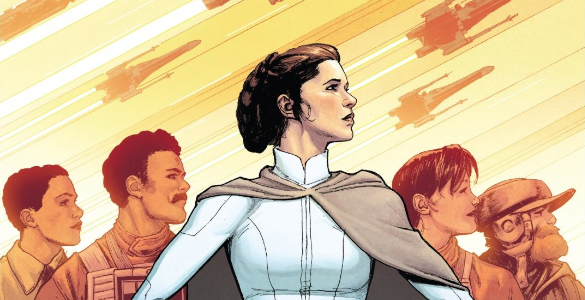
“There’s no time to lose!” is a line you’ve probably heard in more movies than you can count. I can’t recall a situation in recent memory that applies this idea better than Star Wars 44.

The Rebels are as desperate as ever so they enlist everyone’s favorite trap enthusiast Admiral Ackbar to negotiate a new alliance with his people, the Mon Calamari. An Imperial garrison interrupts the secret meeting, but Leia refuses to let mortal danger postpone this very important rendezvous. Continue reading

The Burden and Joy of Public Service in Captain America 699

by Drew Baumgartner

Captain America 699

This article will contain SPOILERS. If you haven’t read the issue yet, proceed at your own risk!

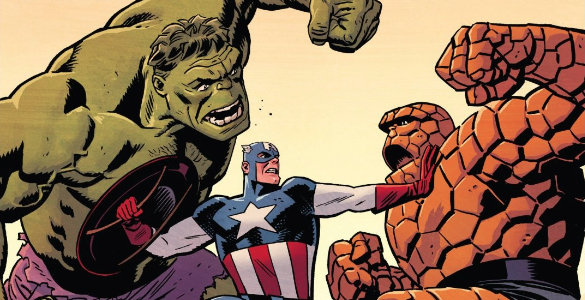
For many superheroes, superheroics are a means of righting some cosmic injustice — the death of a loved one a the hands of a criminal, for example. Indeed, that particular motivation is so ubiquitous, it’s easy to forget that many heroes are motivated not out of some personal vendetta, but because they feel morally compelled to help when they can. We tend to think of Spider-Man (death of a loved one at the hands of a criminal notwithstanding) for that kind of power/responsibility stuff, but I’ll suggest that Captain America might embody those ideals even more thoroughly. For Cap, superheroing is a public service, no different from volunteering at a soup kitchen or picking up trash at your local park. He’s able to make the world a better place by being Captain America, so he has to be Captain America. Again, it’s not an attitude that’s entirely unique to Steve Rogers, but as Mark Waid and Chris Samnee crank that aspect up to eleven in Captain America 699, it’s hard to imagine any other character living that ideal so perfectly. Continue reading

East of West 36: Discussion

By Drew Baumgartner and Taylor Anderson

East of West 36

This article contains SPOILERS. If you haven’t read the issue yet, proceed at your own risk!

American history is longer, larger, more various, more beautiful, and more terrible than anything anyone has ever said about it.

James A. Baldwin

Drew: The sci-fi trappings of East of West can at times make its alternate history feel particularly exotic, but for better or for worse, much of its history resembles our own. I mean, sure, our own Civil War ended in just over four years, and there was no comet that brought with it an apocalyptic prophecy, but most of the makings of that world lie in the very real history of the antebellum United States. Indeed, the ugliest parts of East of West‘s history are based entirely on the truths of American slavery and Manifest Destiny — the legacies of which we’ve never truly reconciled as a nation. Case in point: the Union’s capitol is built on the literal bones of the Endless Nation, turning a symbol of our own shameful past into a potent image that had heretofore given the Union power over the Nation. It’s only by — again, literally — digging up that history that any progress can be made. Continue reading

A Beautifully Low-Key Resolution in She-Hulk 163

by Spencer Irwin

This article contains SPOILERS. If you haven’t read the issue yet, proceed at your own risk!

Last month’s installment of She-Hulk was a beautiful way to wrap up the many issues Jen’s been dealing with throughout writer Mariko Tamaki’s run, but those resolutions came at an unrealistic, breakneck speed. It’s nice, then, that She-Hulk 163 finds Tamaki and artist Diego Olortegui slowing down again, allowing this run’s finale to be the kind of simple, low-key resolution that fits the more realistic tale of trauma and recovery Tamaki’s been telling ever since Civil War II. Continue reading