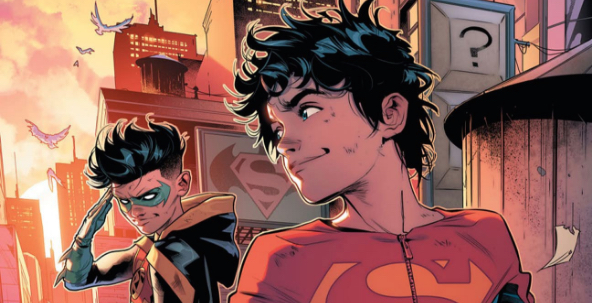
Trust Saves the Day in Super Sons 16

by Spencer Irwin

This article contains SPOILERS. If you haven’t read the issue yet, proceed at your own risk!

This month’s issue 16 marks the end of Super Sons (for now — a continuation is already solicited), so it only makes sense that writer Peter Tomasi, along with artists Carlo Barberi and Brent Peeples, would want to close on a milestone victory for Superboy and Robin. More important than the actual victory, though, is how they achieve it — partially by channeling their parents, but mostly by trusting in each other. Continue reading

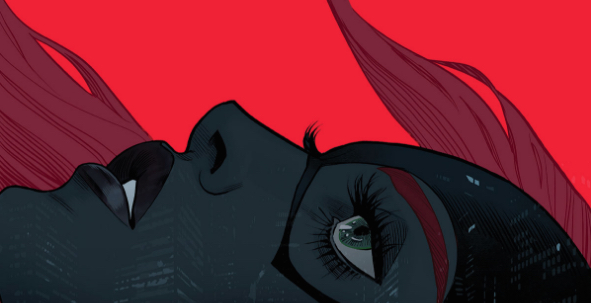
Breaking the Loop in Batgirl 23

By Drew Baumgartner

Batgirl 23

This article contains SPOILERS. If you haven’t read the issue yet, proceed at your own risk!

We all have patterns. We run through them again and again until, one day, we finally see ourselves clearly and choose a different path.

Barbara Gordon, Batgirl

Let’s hear it for the quarter-life crisis. We tend to hear more about the mid-life crisis as either a pitiful or destructive force (usually middle aged men blowing money on a sports car or torpedoing their family life for a young girlfriend), but I think the quarter-life crisis is almost the opposite. As society extends adolescence well beyond the teenage years, and careers now take longer to kickstart than they did in generations past, the “what am I doing with my life?” urgency that kicks in around 25 can add some guiding structure. Maybe I’m biased in that way — my own quarter-life crises forced me to identify concrete goals that eventually sent me back to school — but I think a lot of us fall into a rut in our early 20s that we only later get the perspective to shake us out of. Maybe it’s a dead-end job, or an unfulfilling relationship, or a crummy apartment, or bad eating habits. For Barbara Gordon, that rut is a literal mind loop, preventing her from moving forward with her life. Continue reading

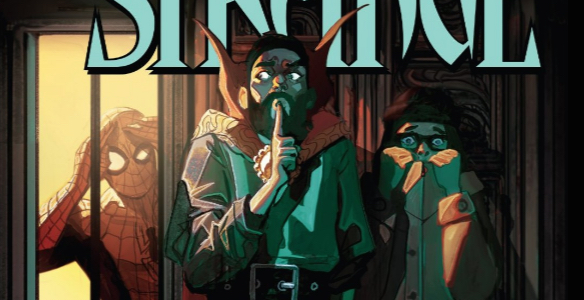
Ambiguity and Closure in Doctor Strange 390

by Patrick Ehlers

This article contains SPOILERS. If you haven’t read the issue yet, proceed at your own risk!

slim-banner

I had a writing teacher in college that used to say there were four kinds of stories. The first is the most common: the hero wants something, gets it, and is happy he got it. We see this one in superhero media all the time, right? Batman wants to catch the Riddler, he does, feels great about it. The second type of story is the hero wants something, gets it, is unhappy he got it. This is the old Twilight Zone twist — “I can live forever, BUT AT WHAT COST?” The last two kinds of stories are similar: hero wants something, doesn’t get it, is happy to have not gotten it, and; hero wants something, doesn’t get it, is unhappy to have not gotten it. Doctor Strange 390 manages to be a weird mix of all these types of stories, where even the question of who our hero is leads to some fascinating ambiguity. Donny Cates’ send-off to Doctor Strange is as mysterious, and true to the tone of the character, as a reader could possibly hope for. Continue reading

X-Men Red 4 Battles Real-World Threats

by Drew Baumgartner

X-Men Red 4

This article containers SPOILERS. If you haven’t read the issue yet, proceed at your own risk.

Comics have always reflected our real-world fears — from inner-city crime or nuclear panic — by heightening them to exaggerated extremes. Except, I’d argue, when it comes to the X-Men’s persecution. Sure, the X-Men’s superpowers would qualify as an “exaggerated extreme” of the types of differences that normally mark a minority class, but it’s straight-up not possible for writers to come up with more exaggerated ways societies persecute their minorities. From apartheid to lynchings to genocides, there’s nothing the X-Men have faced that real-world minorities haven’t already suffered, grounding even their most fanciful stories in sober reality. It’s a fact that Tom Taylor and Mahmud Asrar have leaned into from the start of X-Men Red, lending the series a “ripped from the headlines” approach that is truly unique in superhero comics. Continue reading

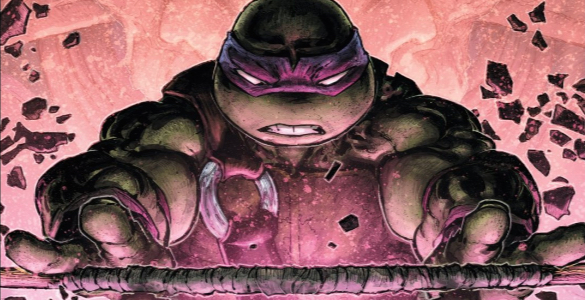
Donatello’s Peace in Teenage Mutant Ninja Turtles Universe 22

By Taylor Anderson

This article contains SPOILERS. If you haven’t read the issue yet, proceed at your own risk!

It’s always easy to say that peace is worth fighting for when we’re talking about cessation of hostilities between two groups of people. It’s not quite as easy to say that peace is worth fighting for when the type of peace being discussed is the inner kind. While the idea of inner-peace is always talked about with a special reverence, it’s uncommon to find it placed at the forefront of importance. That means a lot of inner turmoil for a lot of people, but what if both inner and outer peace could be achieved at the same time? If that sounds difficult, it is — just ask Donatello in TMNT Universe 22. Continue reading

X-Men: The Wedding Special 1

by Spencer Irwin

This article containers SPOILERS. If you haven’t read the issue yet, proceed at your own risk.

What’s a Wedding Special without a wedding? It’s X-Men: The Wedding Special 1, I suppose. I’ll try not to hold the fact that this isn’t actually Kitty and Colossus’ wedding against this issue — chalk it up to a failure of expectations and research on my behalf, although I’ll still argue that it’s a misleading title. If anything, the real problem with this special isn’t the lack of a wedding, but the fact that much of what we get instead feels insubstantial and, at times, even generic. Continue reading

Mind Wipes and Missteps in Infinity Countdown: Daredevil 1

by Michael DeLaney

This article contains SPOILERS. If you haven’t read the issue yet, proceed at your own risk!

slim-banner

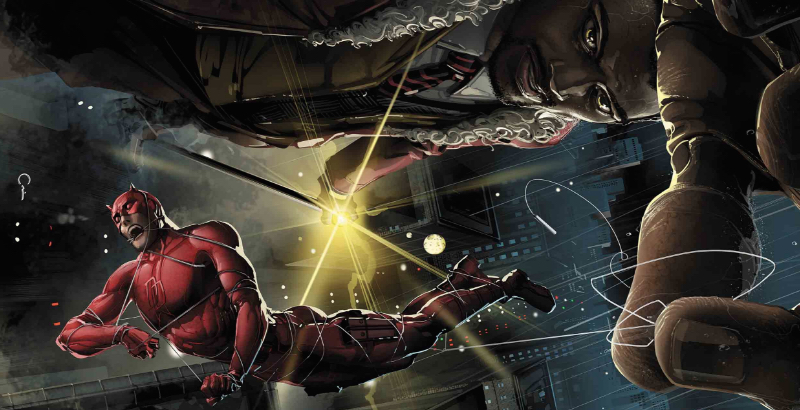
Infinity Countdown is well under way which means…time for some tie-ins! Written by the Infinity Countdown helmer Gerry Duggan, Infinity Countdown: Daredevil 1 focuses on the current owner of the Mind Gem: Daredevil “villain” Turk Barrett. Many readers scratched their heads when it was revealed that low-level criminal Turk was in possession of an Infinity Stone. While Duggan highlights why Daredevil is a good pairing for the Mind Gem, the issue lacks consequence. Continue reading

Breaking the Cycle in The Wicked + The Divine 36

by Spencer Irwin

This article contains SPOILERS. If you haven’t read the issue yet, proceed at your own risk!

It’s happening now. It’s happening again.

The Wicked + The Divine

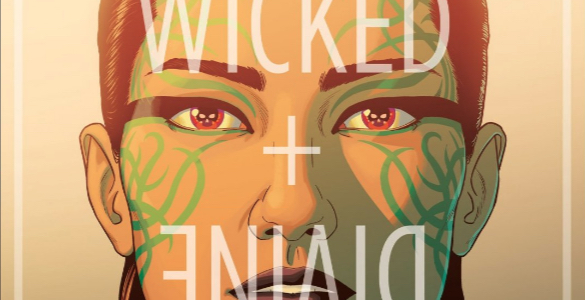
Endless cycles are a motif that runs deep throughout The Wicked + The Divine, from the unending dysfunction and madness of the Pantheon, to the circle that makes up their logo and meeting table, to the very nature of their perpetual rise and fall, a neverending cycle of death and rebirth. In fact — if anything she’s said can ever be believed — one of Ananke’s greatest fears seemed to be the idea that this cycle could somehow be broken.

These are both ideas that Kieron Gillen, Jamie McKelvie, Matthew Wilson, and Clayton Cowles dig into in The Wicked + The Divine 36, an issue that spends a shocking amount of space detailing yet another endless cycle, and the rest of the issue breaking an entirely different one. Continue reading

The Shield as Excalibur in Captain America 702

by Drew Baumgartner

Captain America 702

This article contains SPOILERS. If you haven’t read the issue yet, proceed at your own risk!

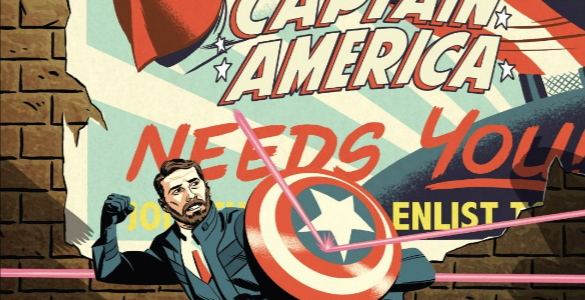
Drew: Comics historians are obsessed with Wonder Woman’s Lasso of Truth. There’s fun parallels to draw between the lasso and Wonder Woman creator William Moulton Marston’s invention of the lie detector, but another essential point is that a lasso isn’t a phallus in the same way that a sword or gun is. That is, it’s a feminine weapon, designed to entwine Wonder Woman’s enemies, rather than pierce their flesh. I think that reading certainly has utility, but I think practically, the effect of that choice is that Wonder Woman is less concerned with injuring and maiming her enemies as she is neutralizing them — her weapon of choice embodies her compassion. I think Captain America’s shield represents a similar compassion, positioning as a defender, rather than an aggressor. That fact becomes particularly salient as Mark Waid and Leonardo Romero explicitly draw parallels between the shield and Excalibur, effectively highlighting the difference between a shield and a sword. Continue reading

Moonshine 10: Discussion

by Drew Baumgartner and Patrick Ehlers

Moonshine 10

This article contains SPOILERS. If you haven’t read the issue yet, proceed at your own risk!

Remove everything that has no relevance to the story. If you say in the first chapter that there is a rifle hanging on the wall, in the second or third chapter it absolutely must go off. If it’s not going to be fired, it shouldn’t be hanging there.

Anton Chekhov

Drew: Chekhov’s gun has parallels in virtually every artform (at least in aesthetics that value clarity); whether it’s a brushstroke in illustration, a word in prose, or a note in music, if it doesn’t have an explicit purpose, it shouldn’t be there. But, of course, our knowledge of this principle lends a sense of foreshadowing to every object, character, or concept that is introduced in a narrative (again, if we can assume the narrative is playing by Chekhov’s rules). But because narratives are driven by drama (that is, difficulties for the protagonist), Chekhov’s gun mostly applies to things that can somehow harm or disrupt the characters’ lives — there’s a reason it’s not called “Chekhov’s birthday present.” Which creates very different expectations for things going right and wrong — things going wrong are far more likely to be introduced ahead of time (per Chekhov’s rules), while the drama of things going right is left best to the last possible moment. In that way, narratives reflect our own experience of reality, where we’ve given the name “Murphy’s law” to the notion that things will go wrong if they can, but no similar expectation for things going right. That is, we expect things to go wrong, so things going right is always a pleasant surprise. Or, as Lou Pirlo puts it in Moonshine 10, “God works in mysterious ways,” but “Old Lucifer…he was direct.” Continue reading