Malice in Civility in Mister Miracle 9

By Patrick Ehlers

This article contains SPOILERS. If you haven’t read the issue yet, proceed at your own risk!

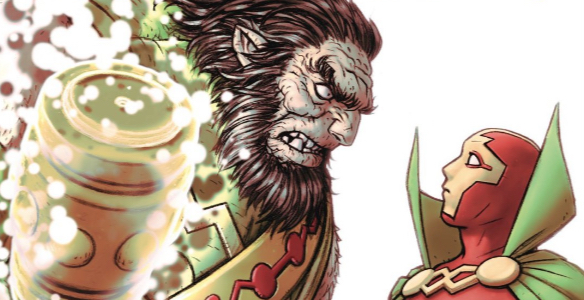
War is hell. It is economically, physically, and psychologically catastrophic for both those waging war and anyone unfortunate enough to be in war’s orbit. But ending a war? Ending a war requires one of two things: one side to be completely destroyed, or an agreement to be reached between the warring parties. Most wars end the second way. Which is borderline unfathomable, right? Imagine sitting down to negotiate with someone who has been systematically, enthusiastically, killing your friends and family every day for months or years. Tom King and Mitch Gerads’ Mister Miracle 9 wrestles with the dissonance of trying to make peace out of war. Continue reading

The Fix 12 is a Perfect Revenge Fantasy Parody

by Patrick Ehlers

This article contains SPOILERS. If you haven’t read the issue yet, proceed at your own risk!

“When I woke up, I went on what the movie advertisements refer to as a roaring rampage of revenge. I roared. I rampaged. And I got bloody satisfaction.”

The Bride, Kill Bill

I tend to struggle with revenge fantasies. The objective of the protagonist is too prescribed for me, as though the sentiment “I want the people who made me suffer to feel what I feel” is a universal impulse. That is, of course, part of the genius of Kill Bill: the revenge fantasy is challenged the second Beatrix Kiddo sees the life she’s sworn to ruin. It’s a twist on the formula, just like Nick Spencer and Steve Lieber’s The Fix 12. The motivation remains the same, but our hero’s efficacy is the variable. Roy’s complete inability to get revenge for Mac’s death makes this issue a borderline genre spoof, and it’s just so perfect. Continue reading

Indifference is the Enemy in Analog 3

by Patrick Ehlers

This article contains SPOILERS. If you haven’t read the issue yet, proceed at your own risk!

“Oona can handle herself…”

Analog 3

We find ourselves in a wholly irrational place in history — a swing away from progressive ideals. Regressive. Part of what makes this era so fucked up is that we believed ourselves to be beyond history. The concept of the “end of history” is contingent on society having reached a perfect state of civility. There would be no war, no famine, no racism, no inequality, no income disparity if only we reached this civil equilibrium. Here’s the problem: we never got close to perfection before white America declared that we were living in a post-racial world. And why would they? We are Americans and we are exceptional! We saved the world from the most obvious evil history has ever seen, and everything since 1945 has been a victory lap. Essentially, the belief has been that the system would find justice, or that society can “handle itself.” Gerry Duggan and David O’Sullivan’s Analog 3 explores the dangers of expecting a situation to fix itself. Continue reading

Good vs. Evil in Astonishing X-Men 12

by Patrick Ehlers

This article contains SPOILERS. If you haven’t read the issue yet, proceed at your own risk!

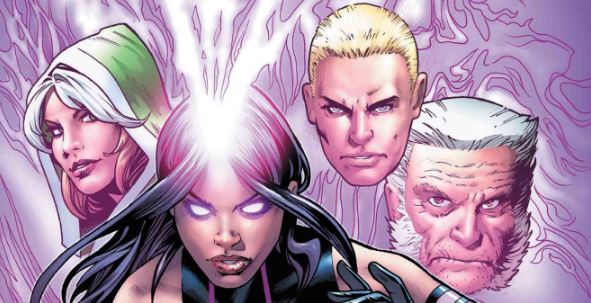
“Good vs Evil” implies that there are two sides — two warring factions — battling for the fate of the world. It’s a compelling image: a battlefield with good guys on one side and bad guys on the other. Good and evil are separate forces, and in our imaginations, represented by two different groups of people. While Charles Soule and Gerardo Sandoval’s Astonishing X-Men 12 still gives the reader avatars of light and darkness in the forms of X and The Night King, the armies fighting for each side are made up of all the same players. Old Man Logan is both a reformed ally-murderer and an irredeemable death machine; good and evil waging war within one mind. Continue reading

Compassion vs. Accountability in Green Lanterns 48

by Patrick Ehlers

This article contains SPOILERS. If you haven’t read the issue yet, proceed at your own risk!

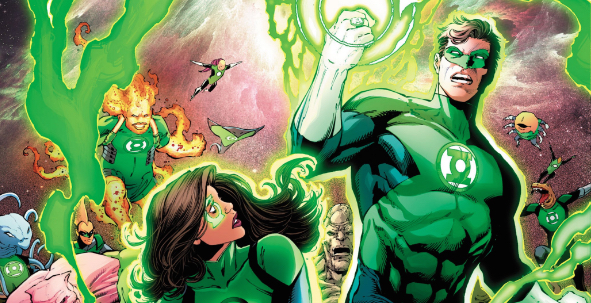
One of my coworkers was really upset about Kanye West a couple weeks ago. No shit, right? Her problem wasn’t that West was tweeting racist things about slavery probably being a choice, or even his support of Trump (who she also loathes), but that the entire would was holding a mentally ill man on a psychotic break accountable for his actions. Her argument goes that someone in West’s condition isn’t being themselves — they are literally being their illness. I began to stammer back with some feeble counterargument, something about the illness being made manifest by that person, so while we can practice compassion, we do still have to hold them accountable. “So you think he… put his own spin on mental illness?” she exhaled back at me. Shit. No. What the hell point was I trying to make? All I can really say is that I want anyone who does something wrong to face consequences, but is a mentally ill person really the one “doing” it? We are bad at talking about, dealing with, and even understanding mental illness. Aaron Gillespie and Ronan Cliquet’s Green Lanterns 48 takes our capacity for compassion and places it squarely against law and order. Continue reading

Star Wars 49: Discussion

By Patrick Ehlers and Taylor Anderson

This article contains SPOILERS. If you haven’t read the issue yet, proceed at your own risk!

Patrick: If there’s one part of the Star Wars formula I’ve had the hardest time connecting to on a personal level, it’d have to be the huge battles between spaceships.  Don’t get me wrong: I think the ships look cool, and the Millennium Falcon is so near and dear to my heart that I almost cried during its reveal in The Force Awakens. But there’s something about two factions of cold, gray, lifeless ships zipping through space and shooting blasters at each other that feels remarkably impersonal. With Star Wars 49, writer Kieron Gillen and artist Salvador Larroca set out to stage the mother of all space battles at the birth of the Rebel Armada. By linking the ships to the characters, the creators create a sense of emotional continuity that makes this one of the best space ship battles I’ve ever seen. Continue reading

Waging Peace in X-Men Red Annual 1

by Patrick Ehlers

This article contains SPOILERS. If you haven’t read the issue yet, proceed at your own risk!

“I was the Phoenix. I burned so brightly. Then I was dead. And everything was dark.”

Jean Grey, X-Men Red (2018) Annual #1

Writer Tom Taylor starts this issue with the narration above, quickly summarizing the tragic arc of Jean Grey. It was a violent life, and the bullet points of her story are mostly bummers. Over Scott Summer’s grave, Jean promises that this time is going to be different, and this annual is all about what that might look like. Taylor and artist Pascal Alixe offer an issue full of love, understanding, and difficult conversations. Jean’s still here to win, but it’s not war she’s waging. It’s peace.

Continue reading

Man of Steel 1 Reclaims Superman

by Patrick Ehlers

This article contains SPOILERS. If you haven’t read the issue yet, proceed at your own risk!

“Let’s make America great again / by making racists ashamed again.
Let’s make compassion in fashion again; / let’s make America great again.”

“Make America Great Again,” Frank Turner

In isolation, the words “make America great again” shouldn’t elicit a strong negative biological/emotional response. But this fairly innocuous phrase has been twisted beyond recognition by white nationalism, isolationism, and just general shitheadery. On Frank Turner’s newest record, Be More Kind, he attempts to overwrite the listener’s associations with those four little words on track five, boldly titled “Make America Great Again.” The song is big, joyful and rebellious at the same time, like all of Turner’s best tunes. I like it a lot, but I still flinch when chorus comes around. Some words and some symbols are just too thoroughly corrupted to be reformed. Brian Michael Bendis and Ivan Reis’ Man of Steel 1 has a similar hurdle to overcome: attempting to return Superman to the platonic ideal that maybe only exists in the imaginations of Kal El’s biggest fans. The results are miraculous. Continue reading

Harbinger Wars 2 1: Discussion

by Patrick Ehlers and Michael DeLaney

This article contains SPOILERS. If you haven’t read the issue yet, proceed at your own risk!

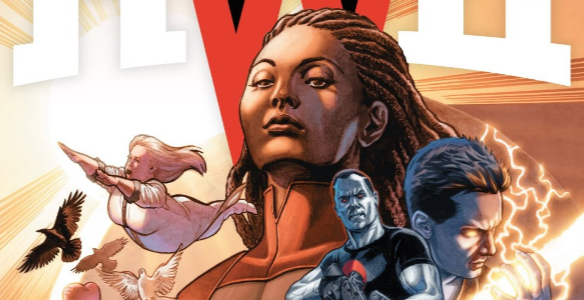
Patrick: Let’s run a hypothetical scenario: you’ve got access to a shared universe, full of superpowered characters, all of whom you’d classify as either heroes or antiheroes. You want to pit them against each other, in a… I don’t want to call it a “Civil War” for litigious Disney-related reasons… we’ll say it’s a “Harbinger War.” How do you establish sides? Pick an ideological divide and let it split up your character base, right? That’s a fun, toothless way to pit all your favorites against each other! With Harbinger Wars 2, writer Matt Kindt is crafting a more direct criticism of structures of power, casting the dutiful soldiers and company-men as stooges. It’s a clash of superheroes with the courage to say “hey, some of these guys are wrong.” Continue reading

The Perversion of Meaning in Lazarus 28

by Patrick Ehlers

This article contains SPOILERS. If you haven’t read the issue yet, proceed at your own risk!

Do you feel that disconnect between what you love and what you have to do? Of course you do. Human beings tend to have pretty good bullshit-detectors, and we usually know when someone is selling us something. The problem is we don’t always reject false forms of happiness. That’s the real disconnect. We can recognize the flashing lights as hollow spectacle and still opt in. Lazarus 28 shows us both the meaningful and the superficial connections to the world Jonah lives in, and the damage exacted on one by the other. It’s a harrowing issue, and creators Greg Rucka and Michael Lark place sex and family at the very center of this dichotomy between meaning and meaninglessness. Continue reading