All-New Wolverine 35: Discussion

by Spencer Irwin and Taylor Anderson

This article contains SPOILERS. If you haven’t read the issue yet, proceed at your own risk!

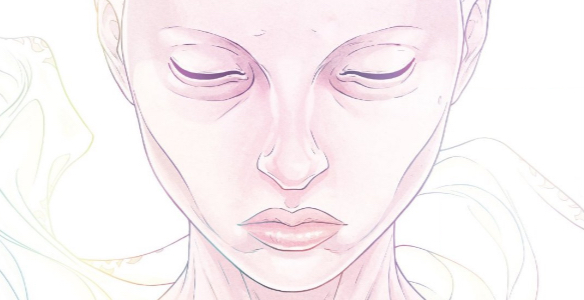
Spencer: I think I may have missed the mark a bit when discussing last month’s installment of All-New Wolverine. I claimed that “Old Woman Laura” was a story about redeeming Bellona and defeating Doctor Doom, the last tyrant left in a world that’s otherwise an utopia, but Tom Taylor and Ramon Rosanas have proven me wrong in All-New Wolverine 35, the series’ finale. Those are a part of this adventure, to be sure, but only a small part. What this story is about — what it’s always been about — is giving Laura Kinney the happy ending she deserves.  Continue reading
The Unbeatable Squirrel Girl 32: Discussion

by Taylor Anderson and Michael DeLaney

Unbeatable Squirrel Girl 32

This article contains SPOILERS. If you haven’t read the issue yet, proceed at your own risk!

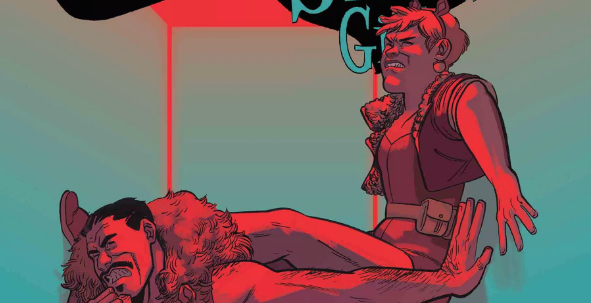
Taylor: Usually when I go to work, I wear contact lenses instead of glasses. Generally, that’s a decision I make based on comfort, or more accurately, on how late I wake up that morning. This being so, people at work don’t see me in my glasses that often and frequently express surprise that I’m bespectacled. My students think it’s hilarious to lovingly (I think) mock me by calling me “Professor Anderson” in their best nerd voice when they see my Clark Kent look. This just shows that superficial changes to one’s appearance often lead to you being seen differently, and the same can be said of comics. Being a visual medium, how things look matters. And when that look changes, it’s a total gambit as to whether it works or not. Continue reading

Despicable Deadpool 300: Discussion

by Drew Baumgartner & Patrick Ehlers

Despicable Deadpool 300

This article contains SPOILERS. If you haven’t read the issue yet, proceed at your own risk!

slim-banner

Drew: Five years into this run, pointing out that Deadpool is a Sad Clown would be lazy analysis — not only has that point been well established, but the series itself has managed to explore it so thoroughly, reducing the character’s emotional journey to a two-word summary couldn’t possibly do it justice. And yet, I couldn’t think of a more appropriate way to begin this piece than embedding Smokey Robinson’s “Tears of a Clown,” not because of a shallow similarity between the content of these two works, but because of some profound similarities in how they treat that content. The lyrics describe a narrator who puts on a good face in spite of his profound sadness, but the music doesn’t betray that sadness for a second — it sounds like any other Motown hit (though that bouncy bassoon that maybe hints that this song is about a clown). By this point in the story, Wade Wilson has completely dropped that fascade of silliness, but just like the instruments in “Tears of a Clown,” the series itself maintains that clownish exterior. Continue reading

Harbinger Wars II Prelude 1: Discussion

By Patrick Ehlers and Ryan Mogge

This article contains SPOILERS for both this issue and Avengers Infinity War. If you haven’t read the issue or seen the movie yet, proceed at your own risk! 

Patrick: Every big superhero event story needs to kick off with some kind of world-altering, morality-testing incident. A kind of “what did you just do?” moment that our characters will spend the next however-many-issues sorting out. Hell, the climax of Avengers Infinity War happened like 15 pages into the first issue of Jim Starlin’s The Infinity Gauntlet. Where writer Eric Heisserer distinguishes his story is in giving that catastrophic action to our hero, and making damn sure we understand why. Continue reading

Death or Glory 1: Discussion

By Spencer Irwin and Mark Mitchell

This article contains SPOILERS. If you haven’t read the issue yet, proceed at your own risk!

Spencer: A few weeks ago I covered Isola 1, a comic I praised for its subtlety and its trust and respect for its readers’ intelligence; there was very little hand-holding, exposition, or lore, and the issue was all the stronger for it. Rick Remender and Bengal are attempting something similar in the debut of their new Image series, Death or Glory, but it unfortunately doesn’t work quite as well. By the end of the issue — and especially on a second read — the story and structure, the characters and their relationships, they all snap together in a satisfying way, but I spent much of my first read puzzled; moreover, there’s still a few elements that don’t mesh even on that second time around. Continue reading

Days of Hate 4: Discussion

By Patrick Ehlers and Drew Baumgartner

This article contains SPOILERS. If you haven’t read the issue yet, proceed at your own risk!

Patrick: Aleš Kot and Danijel Žeželj’s Days of Hate is the story of a future chillingly extrapolated from our social and political present. It’s an authoritarian hellscape where liberal and conservative are less policy preferences and more tribal banners. Ideologies are buried under the methodologies of success. Our characters are tools of either the regime or the revolution, so it’s tempting to say that their motivations are obvious: do whatever it takes so their side wins. But… that’s incomplete. People are more than just their beliefs — they are also the places and people they love. Days of Hate 4 shows how love anchors our heroes, but it also shows how it puts them in very serious danger of drowning.

Continue reading

Doctor Strange: Damnation 4: Discussion

by Spencer Irwin and Taylor Anderson

Doctor Strange Damnation 4

This article contains SPOILERS. If you haven’t read the issue yet, proceed at your own risk!

Spencer: Big comic book events and crossovers aren’t exactly known for intimate, character-based storytelling — instead we read these stories to see dozens (sometimes hundreds) of characters all hanging out and mixing together in ways they never would at any other time. Damnation has been an interesting event because it’s the exact opposite — Donny Cates, Nick Spencer, and Rod Reis’ story works best when the scope remains small, and becomes weaker and weaker the more it tries to be an “event.” Continue reading

Mighty Thor 706: Discussion

by Drew Baumgartner and Spencer Irwin

Mighty Thor 706

This article contains SPOILERS. If you haven’t read the issue yet, proceed at your own risk!

And on the seventh day God ended his work which he had made; and he rested on the seventh day from all his work which he had made.

Genesis 2:2

Drew: Can gods be heroes? I might posit that immortality voids the noble qualities like courage and sacrifice that define heroism. To me, anyway, gods and heroes are mutually exclusive groups, which might well be the reason we created the concept of demigods — Hercules slaying the Nemean Lion is less impressive if he has infinite time and power at his disposal, and Jesus dying on the cross is literally meaningless if he can’t die. In this way, we understand that Jane Foster’s nobility comes not from her godliness, but from her humanity — from the sacrifice she can only make because she isn’t a god. But still, she was a god, at least briefly, which maybe entitles her to a bit of rest after all of that sacrifice. Continue reading

Lazarus 27: Discussion

By Spencer Irwin and Ryan Desaulniers

This article contains SPOILERS. If you haven’t read the issue yet, proceed at your own risk!

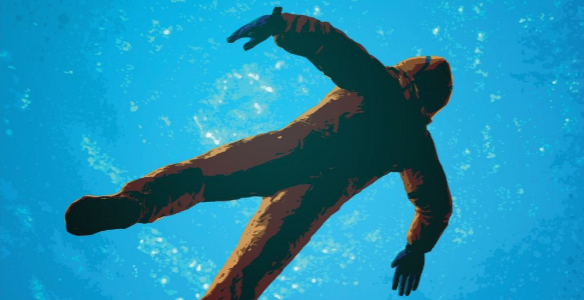
Spencer: An interlude is meant to be a break, a diversion, something different from the norm. In the case of Lazarus 27 — specifically billed as part one of a two-part interlude — it means that Greg Rucka and Michael Lark are taking a break from the story of Forever Carlyle to instead focus on her brother Jonah. Jonah’s adventure isn’t just an interlude for readers, though; it’s one for Jonah as well, a chance for him to experience a lifestyle far different than anything he’s ever seen before. Unfortunately, like most interludes, I fear this experience may be a temporary one for Jonah. Continue reading

Action Comics 1000: Discussion

by Drew Baumgartner, Michael DeLaney, Patrick Ehlers, and Spencer Irwin

Action Comics 1000

This article contains SPOILERS. If you haven’t read the issue yet, proceed at your own risk!

“From the City that Has Everything”

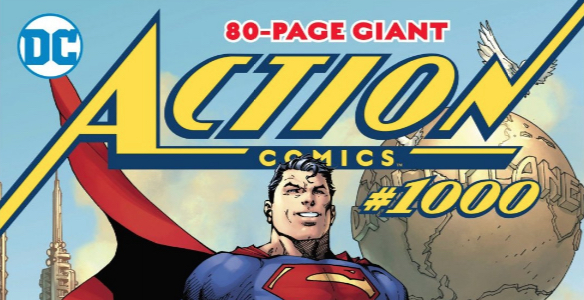
Drew: Superman changed the world. That’s obvious enough in-universe, but it’s just as true of our world. Action Comics 1 created (or at least codified) the superhero genre, a genre that came to define both the 20th and 21st centuries, and is still growing as Action Comics rings in its 1000th issue. It’s a singular achievement, but celebrating it as such might not be in the spirit of Superman, for whom humbleness is as much a part of his character as heroism. He’s not one to take compliments easily, let alone brag, so any efforts to do so on his behalf run the risk of feeling crass. Most of the stories in this issue opted to ignore lionizing Superman outright, aiming instead to illustrate what it is that makes him so laudable, but in the issue’s opening chapter, Dan Jurgens came up with a way to address the issue with Superman himself, providing a commentary on the whole exercise of a huge anniversary issue, and offering a justification that even Superman can get behind. Continue reading