Despicable Deadpool 300: Discussion

by Drew Baumgartner & Patrick Ehlers

Despicable Deadpool 300

This article contains SPOILERS. If you haven’t read the issue yet, proceed at your own risk!

slim-banner

Drew: Five years into this run, pointing out that Deadpool is a Sad Clown would be lazy analysis — not only has that point been well established, but the series itself has managed to explore it so thoroughly, reducing the character’s emotional journey to a two-word summary couldn’t possibly do it justice. And yet, I couldn’t think of a more appropriate way to begin this piece than embedding Smokey Robinson’s “Tears of a Clown,” not because of a shallow similarity between the content of these two works, but because of some profound similarities in how they treat that content. The lyrics describe a narrator who puts on a good face in spite of his profound sadness, but the music doesn’t betray that sadness for a second — it sounds like any other Motown hit (though that bouncy bassoon that maybe hints that this song is about a clown). By this point in the story, Wade Wilson has completely dropped that fascade of silliness, but just like the instruments in “Tears of a Clown,” the series itself maintains that clownish exterior. Continue reading
Assembling the Team in Hunt for Wolverine: Weapon Lost 1

By Drew Baumgartner

Hunt for Wolverine Weapon Lost 1

This article contains SPOILERS. If you haven’t read the issue yet, proceed at your own risk!

There’s something fun about watching a team put itself together. It lends urgency to everyone’s presence, making their utility to the team explicit in a way that isn’t inherently true of pre-existing teams. That is, while Iceman is coming on this X-Men mission whether or not anything needs to be iced, Danny Ocean is only adding someone to the team if their skills are essential to the plan. With so many pre-existing teams in comics, we don’t always get to see purpose-built teams with quite so narrow a focus as the one in Charles Soule and Matteo Buffagni’s Hunt for Wolverine: Weapon Lost, which is exactly what makes its first issue so fun. Continue reading

The Darkest Timeline in Batman 46

By Drew Baumgartner

Batman 46

This article contains SPOILERS. If you haven’t read the issue yet, proceed at your own risk!

From now on, I am Evil Abed. We are the Evil Study group, and we have but one evil goal: return somehow to the Prime Timeline, the one that I stopped you from rolling that die. Then we destroy the good versions of ourselves and reclaim our proper lives.

Evil Abed, Community

The notion of the “darkest timeline” seems to have entered the zeitgeist, mostly through tongue-in-cheek suggestions that we’re currently living in it, but it’s a relatively common concept in science fiction. Indeed, there are so many examples, I kind of split my metaphor on my discussion of Batman 45, touching on everything from Back to the Future Part II to It’s a Wonderful Life to that “Treehouse of Horror” episode of The Simpsons where Homer keeps accidentally changing the timeline. But none are more explicit about the superlativeness of the badness of the timeline than Community‘s darkest timeline.

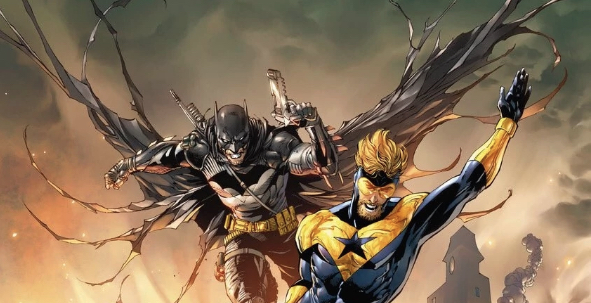
It stands as a kind of conceptual opposite of Gottfried Leibniz’s “best of all possible worlds” theory — his explanation for human suffering that any other “world” (effectively, a different timeline) would be worse. The Back to the Future franchise suggests that the original timeline was neither the best nor the worst (Marty improves it in the first movie, turning his father into a successful science fiction writer, Biff makes it worse in the second, turning himself into a Trump-ian real-estate mogul), but most of these other examples only show changes to the timeline making things worse — effectively, that we’re actually living in the best of all possible worlds. This is definitely supported in the horrific timeline Booster Gold created as Bruce’s wedding gift, which is undeniably worse than the DC Universe as we know it, though on the surface appeared better for Bruce. That is, until Booster tries to fix things in this issue. Continue reading

Avengers 1: Discussion

by Taylor Anderson and Drew Baumgartner

This article contains SPOILERS. If you haven’t read the issue yet, proceed at your own risk!

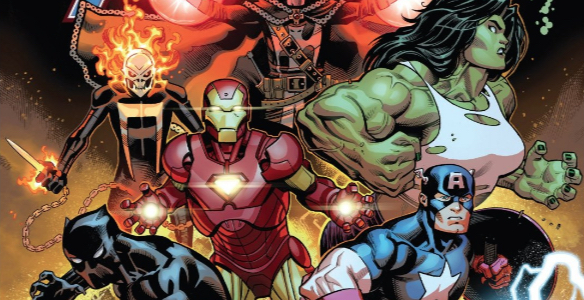
Taylor: In middle school, my favorite book was a archaeology tome titles Ancient Mysteries. The book is exactly what you would think — a survey of all the unsolved mysteries archaeologists have studied such as how the inhabitants of Easter Island made their statues and the relevancy of the Atlantis story. I was entranced by these mysteries because they suggested a history of Earth that was far bigger and far stranger than anything I had imagined up to that point. This was exciting at the time, and to this day my interest is still piqued by random archaeology articles on the BBC. It’s maybe for this reason that Avengers 1 intrigues me so much. It points to a deep, weird history of Earth I want to know more about. Continue reading

Days of Hate 4: Discussion

By Patrick Ehlers and Drew Baumgartner

This article contains SPOILERS. If you haven’t read the issue yet, proceed at your own risk!

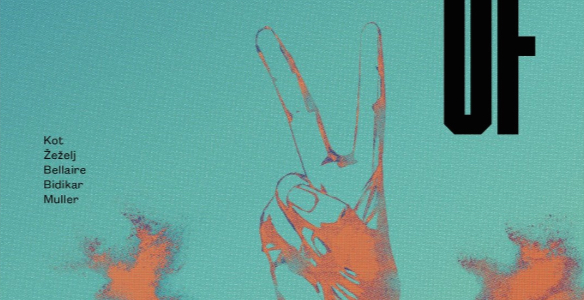
Patrick: Aleš Kot and Danijel Žeželj’s Days of Hate is the story of a future chillingly extrapolated from our social and political present. It’s an authoritarian hellscape where liberal and conservative are less policy preferences and more tribal banners. Ideologies are buried under the methodologies of success. Our characters are tools of either the regime or the revolution, so it’s tempting to say that their motivations are obvious: do whatever it takes so their side wins. But… that’s incomplete. People are more than just their beliefs — they are also the places and people they love. Days of Hate 4 shows how love anchors our heroes, but it also shows how it puts them in very serious danger of drowning.

Continue reading

Lockjaw 3 is a Cartoony Romp

By Drew Baumgartner

Lockjaw 3

This article contains SPOILERS. If you haven’t read the issue yet, proceed at your own risk!

Gordie: Alright, alright. Mickey’s a mouse. Donald’s a duck. Pluto’s a dog. What’s Goofy?
[…]
Teddy: Goofy’s a dog, he’s definitely a dog.
[…]
Chris: He can’t be a dog. Wears a hat and drives a car.
[…]
Vern: God, that’s weird. What the hell is Goofy?

Stand By Me

There are no rules inherent to a cartoon world. Maybe this is one where dragons exist. Maybe this is one where elephants can fly. Maybe this is one where an anthropomorphized mouse can own a regular (albeit cartoon) dog. We can accept those conceits on the terms they’re given, because it’s a cartoon. Audiences balk at other media for being “unrealistic,” but “cartoony” — effectively stylized unrealism — is a compliment. At least, that’s how I tend to think of cartooniness: a fun relaxations of the “rules” that govern fictional worlds, making room for a heck of a lot more imagination and fun. Such is certainly the case with Lockjaw 3, which finds even more fun to mine from relaxing its already madcap rules. Continue reading

Mighty Thor 706: Discussion

by Drew Baumgartner and Spencer Irwin

Mighty Thor 706

This article contains SPOILERS. If you haven’t read the issue yet, proceed at your own risk!

And on the seventh day God ended his work which he had made; and he rested on the seventh day from all his work which he had made.

Genesis 2:2

Drew: Can gods be heroes? I might posit that immortality voids the noble qualities like courage and sacrifice that define heroism. To me, anyway, gods and heroes are mutually exclusive groups, which might well be the reason we created the concept of demigods — Hercules slaying the Nemean Lion is less impressive if he has infinite time and power at his disposal, and Jesus dying on the cross is literally meaningless if he can’t die. In this way, we understand that Jane Foster’s nobility comes not from her godliness, but from her humanity — from the sacrifice she can only make because she isn’t a god. But still, she was a god, at least briefly, which maybe entitles her to a bit of rest after all of that sacrifice. Continue reading

An Episodic Reprieve in The Further Adventures of Nick Wilson 4

By Drew Baumgartner

The Futher Adventures of Nick Wilson 4

This article contains SPOILERS. If you haven’t read the issue yet, proceed at your own risk!

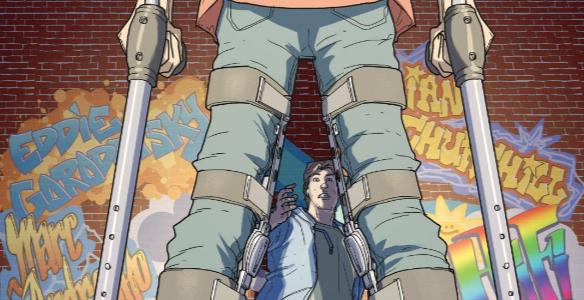
Comics and TV both exist on a spectrum between fully serialized and fully episodic storytelling modes. And any given series will move a bit within that spectrum, often to great effect — a typically heavily serialized story will offer up a beautifully self-contained installment, or a typically episodic one might find extra emphasis from that occasional “to be continued…”. As a miniseries, my expectations of serialization in The Further Adventures of Nick Wilson are even stronger, with each episode building to whatever conclusion writer Eddie Gorodetsky has engineered. Which makes issue 4’s episodic nature so refreshing — we couldn’t have seen it coming. Continue reading

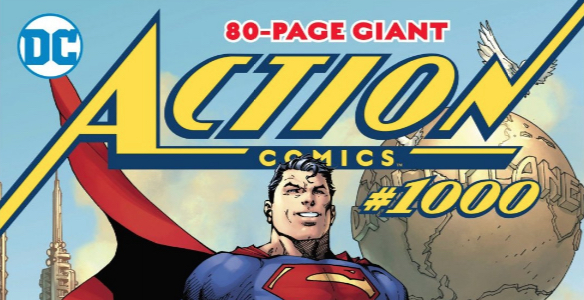
Action Comics 1000: Discussion

by Drew Baumgartner, Michael DeLaney, Patrick Ehlers, and Spencer Irwin

Action Comics 1000

This article contains SPOILERS. If you haven’t read the issue yet, proceed at your own risk!

“From the City that Has Everything”

Drew: Superman changed the world. That’s obvious enough in-universe, but it’s just as true of our world. Action Comics 1 created (or at least codified) the superhero genre, a genre that came to define both the 20th and 21st centuries, and is still growing as Action Comics rings in its 1000th issue. It’s a singular achievement, but celebrating it as such might not be in the spirit of Superman, for whom humbleness is as much a part of his character as heroism. He’s not one to take compliments easily, let alone brag, so any efforts to do so on his behalf run the risk of feeling crass. Most of the stories in this issue opted to ignore lionizing Superman outright, aiming instead to illustrate what it is that makes him so laudable, but in the issue’s opening chapter, Dan Jurgens came up with a way to address the issue with Superman himself, providing a commentary on the whole exercise of a huge anniversary issue, and offering a justification that even Superman can get behind. Continue reading

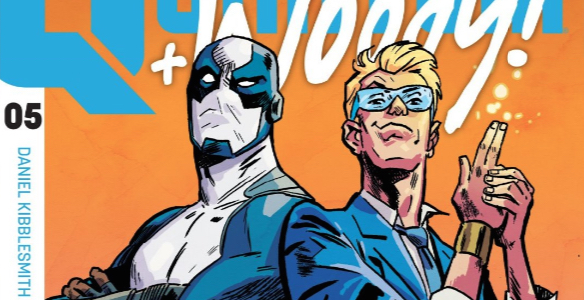
Quantum and Woody 5 is Chaotic-Good

by Drew Baumgartner

Quantum and Woody 5

This article contains SPOILERS. If you haven’t read the issue yet, proceed at your own risk!

Superhero comics are full of Chaotic Good characters — conscientious free spirits that believe in doing good, but by their own standards. From Batman to Wolverine to the Teenage Mutant Ninja Turtles, Chaotic Good characters fight for their morals, though not necessarily for the law. Neither Quantum nor Woody would fit this category — Quantum is good, but too lawful, while Woody is chaotic, but too morally passive. Together, though, their actions end up taking on a Chaotic Good, picking up Woody’s chaotic nature and Quantum’s desire to do good. Writer Daniel Kibblesmith and artist Kano attempt something similar with Quantum and Woody 5, delivering an issue that is both chaotic and good. Continue reading