Doomsday Clock 5 Meanders

By Drew Baumgartner

Doomsday Clock 5

This article contains SPOILERS. If you haven’t read the issue yet, proceed at your own risk!

The essence of drama, and especially melodrama, is compression. Show only what’s important. So start the scene as late as possible and once the dramatic point is made, end it.

Dennis O’Neil, The DC Comics Guide to Writing Comics

Pound for pound, this might be some of the best writing advice I know. But in this age of sequels, prequels, spin-offs and tie-ins, it seems like it’s all but been forgotten. That is, the artistic discipline of narrative efficiency is no match for the commercial demands of more familiar content. I don’t mean to dismiss all sequels etc. out of hand (The Godfather: Part II is a goddamned masterpiece, and is both a sequel and a prequel), but I do think they need to work a bit harder to justify their existence — if the details of this prequel story truly are essential, why weren’t they included in the original. And that scrutiny goes double when augmenting a beloved masterpiece. It’s absolutely possible for a sequel to justify itself, even under those circumstances (again, The Godfather: Part II), but it’s no easy feat. Unfortunately, the longer Doomsday Clock wears on, the less it seems up to that task, not only failing to justify its existence, but pretty much every storytelling choice it makes. Continue reading
Harbinger Wars 2 1: Discussion

by Patrick Ehlers and Michael DeLaney

This article contains SPOILERS. If you haven’t read the issue yet, proceed at your own risk!

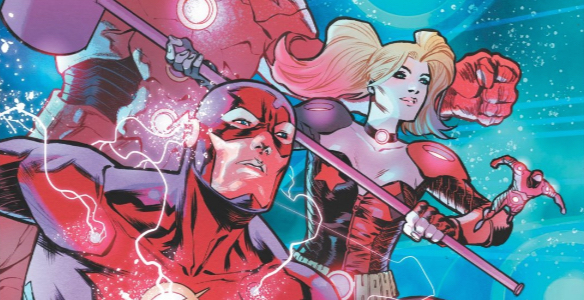
Patrick: Let’s run a hypothetical scenario: you’ve got access to a shared universe, full of superpowered characters, all of whom you’d classify as either heroes or antiheroes. You want to pit them against each other, in a… I don’t want to call it a “Civil War” for litigious Disney-related reasons… we’ll say it’s a “Harbinger War.” How do you establish sides? Pick an ideological divide and let it split up your character base, right? That’s a fun, toothless way to pit all your favorites against each other! With Harbinger Wars 2, writer Matt Kindt is crafting a more direct criticism of structures of power, casting the dutiful soldiers and company-men as stooges. It’s a clash of superheroes with the courage to say “hey, some of these guys are wrong.” Continue reading

Being The Hero, and Being the Sidekick in Lockjaw 4

By Spencer Irwin

This article contains SPOILERS. If you haven’t read the issue yet, proceed at your own risk!

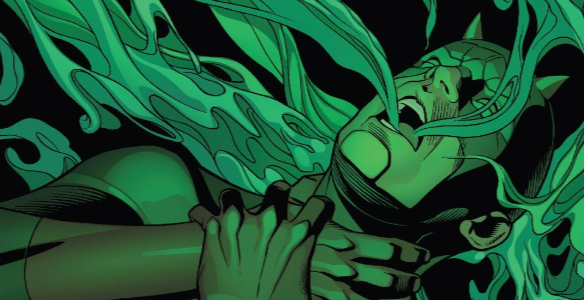
Lockjaw is a pet, Black Bolt’s (and sometimes Ms. Marvel’s) faithful companion, so often a sidekick in their adventures. Daniel Kibblesmith and Carlos Villa’s Lockjaw miniseries has provided a chance for the teleporting canine to step into the spotlight and become the hero of his own story, a fact that takes center stage in the series finale. Continue reading

The Perversion of Meaning in Lazarus 28

by Patrick Ehlers

This article contains SPOILERS. If you haven’t read the issue yet, proceed at your own risk!

Do you feel that disconnect between what you love and what you have to do? Of course you do. Human beings tend to have pretty good bullshit-detectors, and we usually know when someone is selling us something. The problem is we don’t always reject false forms of happiness. That’s the real disconnect. We can recognize the flashing lights as hollow spectacle and still opt in. Lazarus 28 shows us both the meaningful and the superficial connections to the world Jonah lives in, and the damage exacted on one by the other. It’s a harrowing issue, and creators Greg Rucka and Michael Lark place sex and family at the very center of this dichotomy between meaning and meaninglessness. Continue reading

It’s OK to Keep Secrets in Ms. Marvel 30

by Taylor Anderson

This article contains SPOILERS. If you haven’t read the issue yet, proceed at your own risk!

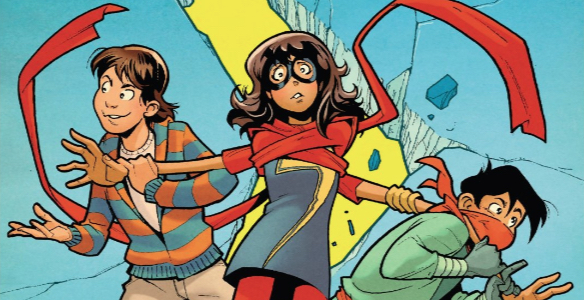
In any relationship, romantic or otherwise, there are bound to be secrets. For a long time, there was belief that prevailed which said your partner was entitled to know everything about you, which basically meant no secrets were kept. However, times have changed, and people have begun to accept that it’s healthy and natural to not tell your partner everything. That’s not being duplicitous, that’s just being human and respectful. This is healthy turn of events, but as with all things, it’s more complicated if you’re a superhero, just as Kamala find out in Ms. Marvel 30. Continue reading

Matt Murdock Holds the Puppet Strings in Daredevil 603

by Michael DeLaney

This article contains SPOILERS. If you haven’t read the issue yet, proceed at your own risk!

Matt Murdock’s modern history is a delightful roller coaster of changing status quo: he’s been a vigilante, the kingpin of crime, a vessel of The Hand and now Mayor of New York City. In Daredevil 603 Charles Soule draws upon these experiences to highlight the fact that Matt is a master strategist and impressive leader. “The Man Without Fear” preys upon others’ fears in order to manipulate them. Continue reading

Justice League: No Justice 4: Discussion

by Drew Baumgartner and Spencer Irwin

Justice League No Justice 4

This article contains SPOILERS. If you haven’t read the issue yet, proceed at your own risk!

Everything changes here!

Comics solicit, traditional

Drew: Okay, that epigraph is maybe too cute by half, but seriously, what does it mean for “everything” to change? The closest parallel I can draw to real life is the conventional wisdom that “a baby changes everything,” but even then, we understand “everything” to be decidedly limited in its scope. Certain events might be life-changing, but only for those with some connection to said events. And yet: comics. Big crossover events are promoted with the promise that the events with change “everything,” and while we might understand “everything” to be limited to the folks involved (in the same way that it is for a birth), there’s also tons of details we might assume exempt from “everything,” from the laws of physics to the peculiarities of english grammar — some things never change. Even so: some comics events are bigger than others, so there’s a range of just what “everything” means. Maybe it’s interpersonal dynamics of the superheroes involved, maybe it’s the principles of the universe as we know it. In its finale, Justice League: No Justice reveals that it falls almost entirely into that latter category, sending the DC Universe into decidedly uncharted territory. Continue reading

Shifting the Narrative in Hunt for Wolverine: Mystery in Madripoor 1

by Drew Baumgartner

Hunt for Wolverine Mystery in Mardipoor 1

This article contains SPOILERS. If you haven’t read the issue yet, proceed at your own risk!

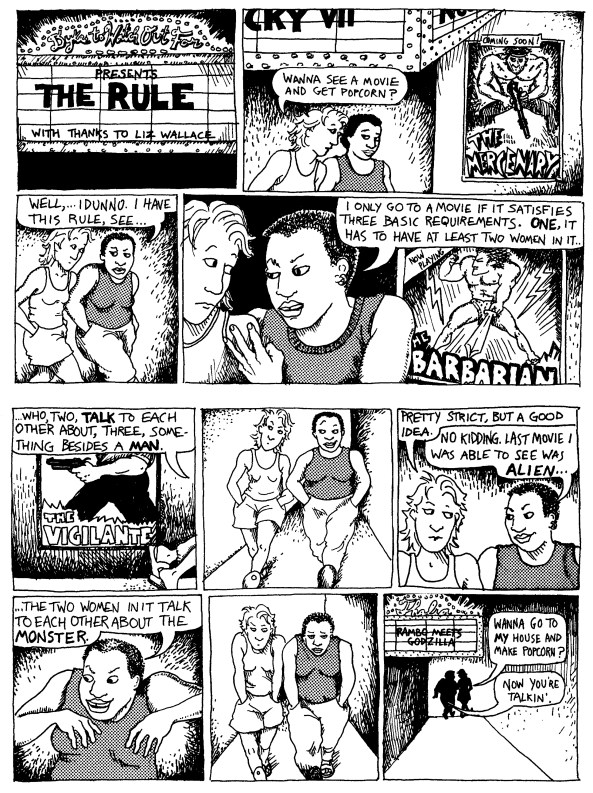
The Bechdel Test

Drew: This particular Dykes to Watch Our For premiered in 1985, and its premise is still ringing in the ears of writers and readers everywhere. Now known as “The Bechdel Test,” these criteria insist on something beyond simple representation (though it’s remarkable how many films fail to satisfy even that first requirement), aiming for a dialogue that features no males (even as subjects of conversation). And that last bit is a huge stumbling block for narratives to this day. Plenty will feature two women and even manage to put them in a scene together, but the conversation will still revolve around the male characters. It’s the kind of problem you might expect to plague any all-female tie-in to the “Hunt for Wolverine” event to suffer from — Logan is necessarily absent, but that fact is likely to be the subject of discussion — but Jim Zub and Thony Silas manage to shift the focus in Mystery in Madripoor 1, pulling the story in totally unexpected directions. Continue reading

“Why?” in Days of Hate 5

by Patrick Ehlers

This article contains SPOILERS. If you haven’t read the issue yet, proceed at your own risk!

Why am I watching this scene?

Screenwriter Advice, Traditional

While the “who,” “what,” and “where” of a scene is crucial to the audience’s understanding of what they’re experiencing in the moment, it’s the “why” of a scene that ends up being the most meaningful. If there’s no reason for the scene, then it doesn’t belong in the piece. This is one of those pieces of writerly advice that’s actually kind of intuitive, and readers and audiences feel it without having to be told. If we start reading about a man climbing a tree, then we assume something happens to him in that tree. Writer Aleš Kot and artist Danijel Žeželj take the conflict inherent the mere existence of a scene — three scenes, actually — to tease out a slowly burning tension-inferno in Days of Hate 5. Continue reading

Finding Balance in Justice League: No Justice 3

by Spencer Irwin

This article contains SPOILERS. If you haven’t read the issue yet, proceed at your own risk!

slim-banner

We here at Retcon Punch, sadly, haven’t had much of a chance to discuss Justice League: No Justice until now, but I’ve been enjoying it immensely from the start. It has many of the same strengths as its predecessor, Dark Nights: Metal, but since No Justice is working with only four issues, avoids most of its excesses. No Justice is focused and easy to follow, yet still has a grand scope and a firm grasp on the characters and history of the DC Universe. It’s well-balanced, which plays right into the themes of the series and the goals of its various League factions. Continue reading