Good vs. Evil in Astonishing X-Men 12

by Patrick Ehlers

This article contains SPOILERS. If you haven’t read the issue yet, proceed at your own risk!

“Good vs Evil” implies that there are two sides — two warring factions — battling for the fate of the world. It’s a compelling image: a battlefield with good guys on one side and bad guys on the other. Good and evil are separate forces, and in our imaginations, represented by two different groups of people. While Charles Soule and Gerardo Sandoval’s Astonishing X-Men 12 still gives the reader avatars of light and darkness in the forms of X and The Night King, the armies fighting for each side are made up of all the same players. Old Man Logan is both a reformed ally-murderer and an irredeemable death machine; good and evil waging war within one mind. Continue reading

A Mid-Issue Shift Elevates Hunt for Wolverine: Weapon Lost 2

By Drew Baumgartner

Hunt for Wolverine Weapon Lost 2

This article contains SPOILERS. If you haven’t read the issue yet, proceed at your own risk!

Listen, I know there were crime procedurals before Law & Order (and there have been plenty since), but that show was such a mainstay of my formative pop-culture years that I can’t help but think of it every time I encounter a new fictional criminal investigation. What’s remarkable to me about that show is how entertaining it could be in spite of having an entirely rote structure (it was so set in stone, in fact, that they decided to enshrine it in the very title of the series). That is, the drama was never in whether they caught the culprit (they always did), or whether they would be convicted (they were found guilty or pled out the vast majority of the time), but in how they did it — or more precisely who was doing it. Individual details of the case might be interesting, but only inasmuch as they prompted quips from Briscoe or righteous indignation from McCoy. The procedural is an excuse to watch detectives do what they do best, so giving those detectives big, distinct personalities makes or breaks the whole exercise. In this way, Charles Soule has truly stacked the deck in his favor, cramming four larger-than-life investigators into tight quarters and giving them a hard case to chew on. Continue reading

(Re)defining the Hulk in The Immortal Hulk 1

by Drew Baumgartner

The Immortal Hulk 1

This article contains SPOILERS. If you haven’t read the issue yet, proceed at your own risk!

It might be stating the obvious to suggest that the Hulk’s identity is fraught, but I don’t mean it in the Jungian dualistic sense. Obviously, the tension between Bruce Banner and the Hulk is the primary source of drama for the character, but the Hulk has long suffered from a different kind of identity crisis, in that no two writers ever seem to agree on who and what he is. Is he a senseless destructive force, or is he capable of reason? Is he a monosyllabic brute, or a brilliant physicist? I’ve only occasionally checked in on Hulk’s solo series over the past five or so years, and I’ve seen takes that pretty much run the gamut, if that’s any indication of how rapidly and wildly consecutive runs can change the character. And to be clear, I don’t necessarily see this as a weakness — I’d argue that the flexibility of superheroes to fit the themes different creative teams are most interested in exploring is a huge part of their longevity — but I do think it demands a strong statement of purpose at the start of a run; something to clarify exactly what kind of Hulk we should expect to see. Something like Al Ewing and Joe Bennett’s The Immortal Hulk 1, which introduces the specifics of this particular iteration with remarkable efficiency. Continue reading

A Reveal as a Punchline in Batman 48

by Spencer Irwin

This article contains SPOILERS. If you haven’t read the issue yet, proceed at your own risk!

slim-banner

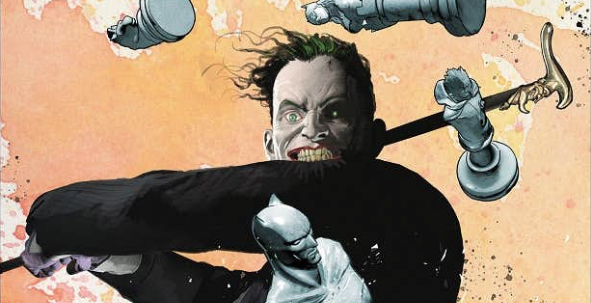
Last time Tom King and Mikel Janin put out a Joker story — in “The War of Jokes and Riddles” — the Clown Prince of Crime wasn’t exactly himself. Batman 48, then, gives King and Janin a chance to show their take on a more platonic form of the Joker. He’s probably more manic and scrambled than usual, but just as devious, cunning, and ruthless as ever. Most importantly, though, this Joker is wickedly funny. Batman 48 is jam-packed with black humor and perfectly constructed (albeit remarkably morbid) jokes. In fact, the entire issue can be viewed as one long set-up to a perfect punchline. Continue reading

Compassion vs. Accountability in Green Lanterns 48

by Patrick Ehlers

This article contains SPOILERS. If you haven’t read the issue yet, proceed at your own risk!

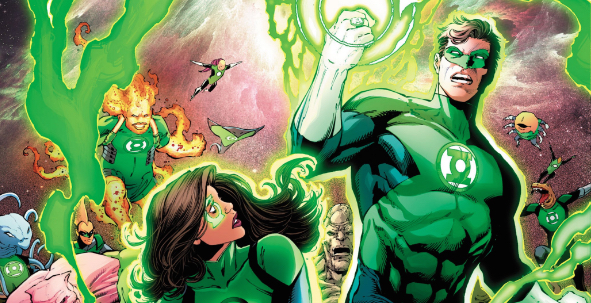
One of my coworkers was really upset about Kanye West a couple weeks ago. No shit, right? Her problem wasn’t that West was tweeting racist things about slavery probably being a choice, or even his support of Trump (who she also loathes), but that the entire would was holding a mentally ill man on a psychotic break accountable for his actions. Her argument goes that someone in West’s condition isn’t being themselves — they are literally being their illness. I began to stammer back with some feeble counterargument, something about the illness being made manifest by that person, so while we can practice compassion, we do still have to hold them accountable. “So you think he… put his own spin on mental illness?” she exhaled back at me. Shit. No. What the hell point was I trying to make? All I can really say is that I want anyone who does something wrong to face consequences, but is a mentally ill person really the one “doing” it? We are bad at talking about, dealing with, and even understanding mental illness. Aaron Gillespie and Ronan Cliquet’s Green Lanterns 48 takes our capacity for compassion and places it squarely against law and order. Continue reading

Paper Girls 21: Discussion

by Ryan Mogge & Spencer Irwin

Paper Girls 21

This article contains SPOILERS. If you haven’t read the issue yet, proceed at your own risk!

slim-banner

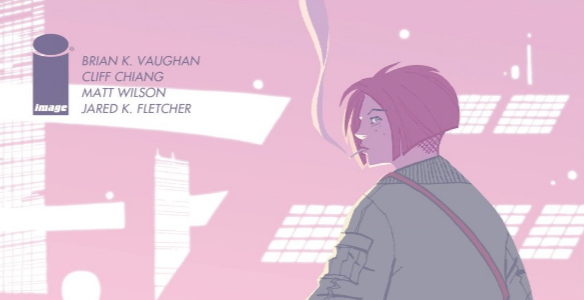
Ryan M: One of the best things about living in 2018 is the decentralization of knowledge. With the internet, you are a few queries away from knowing just about anything. There are, of course, the downsides, like I now have the power to use WedMD to diagnose myself with chronic illnesses or see evidence of the good time my friends were having last night while I watched 100% Hotter and diagnosed myself with chronic illnesses. Despite those minor dangers, though, there is so much to appreciate about how much we can know in moments. The titular Paper Girls come from a world where news and information travels manually, literally carried to your door in a finite form. Throughout the series, they have been at an information disadvantage, constantly trying to play catch up to understand what’s happening. For the first time, in Paper Girls 21, the advancements of the future may be a savior. Continue reading

Deadpool 1 Honors the Past and Embraces the Future

By Michael DeLaney

This article contains SPOILERS. If you haven’t read the issue yet, proceed at your own risk!

“Honor the past, celebrate the present and embrace the future.”

Traditional

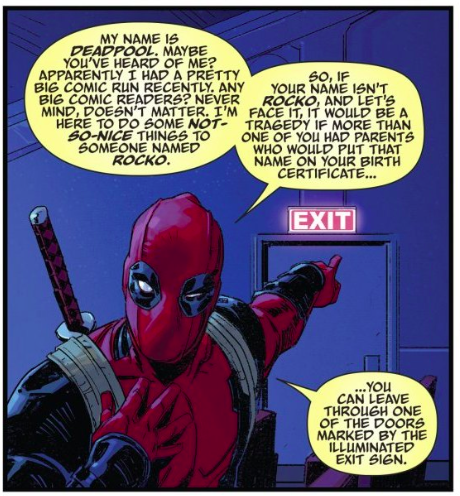
Gerry Duggan’s Deadpool is dead, long live Gerry Duggan’s Deadpool! Duggan wiped the slate clean for future Deadpool creators by having the Merc with the Mouth wipe his own painful memories from his mind. Surprisingly, Skottie Young makes note of this mind wipe in Deadpool 1 — both in dialogue and in the opening credits pages.

Deadpool is still breaking the fourth wall, still has a big ego, and in light of his memory loss, he’s just going to have to assume that his recent comic book run was “pretty big.” Continue reading

Star Wars 49: Discussion

By Patrick Ehlers and Taylor Anderson

This article contains SPOILERS. If you haven’t read the issue yet, proceed at your own risk!

Patrick: If there’s one part of the Star Wars formula I’ve had the hardest time connecting to on a personal level, it’d have to be the huge battles between spaceships.  Don’t get me wrong: I think the ships look cool, and the Millennium Falcon is so near and dear to my heart that I almost cried during its reveal in The Force Awakens. But there’s something about two factions of cold, gray, lifeless ships zipping through space and shooting blasters at each other that feels remarkably impersonal. With Star Wars 49, writer Kieron Gillen and artist Salvador Larroca set out to stage the mother of all space battles at the birth of the Rebel Armada. By linking the ships to the characters, the creators create a sense of emotional continuity that makes this one of the best space ship battles I’ve ever seen. Continue reading

Compassion is the Greatest Weapon of All in X-Men Red 5

by Spencer Irwin

This article containers SPOILERS. If you haven’t read the issue yet, proceed at your own risk.

A few weeks ago in X-Men Red Annual 1, Jean Grey met a bigoted anti-mutant protester and showed him kindness and compassion, relating to the turmoil and abuse he dealt with in his home life and continuing to worry about him long after their meeting had come to an end. Compassion continues to be Jean’s weapon of choice in Tom Taylor and Mahmud Asrar’s X-Men Red 5, and it’s a weapon she’s more than capable of deploying against an entire army. Continue reading

Justice and Symbolism in Justice League 1

By Drew Baumgartner

Justice League 1

This article contains SPOILERS. If you haven’t read the issue yet, proceed at your own risk!

There was no word for justice on my planet. The closest was the symbol on this table. It meant going beyond what was supposed to be possible, the natural laws. Imposing on the universe a higher standard. An ideal.

Martian Manhunter, Justice League 1

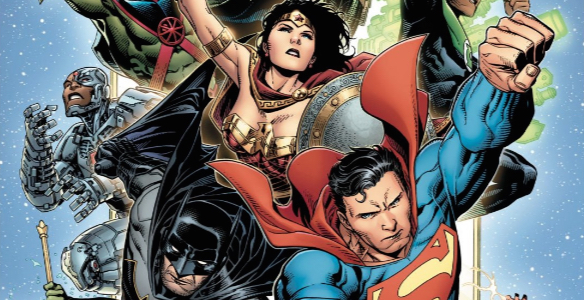
Our conceptions of justice hinge on fairness and impartiality — the notion that we are all held to the same standards of behavior (and face the same punishment for flaunting those standards). We understand how that can break down in practice (humans aren’t great at partiality), but we can imagine justice as a kind of platonic ideal we can strive towards. And that may be the best way to think about it, but closer inspection reminds us that, if it’s a platonic ideal, it’s one that varies from society to society and changes over time. We might reflect on the “justice” of the past (or of other cultures) and find it to be decidedly unjust, but that’s not how justice works — it’s not an objective monolith, but a deeply subjective, dynamic concept. That is, justice is a moral construct that only makes sense in light of the values of the society that construct it. Martian Manhunter’s approximation of justice reflects that idea, adding no moral spin to the “ideal” he mentions — in J’onn’s estimation, any ideologically motivated action “beyond what was supposed to be possible” is justice. In short, J’onn’s brief for the Justice League works just as well for the Legion of Doom. Continue reading